Payment Expert’s ID Check: Payments Professionals offers insight from industry leaders and experts on how they got their start in the financial industry, from their early years in education, to how they have been able to climb the corporate ladder.
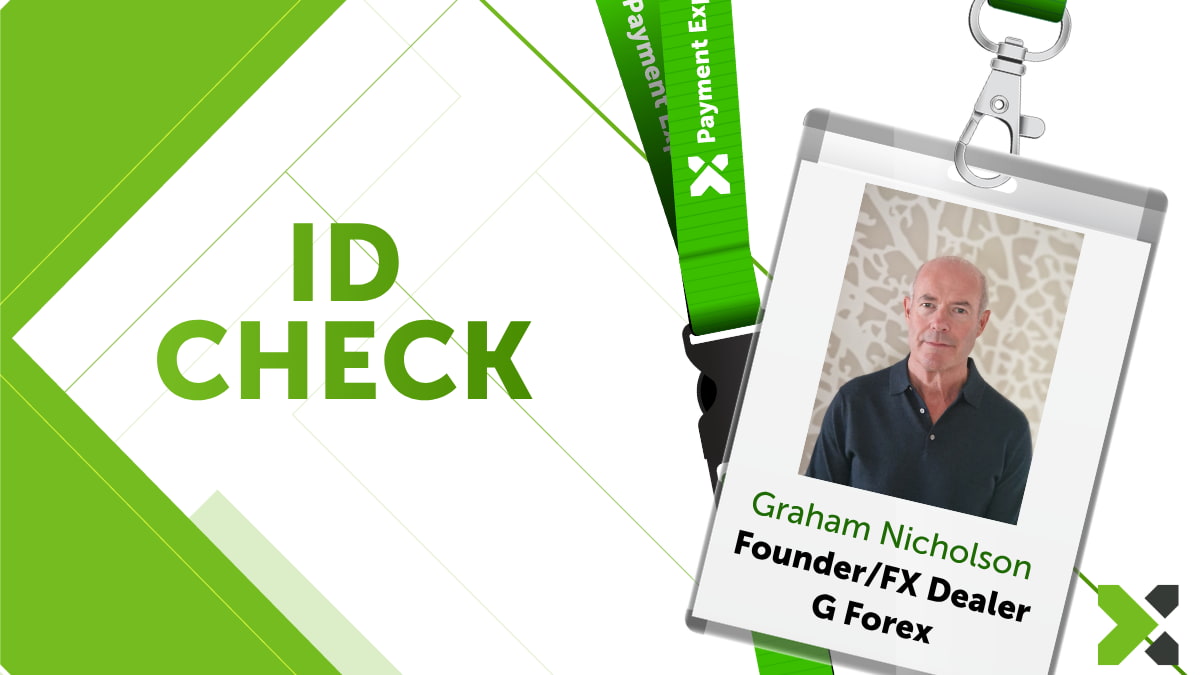
This week, Graham Nicholson, Founder & FX Dealer at G FOREX, delivers insights into how global trade and FX trends move in real-time, why success has never been in a straight line and how he got the nickname ‘Mr. Yen’.
Where did you go to university and what did you study? What impact did this have on your current journey?
I went to Thames Valley University, mainly because it was close to where I was living in Ealing at the time. For me it was always a means to an end, back then you needed a 2:1 degree to get through the door of a dealing room, so getting that qualification was really the first deliberate step towards the career I actually wanted.
I knew exactly what I was working towards the whole way through. The moment I had the paper, I was in, and from there everything I know about FX I’ve built through 36 years on the desk.
What first drew you to the payments industry and why have you stayed?
Maths was always my strength, and economics interested me properly, understanding what actually moves a currency, inflation data, central bank decisions, stimulus programmes, all of it.
International trade fascinated me too, the mechanics of how a business imports and exports and everything that has to align behind that. So it wasn’t some grand calling, it was playing to what I was actually good at.
What’s kept me in it all these years later is that the market never sits still. You can have thirty-something years of experience and it will still throw you something new tomorrow morning, and I still find that genuinely exciting.
Are there any lessons from your first role in the industry which you still draw on?
The industry never stops changing, and staying ahead of it means reinventing yourself alongside it. I saw that first hand at Cornhill, where I was working when iBanFirst acquired the business, the whole way of doing things changed in a matter of weeks, and adapting quickly made all the difference.
It’s exactly the kind of shift you have to be ready for in this industry, nothing stays the same for long. Success in this business has never been a straight line either, I’ve had genuinely strong years and quieter ones, and I’ve learned to treat both as part of the same process.
The constant through all of it has been backing yourself. When you’re self-employed and you only get paid when you deal, that mindset isn’t optional, it’s what gets you up every morning ready to go again.

When was your first big break in the industry? Why was this such a significant moment for you?
I was in my early thirties, running large positions off the back of a major Japanese government stimulus package. The shares and the yen both moved hard in the same direction, and I was positioned for it, which made Bank of America a serious amount of money.
It was as much about timing and conviction as anything else, but it earned me a Vice President title, and more than that, it earned me a reputation. People across the London market started calling me “Mr Yen”, and that stuck. Coming from the North East into a City trading floor, having your name mean something to people who’d never met you was the moment I knew I’d properly made it.
Was there a moment you faced in the industry which really challenged you? How did you overcome this?
COVID is the clearest example. International trade slowed right down overnight, which could easily have hit a business like mine hard. What worked in my favour was diversification I’d built up without even planning for a moment like that, the gaming industry boomed because everyone was at home, and gaming companies do huge volumes of FX moving revenue in from platforms like Microsoft and Meta.
So while manufacturing clients went quiet, gaming more than picked up the slack. It confirmed something I already believed but hadn’t been tested on that scale. Never let your book depend too heavily on one sector, one client, or one region, because circumstances can shift overnight for reasons entirely outside your control.
You keep building new relationships constantly so you’re always resilient to that.
What are some of the skills you deem essential to starting in your industry and how have yours developed over the years?
Communication and transparency, in that order. If a trade goes wrong, and eventually one will, you ring the client immediately and own it, rather than trying to talk your way around it. That kind of honesty is what actually earns long-term trust in this industry, far more than always getting the rate perfectly right.
I’d also say I’ve come to really value working with the women I deal with day to day. Most of the FDs on my client list are women, and honestly, they run tighter ships than a lot of the men I trained alongside coming up, organised, direct, completely without ego, not showing off over a rate.
It’s changed how I think about what makes someone good at this job, and it’s changed how I run relationships now, less bravado, more just getting it right.

Who was your biggest role model – inside or outside of your industry – who continues to inspire you in your current career?
Kevin Keegan. Not for FX reasons obviously, but for how he kept reinventing himself, testing himself abroad, coming back, moving from playing to management without ever losing his identity.
That’s exactly what you have to do in this industry too, the market you traded in five years ago barely resembles the one you’re trading in now.
Outside football, I’ve got real respect for the self-made people you see on Dragons’ Den, people who built something from genuinely nothing. I set G FOREX up from scratch with no backing, so I know exactly how much nerve that takes.
If you didn’t work in the industry, what other career option would you have pursued or would have loved to
Football, without question. I’ve played all my life and I’m still active now. The dealing room was always my first love professionally, but if that door hadn’t opened, I’d have chased football as far as it would take me.
Lastly, what is some advice you would give to an aspiring person looking to get a start in your respective industry?
It comes down to customer service more than people expect in a market this technical. Be the best at it, stay humble, and stay ahead of the competition, that’s not a slogan, it’s operational. I send clients a market update at quarter past eight every single morning without fail, because being the person who’s already given someone the information before they’ve even asked for it is what keeps them with you long-term, even when a competitor could technically offer a slightly better rate.
Never be late for a meeting. Keep your clients informed, even when the news isn’t what they want to hear. And never assume the income will keep coming just because it always has, staying grateful for it is what keeps you sharp. I learned that early on, and it’s shaped how I’ve approached every year since.
Interested in sharing your experiences from the industry and passing on advice to the next-generation for ID Check? Contact: [email protected]