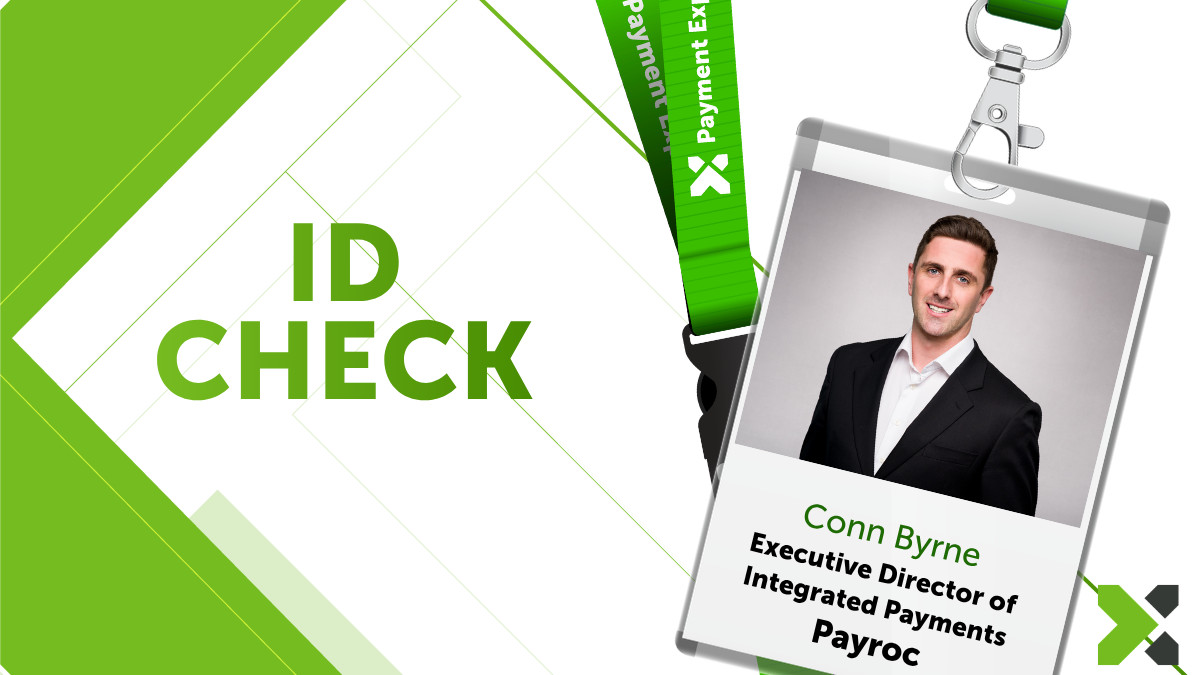
Payment Expert’s ID Check: Payments Professionals offers insight from industry leaders and experts on how they got their start in the financial industry, from their early years in education, to how they have been able to climb the corporate ladder.
This week, Conn Byrne, Executive Director of Integrated Payments, Payroc, details how he followed in his fathers footsteps to build integrated payments, in both Europe and US. He reveals why a key start in the payments industry can lead to meeting influential faces, and engaging in more thought-provoking spaces.
Where did you go to university and what did you study? What impact did it have on your current journey?
I studied at University College Dublin, where I completed a Bachelor of Commerce. It gave me a solid grounding in the fundamentals — finance, economics, marketing — the kind of broad base that’s useful no matter where you end up.
In hindsight, I think I chose that path because of my dad. He was a co-founder of WorldNet, one of Ireland’s early payment gateways, and watching him build something from the ground up made business feel exciting and tangible. I doubt I was fully conscious of that influence at the time, but looking back, it’s obvious.
That said, the real education started the moment I actually got into payments. The industry has a way of teaching you things no curriculum can.
What first drew you to your industry and why have you stayed?
Like a lot of people in payments, I’ll be honest — I fell into it. I joined WorldNet back in 2012 to cover what was meant to be a six-week temporary vacancy. Those six weeks turned into 13 years and counting.
I started in sales support, moved into direct merchant sales, and then discovered integrated payments — which at the time was still a relatively niche, not particularly well-understood corner of the industry.
That’s really where everything clicked. Integrated payments sits at the intersection of technology and commerce in a way that keeps things endlessly interesting. The industry has changed dramatically under my feet over the past 13 years, and I’ve never once felt like I’d outgrown it.
Are there any lessons from your first role in the industry which you still draw on?
Two things stand out.
The first is that detail matters — more than most people appreciate early in their careers. For my first three weeks at WorldNet, I didn’t even have a laptop. So I did what I could: I read product sheets, got deep into the technology, and tried to really understand how everything worked from the ground up. That forced discipline has never left me. If you don’t understand what you’re selling, you have no business selling it.
The second is that relationships are everything in this industry.
Payments is a small world — everybody knows everybody. If you approach it with honesty, consistency, and genuine care for the people you work with, that reputation will carry you. And if you don’t, that’ll follow you too. It’s not about being a traditional salesperson; it’s about solution selling — listening first, understanding what someone actually needs, and then figuring out how you can genuinely help.

When was your first big break in the industry? Why was this such a significant moment for you?
Without a doubt it was leading the expansion into the US. We had built a strong business in Europe and had some US exposure through white-label partnerships, but making the full commitment to grow in the American market — from scratch, building go-to-market strategy and a sales operation from the ground up — was a completely different challenge.
Taking a European company and scaling it into a new, highly competitive market, growing from zero to a profitable business, was both the hardest and most formative thing I’ve done in my career.
Looking back, it was pivotal in every sense. The lessons I learned navigating the US market, and the results we were able to deliver, ultimately earned me a spot on ETA Transact’s 40 Under 40 list — a recognition I’m genuinely proud of, not just as a career milestone, but because it reflected a plan that actually came together.
Was there a moment you faced in the industry which really challenged you? How did you overcome this?
The US expansion — but more specifically, the part that didn’t work at first.
We’d historically operated as a back-end platform for white-label partners, so when we moved to build our own direct presence in the US, we had to develop a strategy essentially from scratch. Our initial plan was to integrate with enterprise resource planning (ERP) providers and pursue that space. We put real time and effort into it, and it didn’t work. The market was too crowded and we hadn’t found our niche.
Having to step back, accept that, and pivot was humbling. But that pivot is actually where our focus on unattended payments came from — and it turned out to be the right call.
Finding our footing in the US market took about two years, from 2017 when we first entered, to 2019 when we really hit our stride. It taught me that competitive markets punish vague strategies, and that being willing to change course isn’t failure — it’s just good judgement.
What are some of the skills you deemed essential to starting in your industry, and how have yours developed over the years?
Relationships, first and always. Payments is a small industry and people talk, so how you conduct yourself from day one matters more than most people realise.
Beyond that, I’d point to the ability to truly listen. Especially in the integrated space, you’re working with software partners who have complex, evolving needs. If you walk into those conversations focused on what you want to sell rather than what they actually need, you’ll lose them quickly. Solution selling isn’t just a technique — it’s a mindset.
Over time, I’ve also come to appreciate how important it is to understand the technology deeply enough to speak credibly about it. Not as an engineer, but as someone who can bridge the gap between a partner’s product team and a payments solution. Building that trust with decision-makers on both the technical and commercial side is what turns a good relationship into a lasting one.
The fundamentals haven’t changed much, honestly. The context just gets richer and more complex as you go.

Who is your biggest role model inside or outside of your industry who continues to inspire you in your current career?
My father, without question — and it’s both personal and professional. He was part of the founding team at Elevon early in his career, and later went on to co-found WorldNet, which became one of Ireland’s leading payment gateways.
He spent a long career in payments, built something genuinely valuable, and successfully sold the business. A lot of people in this industry would know him, and they’d likely all say the same thing: he was someone who understood that trust and relationships are the real currency.
What’s funny is that I didn’t fully appreciate how much of his approach had shaped mine until I was well into my own career. I’d catch myself in a partner conversation — the way I listen, the emphasis I put on the relationship, even some of the instincts I rely on — and realise, that’s him.
I went into business partly because watching him made it look exciting and purposeful, but I never expected to end up in the same industry. The older I get, the more I realise how deep that influence runs.
If you didn’t work in the industry, what other career option would you have pursued or would you love to?
Two very different answers.
The serious one: I’d always had a strong interest in engineering — particularly in how things work, and especially in renewable energy and sustainable technology. I enjoyed it but ultimately didn’t feel confident I could pursue it at the level that would make it truly fulfilling. So I let it go, though I still find myself drawn to it.
The less serious answer — and I mean this completely genuinely — is greenskeeper. There’s something about those early mornings on a golf course, out in nature before anyone else is around, maintaining something that’s both precise and beautiful, that has always appealed to me enormously. Maybe that’s where retirement takes me.
What advice would you give an aspiring person looking to get a start in your respective industry?
Go for it. Payments is an ever-changing, endlessly interesting space, and the career paths it opens up are broader than most people realise. But my biggest piece of advice would be to think carefully about where within the industry you start.
Payments has a lot of different flavours — merchant acquiring, issuing, integrated payments, gateways, enterprise software, and much more — and it’s easy to go down a path and find yourself locked into a corner that doesn’t excite you.
For me, I got lucky. About three months into my career, I noticed that almost every merchant I spoke to was using a software platform we weren’t integrated with. That moment clicked — unless we had those integrations, we weren’t going to win that business. From then on, integrated payments was where I wanted to be. I saw it as the future and I leaned into it completely.
So: be curious, look for those signals early, and then commit to learning — really learning, not just surface-level. Understand the technology, understand your partners’ needs, and dedicate the time it takes to build that depth. That’s what will set you apart.
Interested in sharing your experiences from the industry and passing on advice to the next-generation for ID Check? Contact: [email protected]