A Bank for International Settlements (BIS) paper finds crypto exchanges effectively function as correspondent banks, while retail wires at large banks carried markups up to 470bps in the authors’ own transfers.
Figures drawn from Wise data published in a working paper by the Bank for International Settlements (BIS), found banking fees, treasury activities, and foreign exchange (FX) account for £0.02 of the £0.24 in fixed costs Wise incurs for every transfer from British pounds (GBP) to euros (EUR).
The paper finds stablecoins do not eliminate intermediaries in cross-border payments; rather, they simply replace them with other parties.
Customer service accounts for £0.11 of those fixed costs. Compliance – which includes anti-money laundering and anti-fraud measures, “know-your-customer” (KYC) checks, and sanctions screening – costs £0.06. According to Wise, the marginal cost per transfer is £0.24, plus 0.06% of the transferred amount.
The BIS report was authored by Wenxin Du, Catherine Huang, and David Scharfstein of Harvard Business School. They note cost estimates for stablecoin transactions often fail to account for customer service and compliance, the largest fixed cost components in Wise’s data.

The BIS paper was presented in June at the BIS Annual Conference in Basel and was published this month as “BIS Working Paper No. 1385.”
BIS paper: crypto exchanges act as correspondent banks
The authors analysed a “stablecoin sandwich” in the context of a transaction from US dollars to euros. In this scenario, the sender purchases USDC on Coinbase, transfers it via the Ethereum network to Kraken, exchanges the USDC for euros, and subsequently withdraws the funds via SEPA. Blockchain transaction fees amounted to approximately $0.19. Kraken also charged a 1% trading fee and a €1 withdrawal fee.
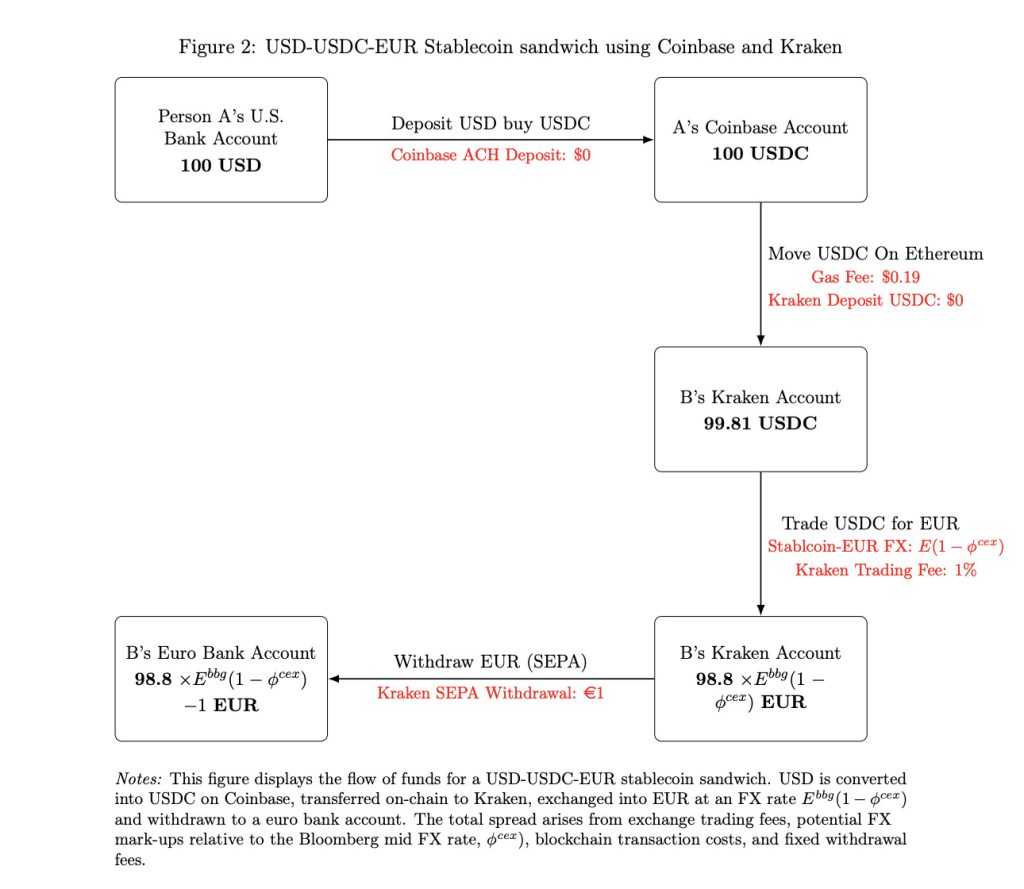
Additional costs – such as fees for withdrawing tokens or bridging across networks – are not included in this example; these would further increase the total amount.
According to the report, centralised crypto exchanges fulfill a role similar to that of correspondent banks in SWIFT payments. They provide entry and exit points for capital—known as on-ramps and off-ramps – within a process often described as “disintermediated”.
In a more complex variation, USDC is swapped on Uniswap for EURC, Circle’s euro-pegged stablecoin. While this moves the currency exchange onto the blockchain, a centralised entity remains necessary for the final payout in fiat currency (such as euros).
Trading fees on the six centralised exchanges analysed range from 0 to 120 basis points (bps). Kraken charges 100 bps to traders with a monthly trading volume of less than $10,000.
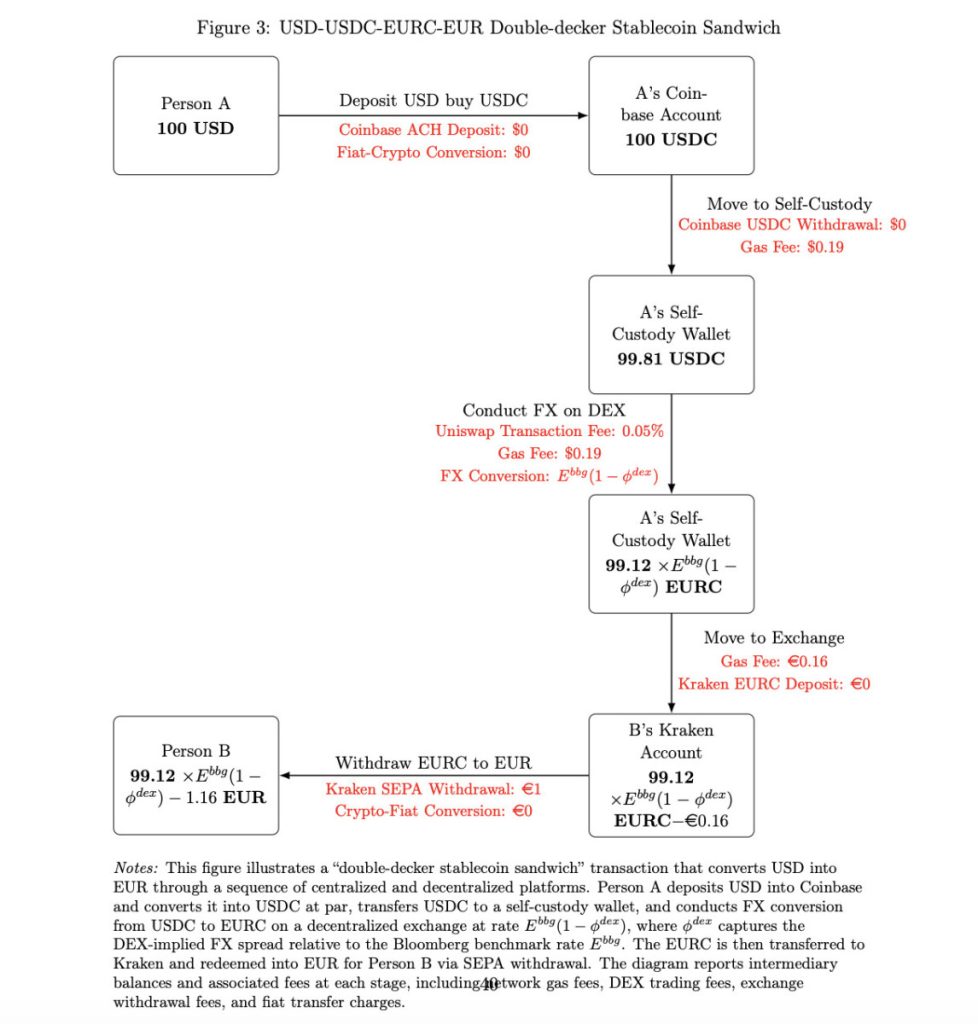
The paper states liquidity acts as a constraint on the scalability of this model. On centralised exchanges, USD-pegged stablecoins traded against the euro at approximately $185m per day on average between 2021 and 2025, rising to about $489m in 2025–26, whereas on decentralised platforms, this figure stands at $15m per day (this trading between USD stablecoins and euro stablecoins, such as USDC to EURC, not trading against fiat euros). Daily euro turnover in conventional FX markets is approximately $2.7trn.
Only five other currencies reached a daily trading volume of more than $10m against stablecoins on centralised exchanges on average between 2021 and 2025: the South Korean won, the Turkish lira, the Brazilian real, the British pound, and the Thai baht.
Banks charge significantly higher margins than fintech providers
The authors found large international banks charge margins ranging from 230 to 470 basis points (bps) on retail transfers involving euros and dollars. The bid-ask spread – the difference between the buy and sell price – in the wholesale market for this currency pair is less than 6 bps.
The bank-wire sample covers eight personal transfers and excludes transaction fees; the figures cited therefore represent a lower bound. The authors said the markups suggest pricing power, and that FX market access or correspondent banking costs are unlikely to account for them fully.
Between January and May 2026, the authors tracked three fintech money transfer operators (MTOs). These providers charged a median all-in cost of approximately 175 bps for transferring $200 from the US into euros; for a transfer of $10,000, this dropped to about 39 bps. For a transfer of $50,000, the median costs for less frequently traded currencies remained roughly three times higher than those for the euro, yen, and British pound.
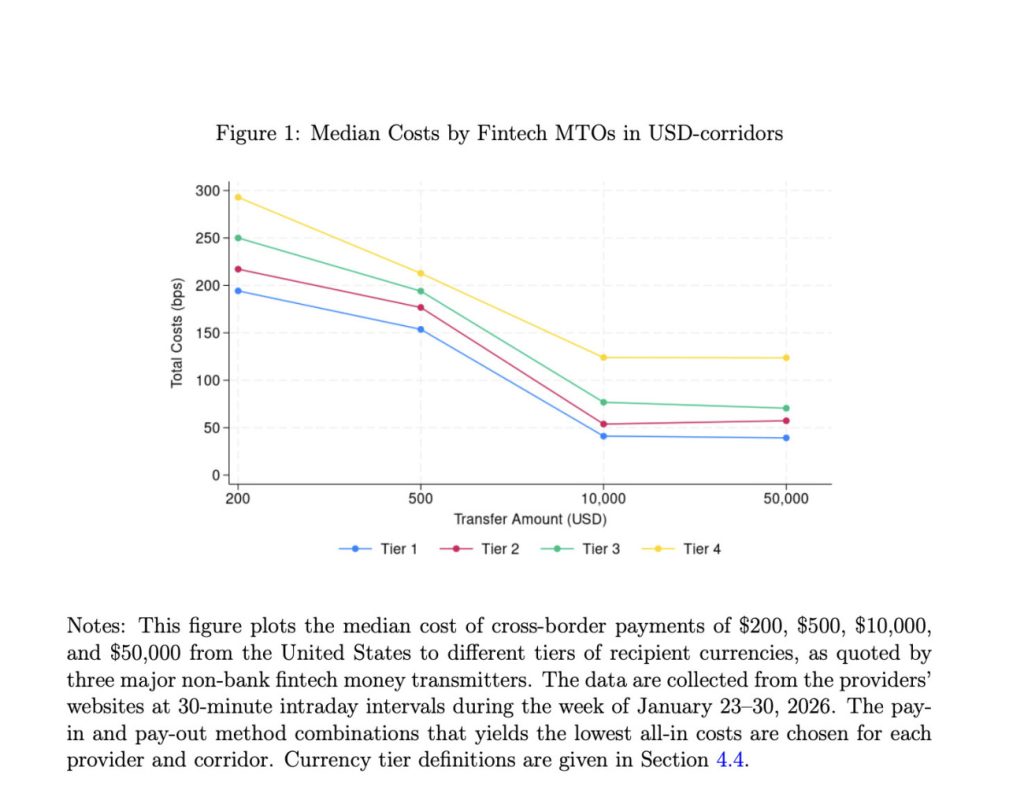
A US community bank and an educational institution that sent wire transfers through the same B2B fintech platform paid average margins of approximately 83 bps for transactions in British pounds, euros, and yen.
According to the authors, this suggests smaller banks can leverage fintech infrastructure to offer more competitive rates on foreign exchange transactions than the largest banks.
Capital controls explain the discount on stablecoins
The research also shows exchange rates facilitated through stablecoins are more favourable than the Bloomberg reference rates for transfers from the US to various emerging markets.
The authors explain this by noting residents of countries with capital controls are willing to pay a premium to gain access to US dollars. Across twelve USD remittance corridors, the average cost for stablecoin-based currency exchange was -124 bps, compared to a total cost of 411 bps for transfers tracked by the World Bank.
The authors argued this discrepancy is driven more by distortions caused by capital controls than by technological efficiency.
However, Tobias Adrian of the International Monetary Fund (IMF), who discussed the paper at the conference, said the comparison sets stablecoin FX costs against all-in remittance costs, which limits conclusions about which channel is cheaper.
IMF research comparing all-in costs on matched corridors puts stablecoin transfers at about 1%, against 5.8% for traditional remittances, he said.
The views shared in the paper are those of the authors and not of BIS.