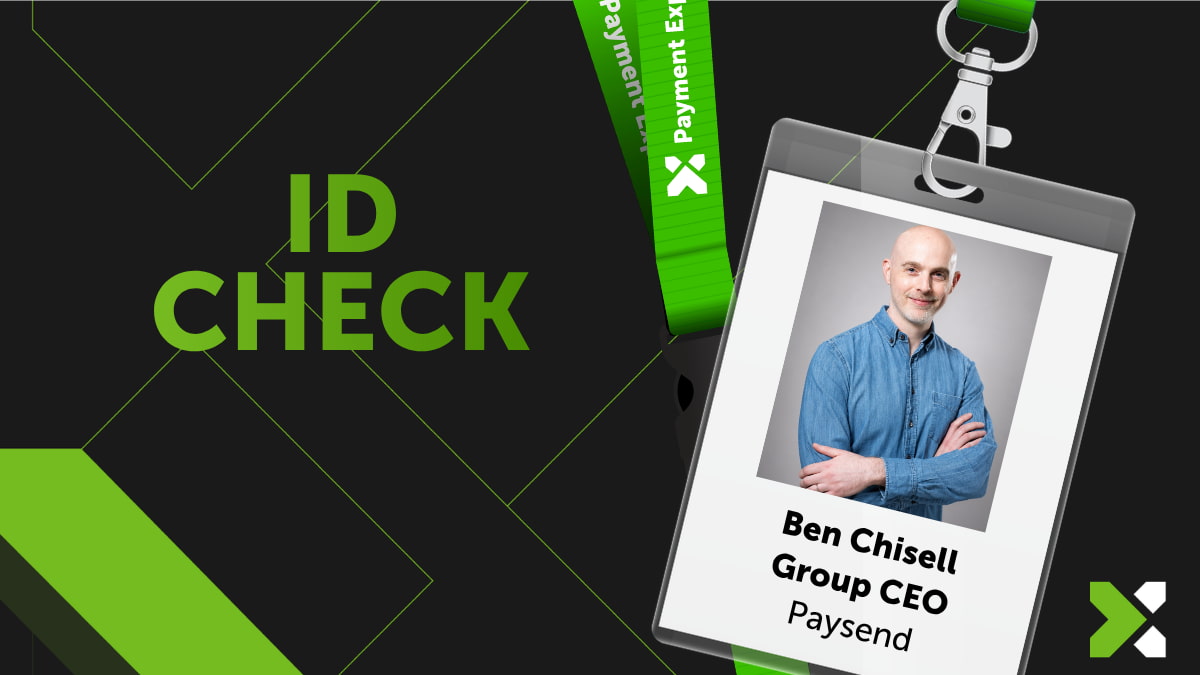
Payment Expert’s ID Check: Payments Professionals offers insight from industry leaders and experts on how they got their start in the financial industry, from their early years in education, to how they have been able to climb the corporate ladder.
This week, Ben Chisell, Group CEO of Paysend, reveals why a decade in Big Tech working for some of the largest companies in the world, led him to payments, and why this has been built on a foundation of accountability, whether that is through engineering finding solutions, to curating a culture as a group CEO.

Where did you go to university and what did you study? What impact did this have on your current journey?
I studied aeronautical engineering at Churchill College, University of Cambridge, specialising in computational fluid dynamics in unstable systems, turbulence modelling and experimentation, atmospheric fluid dynamics, aerodynamics, and solid body mechanics.
Engineering was really about problem solving. It required curiosity to understand a problem, logic to structure it and form hypotheses, gathering data to solve it, and drawing conclusions to understand how to apply it to the real world. I’ve found these general skills critical to approaching solving any product problem, and they have translated well to CEO problems too.
What first drew you to the payments industry, and why have you stayed?
After 10 years in US Big Tech, I wanted to build generational companies in the UK, and finance was a natural choice of industry.
I was invited to join the early team at Starling, where I was able to apply my product approach to a new industry and company, surrounded by a great and supportive team.
There was opportunity then and as the industry matured the opportunities just get bigger. There’s still a lot to solve, and that’s why I’m still here.
Are there any lessons from your first role in the industry which you still draw on?
Being a product manager is perfect training to become a CEO. The logic is simple: a product manager’s job is to make a product successful; a CEO’s job is to make a business successful. A business sells products. If you do a good job by holding yourself accountable for outcomes rather than being a manager of engineering tasks, the transition is a natural progression.
My 20-year background in product, across roles at eBay, Amazon, Starling Bank and OakNorth before Paysend, gave me a bias towards accountability that has served me well to this day. I learnt to find a number and own it, whether that was shopping conversion rates or monthly active users.

When was your first big break in the industry? Why was this such a significant moment for you?
Joining eBay was a big moment for me, as I had the chance to lead the global search engine optimisation across all eBay sites. Early in my career, I was eager to be as proactive as possible, and this was the best place for me to do just that.
At eBay, I started an AB testing programme, running hundreds of successful and unsuccessful experiments to increase shopping conversion rates, and launched a machine-learning ranking system to improve overall search quality.
That way of working – forming a hypothesis, testing it, and letting the data decide – has set a template I’ve carried with me ever since.
Was there a moment you faced in the industry which really challenged you? How did you overcome this?
Through my career I’ve been fortunate to always be able to find, or be given, more and more impactful and challenging products. Everything new has its own set of challenges. My personal favourites were:
- How to create an approach to launch Prime Video in 190+ new countries in 10 months.
- How to launch the first mobile-only business bank account in 10 weeks.
- How to give access to the biggest digital payment network in the world with a single API connection.
What are some of the skills you deem essential to starting in your industry, and how have yours developed over the years?
Knowing your own strengths, and turning them into your superpowers. It can be anything, but you need to really know what you’re best at. Also appreciate everyone else’s superpowers over their weaknesses – you create better solutions and a more harmonious team.
Take accountability and solve real business problems. In the long term, impact matters more than personal brand building. Build a culture of accountability, with clear strategy, measurable goals, and planned initiatives.
Select the right people for the right job very carefully. Understand exactly what you want, write great job descriptions, hunt for superstars at those exact things. Hire quality over quantity.
Stay curious.

Who was your biggest role model – inside or outside of your industry – who continues to inspire you in your current career?
In the industry, I’ve had amazing managers and mentors, who have seen potential in me and have invested their time in my development. There are too many to count.
Outside, my biggest influence is the city of Liverpool. It’s the kindest city in the world. Being from Liverpool helps me stay grounded and grateful for the opportunities I’ve had.
If you didn’t work in the industry, what other career option would you have pursued or would have loved to?
Formula 1 Aerodynamics.
Lastly, what is some advice you would give to an aspiring person looking to get a start in your respective industry?
Find a number you want to be accountable for and own it.
Early in your career, it might be a conversion rate or activation metric. Later, it might be revenue or EBITDA. The specifics matter less than being accountable for an outcome.
That’s been my north star across every role I’ve had, and it’s what I look for when I’m hiring.
Interested in sharing your experiences from the industry and passing on advice to the next-generation for ID Check? Contact: [email protected]