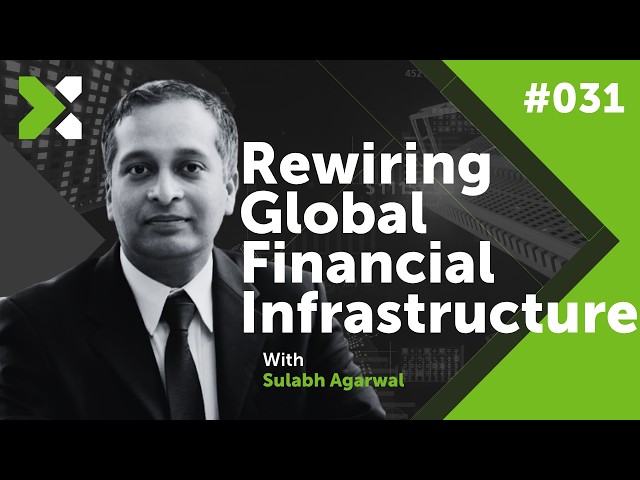
Accenture’s Global Head of Payments Sulabh Agarwal told the Payment Expert Podcast that stablecoin cross-border payments can cost as much as Swift, and that agentic payments still lack a rule book.
Sulabh Agarwal, Managing Director and Global Head of Payments at Accenture, told the Payment Expert Podcast banks are investing in AI and digital currencies ahead of corporate demand, stablecoin cross-border payments can cost as much as Swift, and that agentic payments still need a rule book to settle liability.
Agarwal leads Accenture’s global payments practice of about 5,000 practitioners across Europe, North America and growth markets.
Agarwal joined the podcast after returning from Sibos 2026 with Accenture, where he said conversations fell into three areas: risk and resilience, AI and agents, and tokenisation. Resilience covered cyber risk and threats linked to frontier AI, agents and quantum computing, which Agarwal described as “the hygiene for most of the industry.”
AI use cases “were tested and in some cases proven in production by a number of institutions,” he said, and large institutions are now sorting out the data, context and semantic layers that feed AI models and agents.
Accenture recently soft-launched a report, Money in Motion: Where Value Flows, based on interviews with 205 banking executives and about 230 corporate treasury leaders.
Agarwal said banks are leading investment in AI and digital currencies because they are building the propositions corporates will later use, and that corporates’ stated needs align with where banks are investing. He compared the current stage to the period “where everyone is designing the iPhone,” with corporate apps and use cases to follow.
Accenture: stablecoins match Swift on cost in some corridors
Agarwal divided tokenisation activity into three areas. Wholesale CBDC is gaining use for settling bonds and securities in capital markets, he said, citing the European Central Bank’s (ECB) Pontes service, which went live on 21 September 2026 to settle DLT-based wholesale transactions in central bank money, and bank collaboration on Project Agorá.
Stablecoins including USDC and USDT are gaining traction for cross-border payments to markets outside the G7. Agarwal said the end-to-end cost of a stablecoin cross-border payment “is more or less the same or in some cases greater than” a Swift payment, because last-mile liquidity in those markets “is quite hard and expensive.” People at Sibos told him that cost will fall as more providers supply last-mile liquidity, he said.
Retail CBDC momentum is visible for the digital euro, Agarwal said, but it is “still very, very early days,” with “a long way to go before it is universally accepted and used.”

Agents need a rule book
Agent-led payment routing “has not fully come into existence yet,” Agarwal said. Finance and procurement platforms are adding agents, including SAP’s Joule, Oracle’s AI suite and Coupa, and SAP is planning about 200 agents in its core layer, of which it has launched about 50, he said.
The Accenture research found 88% of banks believe they could own the search and recommendation agent layer, Agarwal said. As agents mature, he said, they will select “the cheapest, the fastest, the surest way” to complete a transaction, whether by corporate card, RTGS, Swift or stablecoin.
Consumers will be able to use agents to execute instructions such as buying a specific pair of shoes once the price drops by 50%, or booking a holiday against several criteria, Agarwal said. And merchants will be able to train their own agents to choose payment methods based on settlement speed, cash flow or transaction cost.
The latest episode of the Payment Expert Podcast is available now on Spotify, YouTube, Apple Podcasts, and all major podcast platforms. Subscribe to the Payment Expert newsletter so you don’t miss an episode.