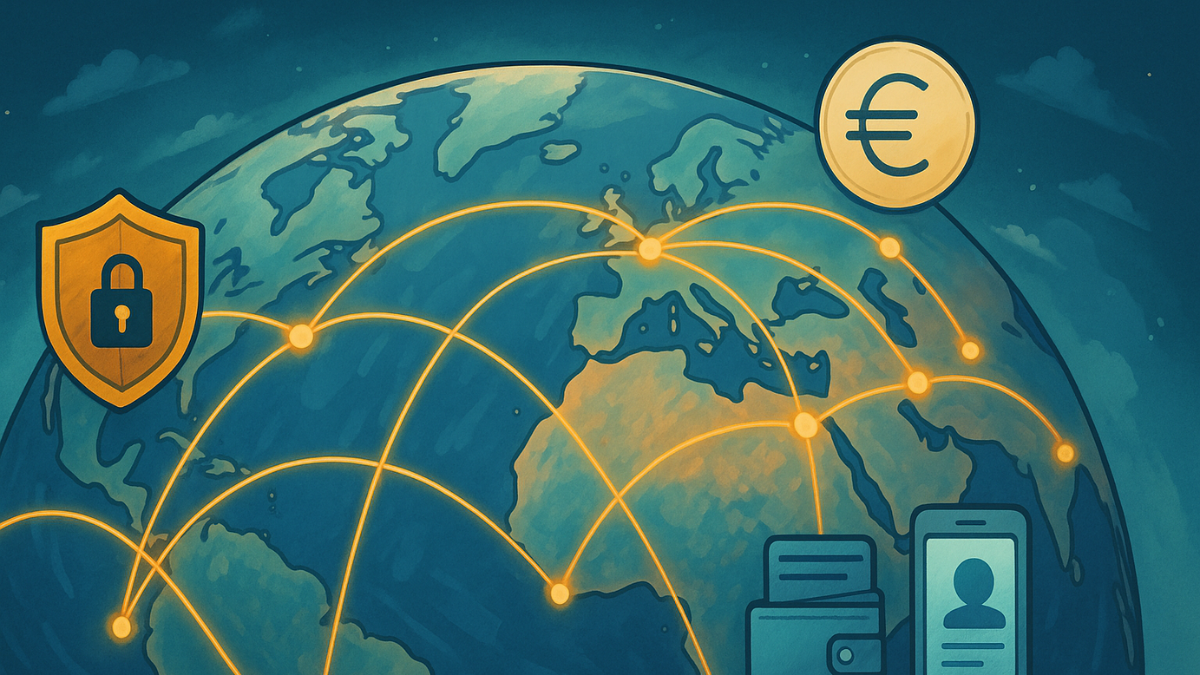
The European Central Bank and Eurosystem have launched a new tokenisation system, Pontes, designed to secure Europe’s position as a leading digital financial market, but industry reactions have questioned how ready it will be before it full launch in two years time.
The European Central Bank (ECB) has launched a new tokenisation system designed to tokenise wholesale transactions from central bank money, called Pontes.
Launched under the Eurosystem, Pontes has been created to tokenise European central banks’ commercial deposits and issued fiat money into the future in a bid to adapt the evolving digital economy.
Building upon a pilot programme led by the Eurosystem in 2024 testing how distributed ledger technology (DLT) can accelerate money settlement, Pontes’ initial core services will consist of adapting to market needs from stakeholders in both the private and public sectors.
Pontes is expected to be expanded over time in line with market needs and technological developments, with enhanced features and longer operating hours introduced gradually with full implementation expected by 2028.
ECB President, Christine Lagarde, believes Pontes will bring innovation and resilience to the European financial market, which has been fighting to protect its sovereignty through new pan-European payment schemes and a digital euro that continues to edge closer to issuance.
“The Eurosystem is working to enable a more integrated, innovative and resilient European financial market in the digital age,” said Lagarde.
“We will continue to make progress in close collaboration with the market.”

Why banks are tokenising financial assets
Tokenisation has become one of the strongest translations from the decentralised finance (DeFi) sector to the traditional finance (TradFi) sector, offering instant settlement, an added layer of security and enhanced programmability of financial assets being broken down into unique digital tokens.
Tokenisation can enable delivery-versus-payment, and payment-versus-payment, which can be instantly settled on DLT. This has been described as atomic settlement which sees the transferring of assets and its payment happen simultaneously, succeeding or failing at the same time.
Other benefits of the tokenisation of financial assets includes greater accessibility for wholesale markets to gain liquidity, smart contracts used to automate transactions in the backend, and the ability to perform multi-currency conversions for cross-border transactions.

Speaking to Payment Expert, Marius Jurglias, CEO of Axiology, believes another benefit of Pontes’ launch will see a more streamlined approach to the tokenisation of financial assets in Europe, but calls on policymakers to provide the necessary liquidity and issuance controls in place before its wider 2028 launch.
“Pontes is a major step towards bringing tokenised securities into mainstream capital markets. Giving institutions a way to settle tokenised securities in central bank money removes one of the biggest practical barriers to broader adoption,” said Jurglias.
“Institutions no longer have to choose between using new DLT infrastructure and settling in central bank money. Connecting the two gives tokenised securities the trusted cash leg they need to scale. But putting the rails in place is only the first step. Europe now needs issuance, investment and liquidity to follow.
“As more financial activity moves onto digital infrastructure, Europe needs to make sure the euro remains at the heart of its tokenised capital markets.”
Is TIPS holding back Pontes’ potential?
Pontes’ DLT-based tokenised transactions will be settled in parallel alongside the TARGET Instant Payment Settlement (TIPS) system.

TIPs already offer real-time processing, 24/7 availability and low costs for transactions. However, OpenPayd CEO, Iana Dimitrova, told Payment Expert the ECB’s settlement rail could hold back Pontes’ future ambitions to tokenise central bank money.
“At launch, Pontes still relies on the existing TARGET infrastructure for settlement finality and remains constrained by its operating model,” she said. “So while the technology is moving forward, some of the underlying limitations of traditional financial infrastructure remain.”
Pontes’ DLT wholesale asset interface will support T+2 settlement leveraging TIPS’ regional network to perform the settlement. This would see the convergence of DeFi and TradFi payment settlement rails working in tandem.
The settlement process would see the separation of both DeFi and TradFi frameworks to use TIPS to perform the settlement in a tokenised form of central bank money. There are no new compliance requirements using Pontes for TIPS.
Despite this, Dimitrova argued this process may incur friction challenges when it comes to using Pontes and TIPS for cross-border settlement built on an infrastructure that is already faced with similar challenges.
“The strongest demand we see in the market today is cross-border settlement and FX,” said Dimitrova. “That is where stablecoins have already proven their utility, because existing systems remain slow and fragmented across borders and stablecoin infrastructure can enable money to move and settle around the clock.
“If Europe’s tokenised financial infrastructure is to realise its full potential, it will need to tackle those cross-border frictions head-on and deliver interoperability across currencies, payment systems and private infrastructure. Without that, there’s a risk that Europe builds new technology around some of the same constraints that businesses are already trying to overcome.”