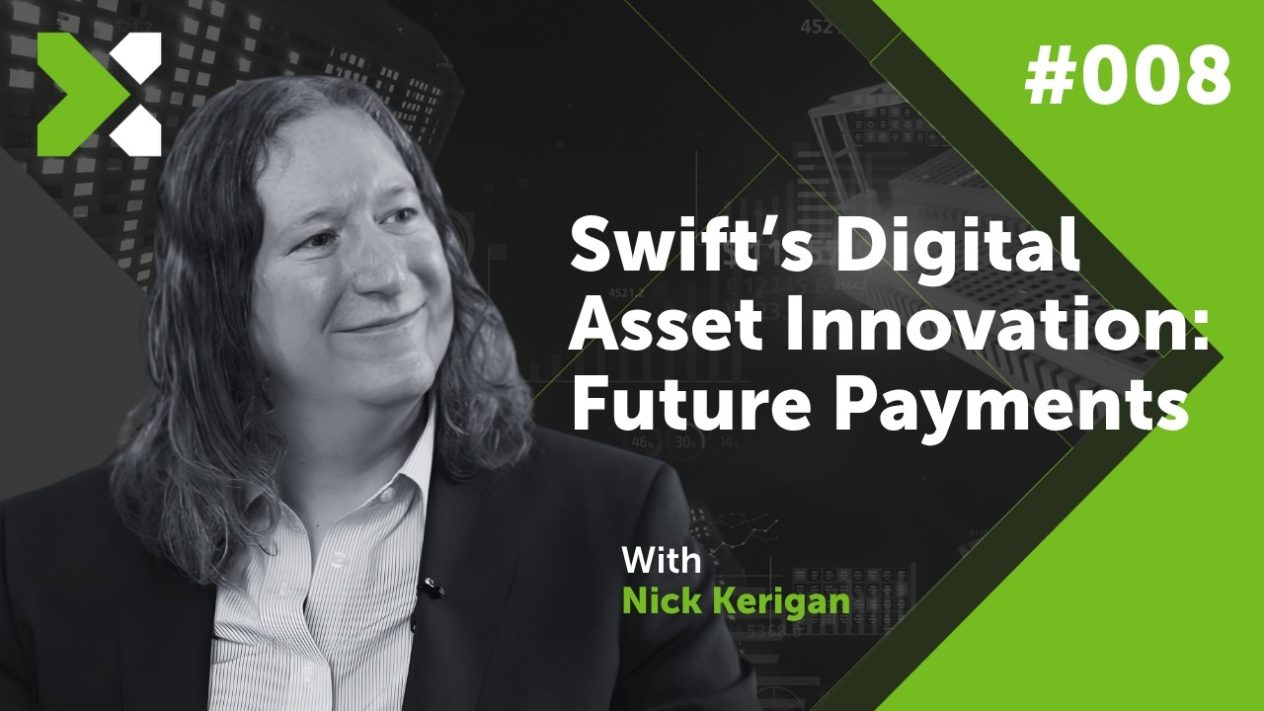
The Payment Expert Podcast is joined by Nick Kerrigan, Managing Director and Head of Innovation at Swift, to discuss the institution’s blockchain-based shared ledger, and the interoperability challenge facing the industry
Cross-border payments have never lacked for infrastructure. What they have lacked is infrastructure that talks to itself.
As tokenised deposits, stablecoins and CBDCs multiply across incompatible networks, the gap between innovation and interoperability has become one of the industry’s most pressing structural problems – and one that Swift, as the network connecting 11,500 banks and corporates globally, believes it is uniquely placed to close.

In the latest Payment Expert Podcast, Nick Kerrigan, Managing Director and Head of Innovation at Swift, sets out the cooperative’s approach to cross-border payments in two tracks.
The first is lifting the experience on existing rails. Swift’s retail payment scheme framework – backed by 25 banks committed to processing payments under it by end of June 2026 – targets upfront cost certainty, end-to-end transparency, full value delivery, and the fastest possible settlement, including instant where domestic infrastructure allows.
The second track is building new rails entirely. Swift is developing a blockchain-based shared ledger on an EVM-compatible, hyperledger-based architecture, combining open source foundations with its existing network, security standards and global reach. The initial use case is real-time, 24/7 wholesale cross-border payments, with a minimum viable product targeting go-live with real-world transactions this year.
The ledger does not change Swift’s role – it is not a settlement system, and that remains the case – but it now introduces a shared coordination layer that records and validates payment commitments between banks, supports multiple settlement options, and enables institutions to tokenise and interoperate deposits between each other.
Swift: Interoperability as the real challenge
Swift has spent over five years examining how different instruments on different blockchains can be synchronised – delivery versus payment, FX settlement, and end-to-end straight-through transfers, including live trials settling tokenised bonds with digital money held on separate platforms.
This has sharpened Kerrigan’s view of where the industry’s real problem lies. Innovation, he argues, is not the constraint – tokenisation is accelerating and the technology is proving itself.
The constraint is connecting new blockchain infrastructures to each other and to existing rails without fragmenting the system further. That, in his view, is where Swift’s role as trusted, neutral infrastructure becomes most significant.
The latest episode of the Payment Expert Podcast is available now on Spotify, YouTube, Apple Podcasts, and all major podcast platforms. Subscribe to the Payment Expert newsletter to make sure you don’t miss an episode.