The IMF’s October stability report puts daily tokenised repo volumes near $350bn, a sliver of the $13tn traditional market, and sets four conditions it says must be met before the technology can scale safely.
Tokenised financial markets are growing fast but remain small, fragmented and less liquid than the markets they copy, the International Monetary Fund (IMF) said in its October 2026 Global Financial Stability Report.
The report, “Scaling Tokenization: New Efficiencies, New Vulnerabilities,” was written by Gonzalo Fernandez Dionis, Caio Ferreira, Mindaugas Leika and Athanasios Vamvakidis.
Chapter 3 of the report notes most tokenised activity sits in repurchase agreements, the short-term loans banks use to fund themselves and move collateral. Tokenised repurchase agreements (repo) runs at $300bn to $350bn in daily transaction volume. Trade in other tokenised assets – private credit, money market funds and equities – adds about $65bn a day.
Currently, these figures sit far below the markets they mirror. The US repo market turns over roughly $13tn a day, the IMF said, and global capital markets hold about $300tn in assets.
Issuance concentrates in the US and a few large offshore jurisdictions, while trading splits across separate platforms, networks and settlement arrangements.
Much of the tokenised repo activity the IMF describes runs through a handful of bank and vendor platforms.
Broadridge’s Distributed Ledger Repo platform processed an average of $362bn in daily repo transactions in May 2026, and JPMorgan’s Kinexys unit settles more than $1.5tn in tokenised repo a month through the Canton Network.
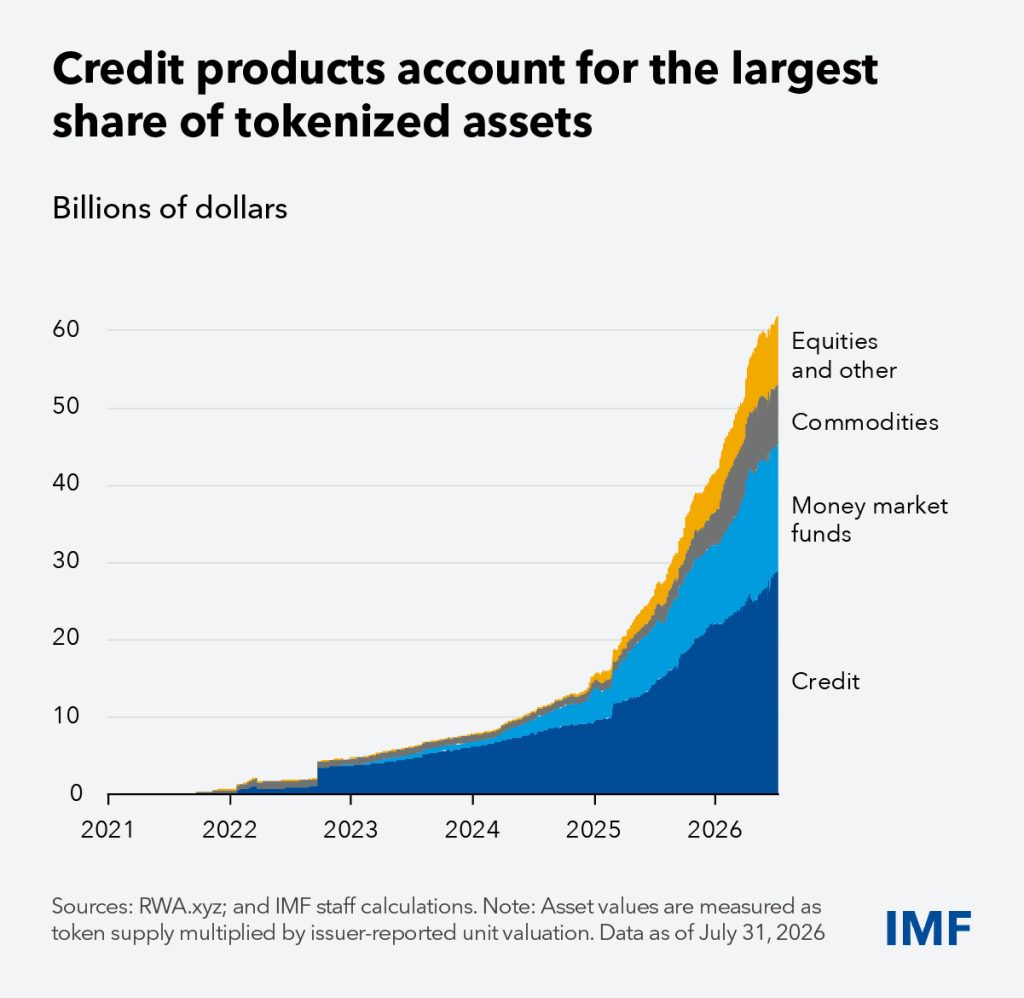
Investors value several features the technology enables, the IMF said. More than half of tokenised trading takes place outside normal market hours, which the Fund reads as demand for round-the-clock access.
Fractional ownership is widely used, letting retail investors buy less than a single share. In fact, the IMF found about 80% of tokenised equity trades were on fractional shares.
Overnight returns on tokenised equities show up in traditional equity prices soon after markets open, the IMF said, indicating both respond to the same information.
Tokenised markets: The current weaknesses
The weak point is liquidity. Tokenised markets stay relatively illiquid and more volatile than traditional ones, the IMF said, and fragmentation across networks and venues weakens price formation and widens price gaps. The absence of a common settlement asset makes it worse, because each platform clears into its own arrangements and the market stays split.
Fixing liquidity depends on fixing settlement, and settlement is where the IMF sets its highest bar. Tokenised trades need to settle in money that is safe and widely accepted, a requirement the IMF says sits alongside other important areas like the need for investors to have legal certainty a token carries enforceable rights. Regulators need to spell out how existing rules apply to new ledgers, and platforms need to connect rather than run as isolated liquidity pools.
The IMF feels progress on any one does little while the others lag.
The payments industry has moved fastest on the settlement leg. Broadridge clears the cash side of its repo trades using JPMorgan’s JPM Coin, which lets both legs settle together in as little as a minute instead of waiting on traditional payment rails.
The regulated money to scale this is still on the way. The US GENIUS Act, signed in July 2025, set federal rules for payment stablecoins used in settlement, and the EU’s MiCA regime reached full enforcement on 1 July 2026, requiring stablecoin issuers to be authorised. Both hand institutions a settlement asset supervisors can recognise.
IMF: The risk in getting bigger
Scale is the point, and the IMF’s warning is that it cuts both ways. As more assets, investors and settlement instruments join a tokenised network, liquidity and efficiency rise, and so does the speed at which trouble moves.
So, larger tokenised markets could carry traditional risks further and faster, and the IMF names fire sales, liquidity runs and contagion through tighter interconnection and leverage as events that could ripple throughout a fully tokenised market.
The sequential steps tokenisation strips out, including messaging, trading, delayed settlement, and reconciliation – add cost now but also act as buffers a fully tokenised market would lose.