Razorpay wants to replace separate AI models for fraud, payment routing and checkout with one system that can learn how payments behave across its wider network.
Razorpay has launched Vulcan, an AI foundation model made specifically for India’s payments ecosystem.
The company says Vulcan has created “a vocabulary for how Indians transact”, allowing it to learn patterns in how money moves and apply that understanding across different payment decisions.
The fintech aims to make payments “more reliable, safer, and predictable”, with the model already being used to improve routing, detect fraud and personalise checkout experiences.
Announced on 18 August, the model has been built using Razorpay’s own data and is used in production across a network that processes almost four billion customer-to-merchant payments every year.
Vulcan was developed by the company’s Data Science, ML Engineering and Data Engineering teams, using NVIDIA computing and AWS cloud infrastructure.
Amazon SageMaker AI, a platform for building, training and deploying machine-learning models, was also used to support Vulcan’s training and help Razorpay expand its use without engineers having to manage as much of the technical infrastructure.
One model for India’s payments stack
Razorpay says the complexity of India’s payments market was one of the main reasons behind building a single foundation model.
In India, consumers use UPI, credit and debit cards, net banking, wallets and Cash on Delivery, with transactions passing across hundreds of banking rails and gateways.
Up until now, the industry has used separate models for different tasks, with one focused on routing, another on fraud and another on checkout.
“If a transaction failed in India, it wasn’t necessarily due to a lack of funds,” the company explained. “It was often because, out of several possible routing paths, one was briefly the wrong choice at that exact millisecond.”
Vulcan can be used to compare payment routes in real time and direct transactions towards the option most likely to succeed.
When it comes to fraud, Razorpay explains that the model can identify suspicious behaviour that may only become visible when activity is viewed across thousands of merchants.
Finally, the model is also used at checkout, where it can recommend payment methods and assess buyer intent to help merchants decide when discounts should be offered.
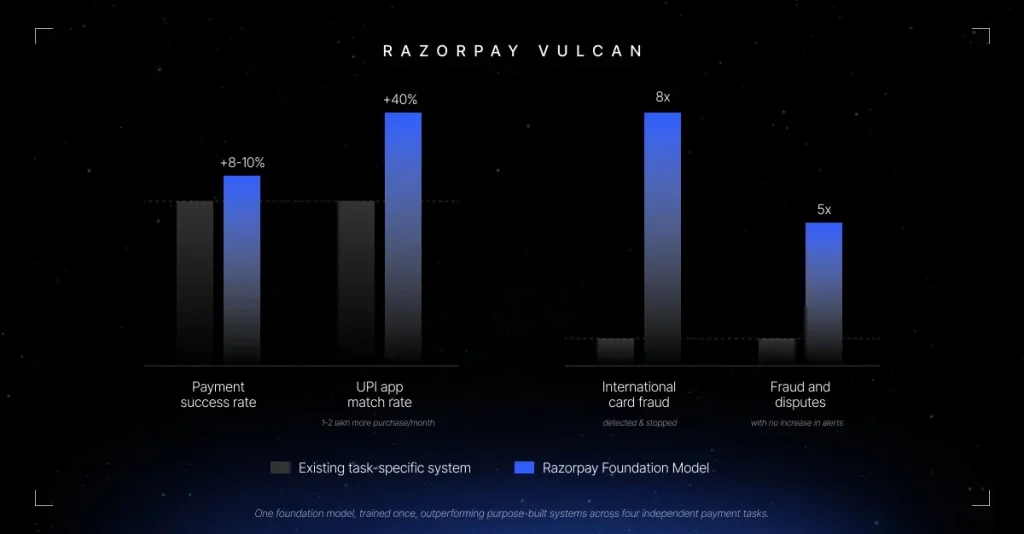
Razorpay says these improvements can translate into “fewer lost sales, protected ad spend, lower fraud losses, and minimised RTOs”, as well as make payments more reliable for consumers.
There is still work to be done, however, with the company stating a long term goal of “every single payment decision on Razorpay” to eventually be powered by the model.
India’s rise as a fintech hub
India is trying to bolster its position as a global hub for fintech and payments, with a part of that push focused on attracting investment, developing domestic infrastructure and making it easier for international firms to enter the market.
In February, the National Payments Corporation of India (NPCI) announced a collaboration with NVIDIA to develop a sovereign, payments-native AI foundation for India’s digital payments ecosystem.
NPCI oversees the infrastructure behind UPI, in addition to products including RuPay, IMPS and NACH, placing the initiative close to the core of the country’s payments network.
The collaboration was announced as a move away from isolated AI use cases towards a “foundational and scalable AI layer”, with trust, resilience, security and India’s regulatory and data sovereignty requirements in mind.
In addition to the development of its payments infrastructure, India has also placed more focus on attracting companies and investment into its financial services sector.
Speaking at Money20/20 Asia in April, Dipesh Shah, Executive Director at the International Financial Services Centres Authority (IFSCA), highlighted the country’s growth in financial services and noted that India now has more than 200,000 start-ups.
Shah also highlighted GIFT City, India’s International Financial Services Centre, as a gateway for firms looking to enter both India and the wider South Asian market, supported by a centralised regulator and access to licences and active channels.