India Ministry of Finance clarifies who would be affected by proposed changes to UPI’s zero-fee model.
India Ministry of Finance has said reports claiming it will charge ordinary users of the Unified Payments Interface (UPI) are incorrect.

In an update on 8 August, the ministry said that consumers will continue to pay nothing to use the instant payments system, that all person-to-person (P2P) transactions will remain free and that any future merchant charges will apply only to a limited set of transactions above a certain threshold.
The clarification follows reports after Finance Minister Nirmala Sitharaman introduced the Taxation and Other Laws (Amendment) Bill, 2026 on 4 August, allowing the government to charge for specific electronic payment methods.
Some coverage about the amendment suggested it would open the door to fees on everyday UPI use. However, the ministry has stated that any charge would be applied to merchants rather than consumers.
Who will pay for UPI?
P2P transfers and the majority of everyday consumer-to-merchant payments will stay free under the proposal. What’s changing is the small share of higher-value merchant transactions, where a Merchant Discount Rate of 0.25 to 0.5% has been proposed for payments above ₹2,000 (£15.53).
The government has said this threshold would touch only around 5% of UPI transactions by volume because it would exclude the low-value payments that make up most of the system’s daily use.
However, the same 5% accounts for roughly 65% of UPI’s transaction value, which is why the change matters despite the government’s attempt to assert that it is limited.
The model is like how card networks work, with Visa and Mastercard charging merchants an interchange-style MDR on card transactions, a fee that was waived when the government made it free for merchants and users in January 2020.
The zero-MDR policy helped UPI become the world’s largest real-time payment system, processing 2,366 crore transactions worth ₹29.9 lakh crore in July 2026. However, maintaining a network of this size has so far relied heavily on government subsidies to banks and payment providers.
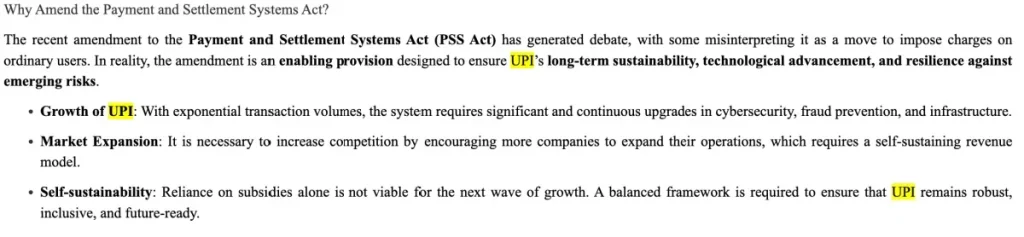
With volumes still growing and the system now live in 11 countries, the ministry has said relying on subsidies alone isn’t viable for the next phase of expansion, hence the push for a “self-sustaining” revenue model.
Pressure from the US?
There are reports that the change could be influenced by external scrutiny from the US, though the Finance Ministry called these “unfounded, completely false and misleading.”
In March 2026, the US Trade Representative flagged India’s zero-MDR policy for UPI and RuPay as a potential foreign trade barrier. The group said that the model disadvantages fee-based networks like Visa and Mastercard, which have lost ground in India since UPI’s 2016 launch.
The USTR has also raised concerns over NPCI‘s proposed 30% market-share cap on third-party UPI apps, a rule that would affect Walmart-backed PhonePe and Google Pay, which handle more than 80% of UPI transactions. Brazil’s Pix has faced similar criticism from Washington over its zero-fee model.
In response to these reports, the Ministry of Finance said: “If external pressure had been a factor, the government would not have introduced UPI in 2016 or made it free of charge for both merchants as well as citizens since January 2020 and ensured that it became the world’s largest real time interoperable payment system.
“The truth is simple: UPI is India’s own innovation, and the government remains committed to keeping it free for citizens while ensuring its sustainability for decades to come.”
The government instead says that the amendment is forward-looking and aims to keep UPI competitive, secure and able to expand further into rural and semi-urban India.
It also issued a request to citizens to only rely on official information from the Ministry of Finance, the Reserve Bank of India and NPCI, and “not to forward unverified messages.”