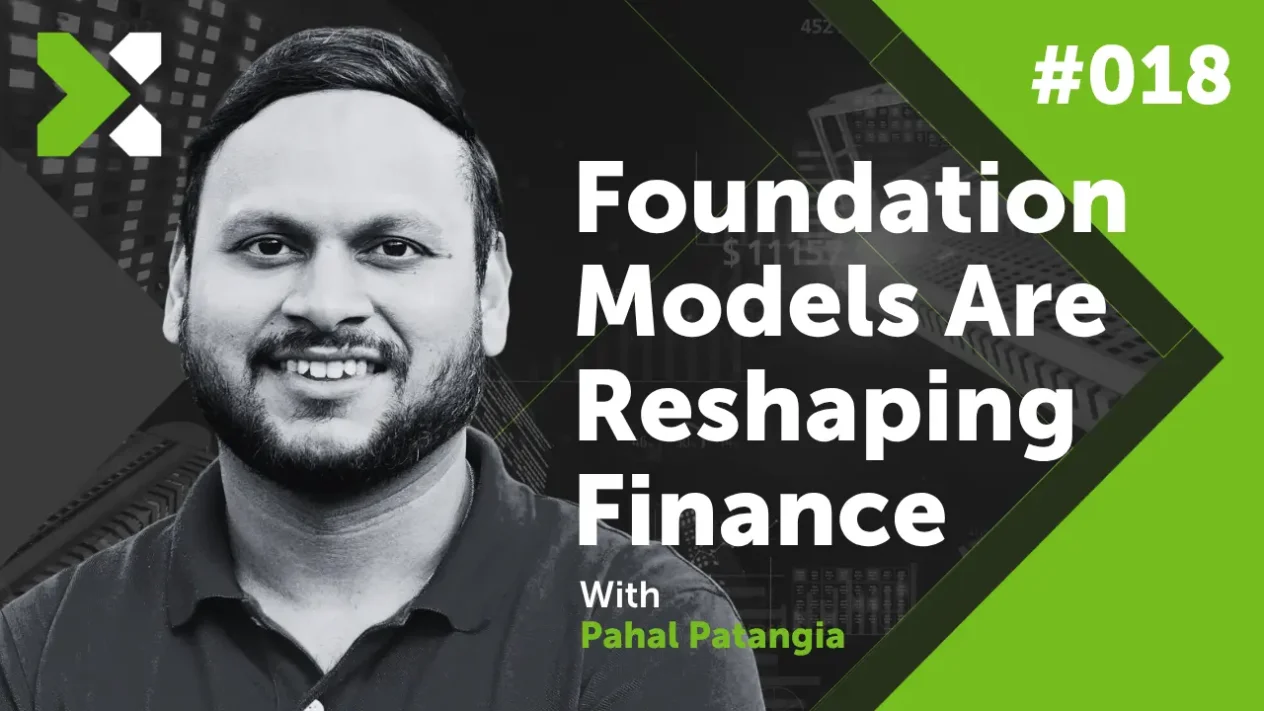
The Payment Expert Podcast is joined by NVIDIA’s Pahal Patangia to discuss payment foundation models, the shift from data to intelligence, and what still stands between the industry and autonomous agentic commerce
In the latest episode of the Payment Expert Podcast, Pahal Patangia, Head of Global Industry Business Development for Payments at NVIDIA, explains how a new class of AI models are changing how the industry reads its own data, and why those models will decide whether agentic commerce works at scale.
Financial services has run for decades on tabular data and relational databases, with machine learning applied to make predictions from it, Patangia says. Transformer architecture – the deep learning approach behind large language models – can now be applied to the same tabular data, producing what he calls contextual representations, or embeddings, which encode a customer’s past, present and likely next behaviour.
Stripe, Mastercard and Revolut have all built payment foundation models on NVIDIA’s platform, several showcased at the company’s GTC conference in March 2026.
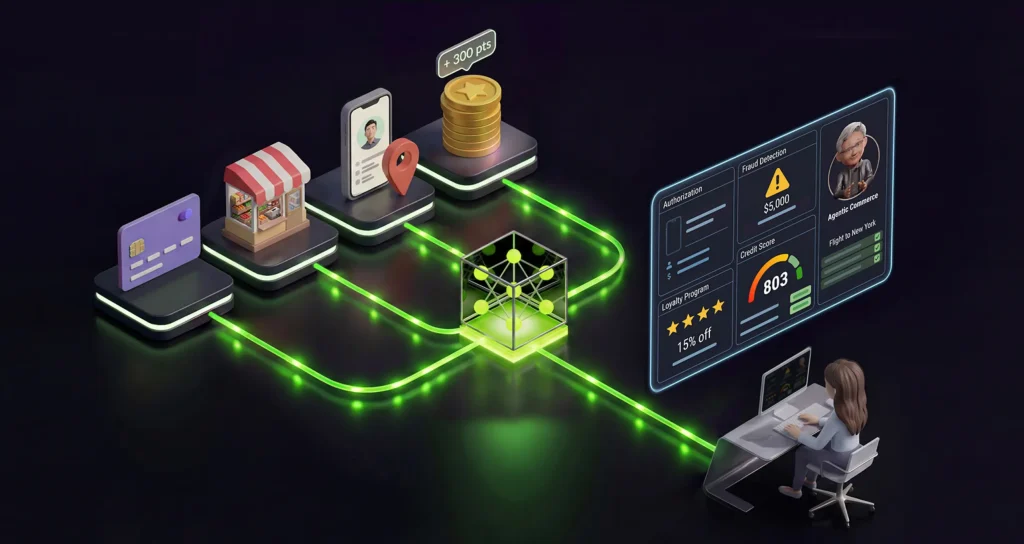
NVIDIA: From system of record to system of intelligence
Patangia argues a firm holding the most transaction data no longer has an outright competitive advantage; the winners are those who can best interrogate the data. Every player in the transaction funnel – acquirers, card networks, issuers – holds data at scale, he notes, so differentiation is no longer at the rails level.
Payment foundation models are the bridge, he says, from a “system of record” to a “system of intelligence” – a semantic layer which turns a reactive data layer into an actionable one, feeding downstream tasks such as fraud and dispute prediction and cross-selling.
A ‘flywheel’ with agentic commerce
Payment foundation models and agentic commerce feed one another, Patangia says. An agent acting on a user’s behalf can only do so if it knows the user well – and the embeddings from a payment foundation model supply this user knowledge, shaping the agent’s actions to one customer, one persona.
The action then loops back to improve the model. “Payments foundation models and agentic commerce are like a flywheel to one another,” he says.
He points to NVIDIA’s work with PayPal, which is rolling agentic capabilities out to 19 million SMBs using open-source models such as NVIDIA Nemotron to solve the search element cost-effectively.
The same infrastructure applies to liability, he says: the industry solved KYC and KYB with data plus deep learning, and he expects “Know Your Agent” (KYA) to follow, using anomaly detection to flag agents behaving outside their brief.
Open-source models sit roughly six months behind the frontier, Patangia says, but match it once fine-tuned on a firm’s proprietary data. Financial institutions use them to keep sensitive data in-house, he adds.
Agentic systems will be hybrid, he says – large closed-source models for reasoning, small fine-tuned models for narrow tasks. This raises two industry trends, he notes: model routing and “tokenomics”.
The latest episode of the Payment Expert Podcast is available now on Spotify, YouTube, Apple Podcasts, and all major podcast platforms. Subscribe to the Payment Expert newsletter to make sure you don’t miss an episode.