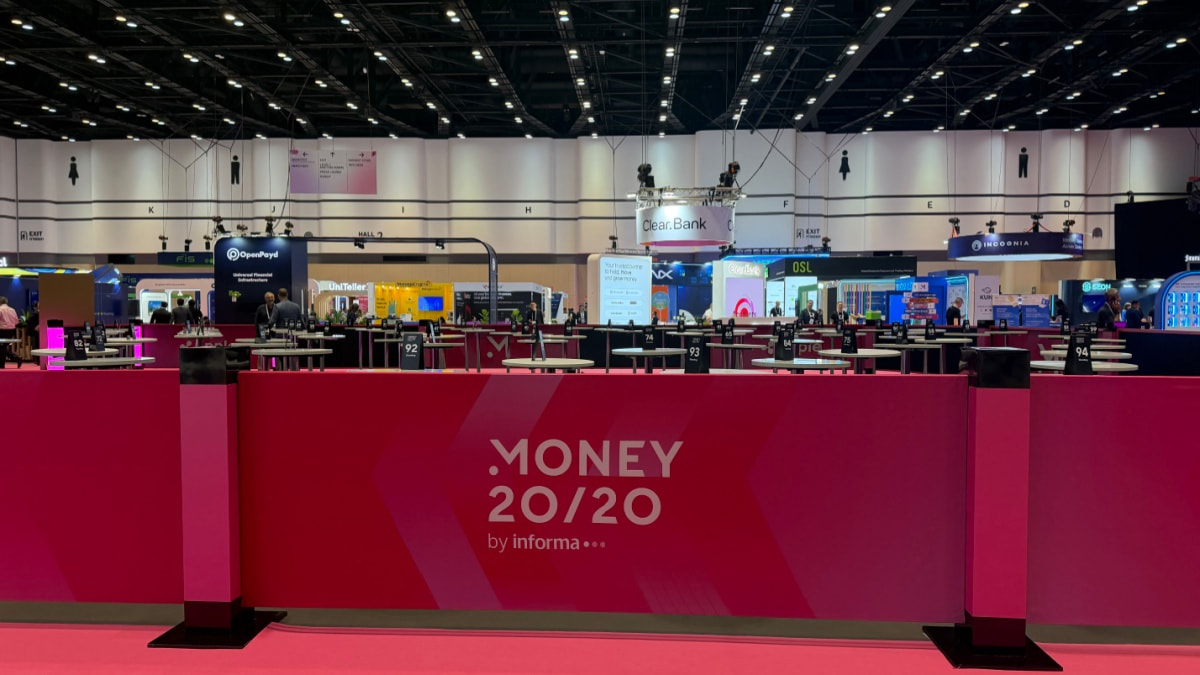
Payment Expert has been on the ground at Mone 20/20 Asia. Expect real-time insights from leading industry leaders engaging in conversations about fintech, payments, banking, digital currencies, and much more.
To read what happened on Day 1, click HERE
16:45 – That’s a wrap
So many more unique and different perspectives were discussed today, revolving around financial trust, market expansion by localising payments, agentic commerce and much more.
Day 3 tomorrow may be shorter in length, but expect more engaging conversations and opinions to be shared on the final day of Money 20/20 Asia 2026.
16:15 – Behind the scenes with Nium

15:35 – ‘AI is going to be the next big thing,’ says Huawei
Roger Wang, Vice President of Huawei’s Digital Finance BU, opened the panel by declaring that AI will be the next big thing in finance. Ning Zhang, CTO at Yusys Technol, agreed, warning that those who let fear hold them back risk missing out.
Statements like these may push bank and fintech executives to dive in quickly, though the panel noted many are still asking about ROI. Wang countered that this may not be the right question: “You must try. Sometimes it’s going to be a failure and you have to tolerate that.”
15:15 – ClearBank opens European remittance corridor to Tazapay
ClearBank announced a new partnership with fast-growing Singaporean payments infrastructure provider, Tazapay, providing it access to UK and European payment rails for greater cross-border flows from Asia.
Through the collaboration, ClearBank UK enable real-time settlement and fiat interoperability for Tazapay’s clients, assisting in Tazapay’s global expansion by connecting its payments platform to European remittance corridors.
The integration connects ClearBank’s cloud-native clearing infrastructure into Tazapay’s single-API global payments platform, enabling cross-border money movement to increase payment flows.
Mark Fairless, CEO of ClearBank, said: “Supporting Tazapay creates new opportunities for ClearBank to support a business with a rapidly expanding international presence. It is also another major deal for ClearBank with a leading Asian business, and our first with a Singapore client, as we continue to build our global reputation.
“With our shared desire to blend innovation and regulation, I am sure that this is just the start of what will be a successful long-term partnership.”
14:30 – Behind the scenes with Thunes

13:40 – Building trust in the new financial order
Money20/20 Asia has put the latest innovations in payments right in the shop window; stablecoins and tokenised assets, AI and digital ID being at the top of everyone’s wishlist. However, in the shadow of the excitement is a challenge of trust. Institutions and individuals are being asked to embrace technologies that are unfamiliar, and scepticism is inevitable.
Fangfang Jiang, Regional Lead for Digital Financial Services at the International Finance Corporation (IFC), stresses the need for accountability, client protection and technological maturity before these solutions can be adopted.
The panel also warned bad actors must become as scarce in the digital world as they are in real life. Navin Gupta of Crystal Intelligence notes that new technologies inevitably attract scammers.
13:10 – APAC a world leader for agentic commerce adoption
Lucy Anderson, Head of SMB Product in Asia for Global Payments, revealed during a keynote presentation that Asia-Pacific countries lead the way in agentic commerce adoption… and it’s not even close.
Three out of the top five countries adopting agentic commerce are from APAC, as China leads in first with 64% of respondents stating they trust and have trusted AI agents to perform commerce searches on behalf of them.
Following China in second is Singapore (45%), the US in third (44%), Brazil in fourth (37%), Australia in fifth (34%), the UK in sixth (31%), and France in seventh (25%), according to Global Payments research.
“Highly sophisticated AI systems have raised new questions about relying on biometric data as a source of truth,” said Anderson.
“We are at the beginning of a major shift. AI agents don’t just shop, they shop on our behalf, it’s not a payment trend, it’s a behavioural trend.”
However, Anderson also stated that trust remains the fundamental barrier between further adoption, for both consumers and merchants.
12:30 – India is on the rise
Dipesh Sphah, Executive Director at the International Financial Services Centres Authority (IFSCA), highlights India’s growth in the financial industry, noting the country now has more than 200,000 start‑ups.
India is becoming a key competitor in global financial services, with instant payments having become a success, and recent partnerships with players like PayPal showing just how attractive the market has become.
Sphah describes GIFT City, India’s International Financial Services Centre, as a gateway for companies entering both the Indian market and the wider South Asian region. He says that with a centralised regulator, GIFT offers firms a simple path to licences and active channels, giving India a significant advantage in attracting global institutions.
12:00 – Navigating Asia’s fragmented landscape for SME growth
Some of the key talking points at Money 20/20 this year have been around cross-border payments and fragmentation that exists in Asia, Southeast Asia and Asia-Pacific.
This fragmentation can be particularly challenging for small and medium-sized enterprises (SMEs) aiming to scale in either one or all three of the aforementioned regions having to navigate these hurdles.
Fragmentation not only exists in payments in Asia, but in regulatory guidelines in different countries, adding to the complexity of SMEs establishing their local branches.
Sean Abbott, Director of APAC Banking for Payoneer, reveals Payoneer has been aiming to address and solve these challenges. He shared how the company has helped their SME clients with tax advice and the ability to offer multi-currency banking accounts with Citi to be paid in the local currency and to pay others.
But while fragmentation across Asia’s payment ecosystem exists, this is not without efforts to reduce this.
Pei Ling Tin, Co-President at MetaComp, highlighted that Project Nexus has enabled several QR code payment methods to be adoptable by businesses in Thailand, Singapore, Malaysia and more to help support interoperable transactions.
This has become essential for SMEs aiming to establish a presence in Southeast Asia. Ling Tin revealed if settlements are delayed, that’s 2.1% of transaction value destroyed and the opportunity cost can far outstrip the valuation cost.
This is why MetaComp, according to Ling Tin, has been aggregating all the payment service providers in a selected market, to become an intermediary layer, between the SME and the larger financial institutions.

11:40 – A peek behind the curtain

The Payment Expert team are setting up a voxpop with Anne Willem de Vries, Co‑founder and CEO of Silverflow, who will be answering the question: What’s holding cross‑border payments back from being truly frictionless?
de Vries is one of four leaders sharing their perspective, with the full video set to go live on Payment Expert’s LinkedIn next week.
This isn’t the only voxpop from the event, as five different voices have also weighed in on What’s the next breakthrough AI will unlock in payments over the next 12 months?
Follow Payment Expert on LinkedIn to catch all the post‑event insights.
11:20 – How banks should leverage and scale AI responsibly
If you blink, it feels like you will miss the next AI innovation and growth phase.
Banks have leveraged AI for nearly two decades, but the technology’s sophistication has grown exponentially over the past six months.
In those six months, Pedro Uria-Recio, Chief Data & AI Officer at CIMB, revealed the arrival of general purpose AI tools, such as Openclaw, has enabled the general consumer to experience the benefits of automation where it used to function as a backend processor for banks.
Financial institutions now have a consumer scalability issue in order to leverage their AI data to hundreds of thousands, and in Standard Chartered’s case hundred of millions of customers.
Craig Corte, Global Head, Digital, Data & Coverage Platforms at Standard Chartered, said the key issue derives from a cost scenario but is not concerned around a “data graveyard issue” where customer data sits idly, but he focuses more on how quickly you cycle AI engines to come to solutions to then scale those solutions to customers.
But once AI is being leveraged by consumers, risk management “must come first”, according to Pichet Durongkaveroj, Executive Director at Bangkok Bank.
Durongkaveroj also highlights ownership risk assessments from within a financial institution’s AI operations, believing risk and ownership management go hand-in-hand, from the systems teams, to the IT teams, and then the compliance teams.

10:45 – How do stablecoins come out of the “experimentation phase”
Stablecoins unsurprisingly has everybody talking about their potential for cross-border remittances and settlement.
Daren Guo, Co-Founder of Reap, and Paul van Sint Fiet, Head of Cross-Currency Solutions, APAC at J.P. Morgan, were quizzed on the MoneyPot Stage as to how stablecoins functionality can move past the experimentation phase, and into a more broad mainstream adoption.
Guo admits that they are “very much in the early stages” as stablecoins have arrived during a period of innovation for financial services, but believes the underlying infrastructure will power the next phase of finance.
Fiet believes there are still complexities to address when it pertains to multi-currency stablecoin settlements. He acknowledges that this will require a lot more discussion around FX rates, policy guidelines and much more.
Despite this, Fiet offered a glimpse into the future of how stablecoins will be viewed in the next five years.
Stablecoins integrated in the current stack “will be the ultimate goal”, and we won’t be talking about stablecoins in five years, “we’ll just be moving funds” as they power the underlying infrastructure.
Gou agreed, highlighting that stablecoin infrastructure will become an added layer to existing infrastructure to help capital liquidity efficiencies.

10:15 – Meeting people where they are
Ken Chenis, Executive Architect at IBM Payments Center, IBM Consulting, tells the audience that while payments are usually discussed in terms of systems and technology, the real impact is on individuals.
Kenny Stridh, CTO at Ericsson MFS, highlighted Africa as an example, where telecom networks have enabled financial inclusion by meeting people where they are, even without smartphones, showing how infrastructure can and should adapt to local realities.


9:45 – Stablecoin acceptance arrives in the Philippines via QR codes
Coins.ph yesterday (21 April) announced the rollout of its QRPh Stablecoin Payment service to help merchants in the Philippines accept stablecoin payments to be converted into Philippine Pesos.
Supported via QRPh, the Philippines’ national QR code standard, customers can pay for goods and services by scanning a QR code. QRPh also removes the need for merchants to display multiple QR codes for different providers.
Coins.ph is aiming to bridge the gap between digital assets and daily commerce, with its latest launch compatible with nearly 700,000 QRPh-enabled merchants across the Philippines.
For the initial rollout, Coins.ph has prioritised the two largest stablecoins in the market globally; USDT and USDC, with more tokens slated for integration in the coming months.
Wei Zhou, CEO of Coins.ph., said: “After a long but exciting development process, Coins.ph is proud to finally introduce its QRPh Stablecoin Payment Support, a new experience that allows eligible users to complete a QRPh transaction using PHP, supported stablecoins, or a combination of both within a single checkout flow.
“We expect this new feature to revolutionise how our users make payments, whether it’s for usual coffee runs or for weekend shopping at large retail chains. This initiative is part of Coins’ broader effort to make crypto more usable in everyday scenarios and to simplify merchant QR transactions for users who hold funds across different asset types.”
09:30 – FIS expands PRIME on AWS
FIS confirms it will launch its PRIME platform, part of its Total Issuing Solutions, on AWS Asia Pacific (Singapore) by early 2027. This is the company’s first major regional expansion since completing its $13.5bn acquisition of Global Payments’ Issuer Solutions business in January 2026.
Speaking to Payment Expert about the news, Andrew Murray, Head of International Banking & Payments, FIS, says:
“Southeast Asia is one of the fastest-growing digital payments markets in the world, but for many financial institutions here, data remains trapped in silos and legacy systems weren’t built for what modern payments demand. With Total Issuing Solutions, FIS is unlocking the technology that helps financial institutions move money more seamlessly.
“The platform is proven at scale, cloud-powered, and built to give issuers a single, connected view of their customers.”
09:00 – The doors are open for Day 2
It’s a slightly later start here at Money20/20 Asia, with the first panels kicking off at 10:00. This gap in the schedule offers a chance to reflect on yesterday’s highlights.
Payment Expert’s Kieran O’Connor picked out his panel of the day, where industry leaders dug into the toughest challenges of cross‑border payments.
Elsewhere, HSBC spoke of tokenised deposits as “the wave of the future,” while Swift reminded the audience that existing rails “are not as bad as people think.” Ant Digital unveiled its AI Super App blueprint, dLocal launched Stablecoin Full for emerging markets, EBANX expanded recurring APMs to six new countries, and Trulioo presented AI‑enabled KYB improvements.
Day 2 promises to be just as packed, so expect insights from the stages, announcements from the floor, and a look behind the scenes at what the Payment Expert team is working on.