Debit cards still dominate 64% card share, but volume growth slows as UK Finance reports a rise in Faster Payments use
UK consumers and businesses made 49.7 billion payments in 2025, excluding CHAPS, a 2% rise on the previous year, according to UK Finance’s UK Payment Markets 2026 report, with Faster Payments now the second most-used payment method.
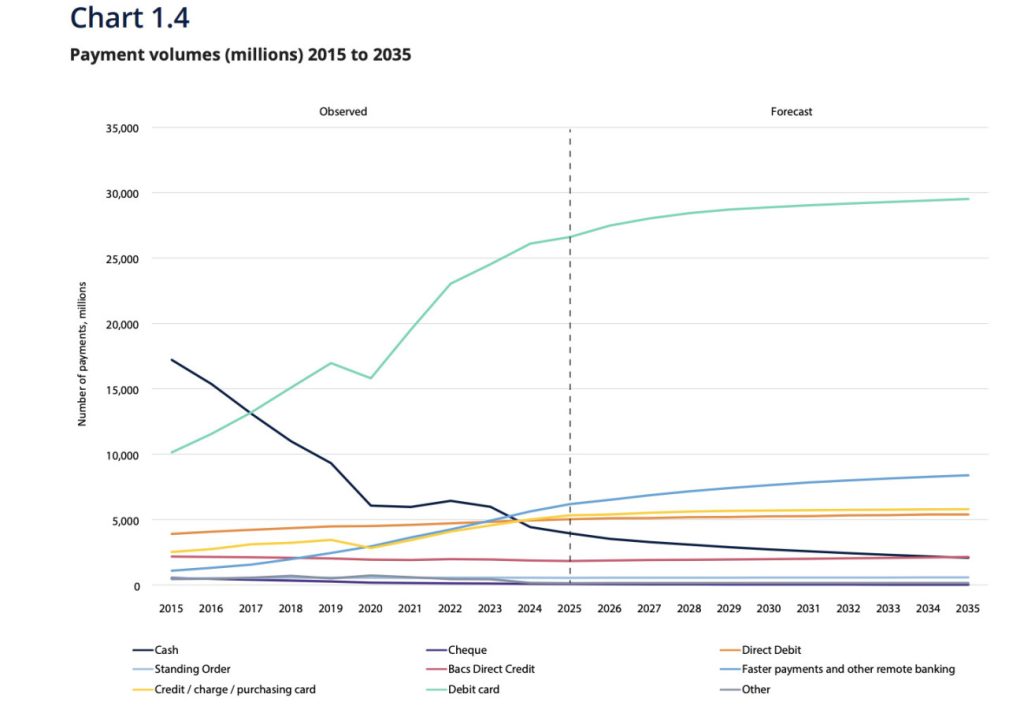
Debit cards remained the most used method, with 26.6 billion payments, or 54% of the total. Card payments overall accounted for 64% of UK payments. Debit card volumes rose 2%, slower than the rate seen over the past decade, which UK Finance attributed to a maturing market rather than falling use.
Faster Payments and other remote banking reached 6.2 billion payments, up 10% in 2024, and became the second most used payment method behind debit cards. UK Finance said the increase was driven mainly by businesses making more account-to-account transfers.
Remote banking payments are forecast to rise to 8.4 billion by 2035, 16% of all transactions, the report said. Some 91% of UK adults used at least one form of remote banking in 2025, and 75% used mobile banking.
As Faster Payments grows, cash falls to fifth
Cash payments fell to 3.9 billion, down from 4.3 billion in 2024, and accounted for 8% of all payments. Cash is now the fifth most used payment method, behind debit cards, Faster Payments, credit cards and Direct Debit. It first dropped out of second place in 2024.
Cash made up 45% of payments in 2015 and 17% in 2020. UK Finance forecasts 2.1 billion cash payments by 2035, around 4% of the total, and said the UK will not become cashless.

Ben Hunter Woollard, Head of Banking at the Post Office, told Payment Expert that cash still matters to millions. “While digital payments continue to grow, we know cash and the infrastructure that supports it is still important to millions of people,” he said.
Post Office research with WPI Economics shows 77% of UK adults use cash at least once a month and 25% use it for at least half of all payments, he said, and Cash Tracker data recorded a 4% rise in personal cash transactions across branches over the past three months.
“We all know the impact that digital payment outages can have on businesses and consumers, banking apps or wider digital infrastructure. In these moments, cash provides an important safety net, allowing people to continue making essential purchases and businesses to keep operating,” Woollard said. “Both digital and cash payments can and do coexist and should not be seen as competitors.”
Pratiksha Pathak, SVP and Head of Payments at RedCompass Labs, told Payment Expert that behaviour is outpacing the infrastructure beneath it. “We have moved the card from our wallet to our phone, but largely kept the same rails underneath,” she said.
“Meanwhile, countries such as Brazil and India have gone further in making account-to-account payments part of everyday commerce.”
“As cash use declines, every banking outage has become even more damaging,” Pathak said.
Treasury Committee data published in March 2025 recorded at least 803 hours of unplanned outages across nine banks and building societies over two years to February 2025.
“Banks are being asked to modernise and remain always-on at the same time, but ageing infrastructure makes that harder,” she said. “The future of payments in the UK will be multi-rail, but the infrastructure isn’t there yet, and the investment case is now urgent.”
Mobile wallet use lags registration
Mobile wallet registration reached 37.6 million consumers in 2025, more than six in ten adults, with 58% using mobile payments to buy goods or services at least monthly.
Contactless payments, including cards and mobile wallets, totalled 19.2 billion, 39% of all payments, up from 3% in 2015.
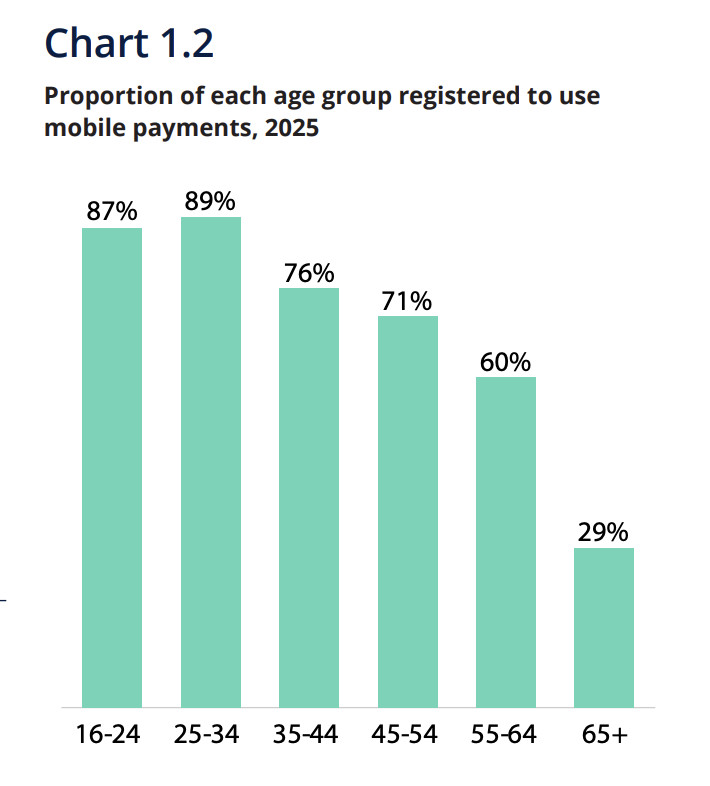
Registration was highest among younger consumers. UK Finance found 89% of 25- to 34-year-olds and 87% of 16- to 24-year-olds were registered for mobile payments, against 29% of those aged 65 and over.
Dr Yalini Pathy, UK CEO of Paysafe, tells Payment Expert the UK is catching up with the world’s leading digital wallet markets. “With 65% of adults now registered for a mobile payment service, the year-on-year growth is striking. But registration doesn’t yet equal everyday habit,” she said.

“We haven’t yet had the ‘contactless moment’ for digital wallets in the UK – where they become instinctive for everyone,” Pathy said. “
Adoption is growing fast but we haven’t reached the tipping point where reaching for your phone becomes second nature for every payment.” Payments are becoming more fragmented and consumers expect to pay by wallet, card, cash or another method, she added.
Buy Now Pay Later was used by 22% of adults, or 12.9 million people, in 2025. User numbers did not grow, but frequency rose: 42% of users made a BNPL payment monthly or more often, up from 33% in 2024. Use was highest among 25- to 34-year-olds, at 35%.
Elsewhere, Direct Debit rose 2% to 5 billion payments, while BACS Direct Credit fell 2% to 1.8 billion. Cheque volumes dropped 16% to 77 million, 0.2% of payments, and CHAPS processed 53.3 million payments worth £93.9 trillion.
UK Finance forecasts debit card payments will reach 29.5 billion by 2035, with card payments at 65% of the UK total and contactless at 26 billion, or 41%.