In the UK, payments rarely make headlines when they work. Salaries arrive on time, contactless terminals respond in seconds, Faster Payments clear almost instantly. It is only when something breaks – a major outage, a spike in fraud, a high-profile scam – that the underlying infrastructure becomes visible.
Yet the system is under constant pressure. Real-time rails have compressed settlement windows. Fraud has industrialised. New entrants are challenging incumbents on speed and user experience. And policymakers, through the Bank of England and HM Treasury’s Vision for Payments, are seeking a more coordinated, competitive, and resilient framework for the years ahead.
For large, systemic banks, this is an operational reality.
NatWest Group processes millions of transactions every day and plays a central role in the UK’s payments ecosystem. That responsibility carries weight, particularly in an environment defined by mandatory APP reimbursement, rising cyber risk, and increasing scrutiny of third-party dependencies.
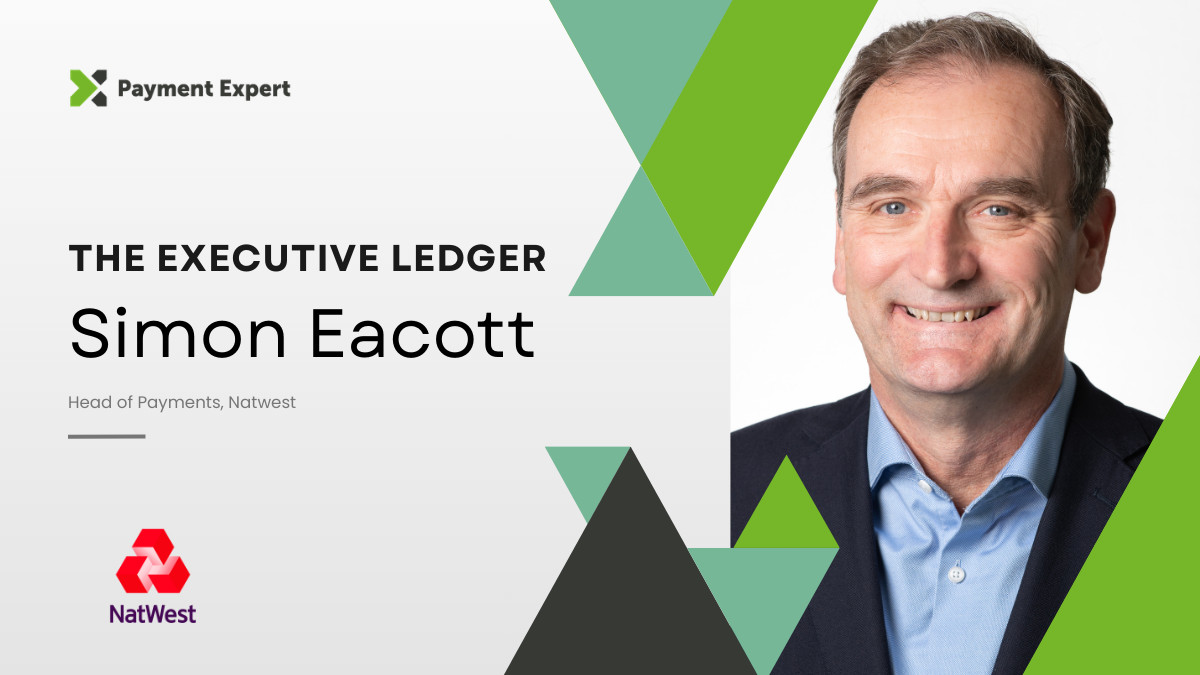
Simon Eacott, Head of Payments at NatWest, sits at the centre of those pressures. His remit spans core infrastructure, fraud strategy, open banking, and long-term modernisation. As part of Payment Expert‘s new Executive Ledger series, he discusses how NatWest is responding to regulatory reform, scaling real-time payments safely, and balancing innovation with the discipline required of a major UK payments provider.
Read the full interview below.
The Bank of England and HM Treasury’s Vision for Payments sets out a roadmap for a more competitive and innovative ecosystem. From NatWest’s perspective, what will that change in practical terms over the next three to five years?
The Bank of England and HM Treasury’s Vision provides a clear direction of travel: a payments ecosystem that is more open, competitive, and coordinated. For NatWest Group, the most tangible changes will be greater consistency in standards, better integration across systems, and a stronger alignment on security and resilience expectations.
These foundations will help deliver faster innovation for our customers while ensuring the UK’s payments infrastructure remains safe, reliable, and trusted.
As a systemic bank, NatWest carries significant responsibility for financial stability. How do you balance the pressure to innovate at pace with the need to protect core infrastructure that underpins millions of daily transactions?
Resilience is non-negotiable. Our approach allows us to innovate at pace while protecting the critical services that our millions of customers rely on every day. That means modernising in a controlled and modular way, supported by rigorous testing, strong risk oversight and phased delivery. As customer expectations continue to evolve, we remain committed to bringing new ideas to market responsibly – always with the discipline, governance and the assurance expected of a major UK payments provider.
Mandatory APP fraud reimbursement has shifted liability across the ecosystem. How has this altered NatWest’s fraud strategy, investment priorities and customer experience?
The new mandatory reimbursement requirements have reinforced the industry’s focus on prevention and early intervention. At NatWest Group, we continue to invest and innovate to protect our customers – including increased investment in real‑time analytics, behavioural monitoring, and safer customer journeys.
While the focus on reimbursement is important, we need to consider the complex nature of fraud too. We believe that no single sector can stop fraud on its own as it spans platforms, networks and borders. This is why collaboration across different industries is crucial in fighting fraud and we are working closely with wider industry partners to strengthen controls upstream.
Customers expect fast, fair, and consistent outcomes when fraud occurs, and we’re committed to collaboration and enhancing our detection capability to keep our customers safe and build trust in the digital economy.
There has been debate about unintended consequences, including moral hazard and displacement of fraud. What early operational lessons have emerged since the regime was introduced?
Fraud evolves quickly. We see criminals shifting between channels and targeting the weakest point in the journey. That makes data sharing, coordinated intelligence and strong cross industry collaboration more important than ever. We are focused on ensuring customers receive clear, timely information and that evidence gathering and decision making are as consistent and efficient as possible.
Faster Payments volumes continue to rise, alongside expectations of real-time, always-on services. What are the biggest technical and operational challenges in scaling instant payments safely?
The biggest challenges centre on delivering instant payments with the highest levels of resilience. That includes managing capacity and performance at peak volumes, ensuring cyber and fraud controls operate in real time, and maintaining availability across complex supply chains. As expectations for 24/7 services continue to rise, our priority is ensuring that speed is matched by reliability and security.
The future governance and access model for Faster Payments remains under review. What reforms would you support to ensure the system remains resilient while enabling greater competition?
Promoting competition while strengthening system-wide resilience is crucial. This includes clear accountability, proportionate but robust access requirements and consistent security and operational standards. A system that is open to competition must also be one where all participants meet high, shared expectations for security, reliability, and fraud prevention – leading to a commercially viable model with positive customer outcomes.
Competition from digital challengers and embedded finance providers continues to intensify. Where do you see the strongest competitive pressure in payments today?
We operate in an increasingly competitive space and we welcome this. Whether from digital challengers, embedded finance providers or large platforms, the bar for speed, transparency and personalisation has risen sharply. Many players are now focused on delivering seamless, embedded and data driven payment experiences.
At NatWest Group, our priority is delivering for our customers by combining these qualities with the trust, resilience and scale they expect from us.
Account-to-account models and open banking payments are often positioned as alternatives to card rails. How does NatWest view the long-term role of A2A in the UK payments mix?
We see account-to-account and open banking as an important and growing part of the UK payments mix, particularly as it can offer choice, lower cost and real time settlement. In our view, account-to-account is a strong complementary option alongside cards. In the short-term, cards will continue to play a major role given their global acceptance, strong consumer protections, and well-established merchant infrastructure.
Over time, we expect customers and merchants to adopt account-to-account more widely as it becomes as easy, safe, and reliable as existing payment options. Our award-winning open banking solution, PayIt, has been recognised as a leading example of how firms are using regulatory change to drive innovation and enhanced user experiences as we continue to meet evolving customer expectations.
Large banks are often described as operating on “legacy” systems. What does modernisation look like in practice for NatWest, and how do you approach transformation without compromising stability?
Modernisation is about simplifying and strengthening our technology so that change can happen safely, efficiently and at scale. From a payment perspective, that means reducing complexity, decoupling services through APIs, enhancing automation and improving the quality, accessibility and real-time nature of data. We take a phased and controlled approach to transformation to ensure we continue to deliver stability and resilience while modernising the core foundations of our architecture.
Being a bank is also not just about patching up legacy systems, we continuously invest and innovate to meet evolving customer expectations and actively collaborate with the wider industry to help shape the future of payments.
How are data, analytics and automation reshaping the way you manage risk, liquidity and settlement across payment flows?
Data and analytics are central to how we manage payment flows. Real time insights help us to identify emerging risks faster, forecast liquidity needs more accurately and streamline operational processes. Automation enables more efficient reconciliation, quicker incident response, and improved end-to-end visibility of exposures throughout the payments lifecycle.
Looking ahead, what do you see as the biggest structural risk to the UK payments ecosystem over the next five years?
The biggest structural risk is the combined effect of rising cyber and fraud threats and the growing interdependencies across critical third-party providers. As the ecosystem becomes more complex, the failure of a single component has the potential to create wider systemic impact. Continued investment in operational resilience, stronger cross-industry coordination and high, consistent international standards will be essential to mitigating risk.
Alongside this, the evolving role and regulation of digital currencies may also introduce new points of vulnerability that the system will need to manage carefully.
And finally, where do you believe systemic banks like NatWest can add the most value in shaping the next phase of the UK’s payments infrastructure?
Systemic banks bring deep experience in resilience engineering, large scale operations, and financial crime prevention. We play a key role in ensuring that new capabilities are delivered safely and consistently for millions of customers. Our priorities are helping to design standards that work in practice, contributing to industry-wide fraud disruption and supporting the development of infrastructure that is both innovative, competitive, resilient and secure.
The Executive Ledger is Payment Expert’s new leadership series spotlighting senior payment executives across the global banking sector. The series explores how systemic institutions are responding to regulatory reform, real-time infrastructure demands, fraud risk, and intensifying competition in the payments market.
If you are a senior payments leader within the banking industry and would like to take part, please contact Editor Rachael Kennedy at [email protected]