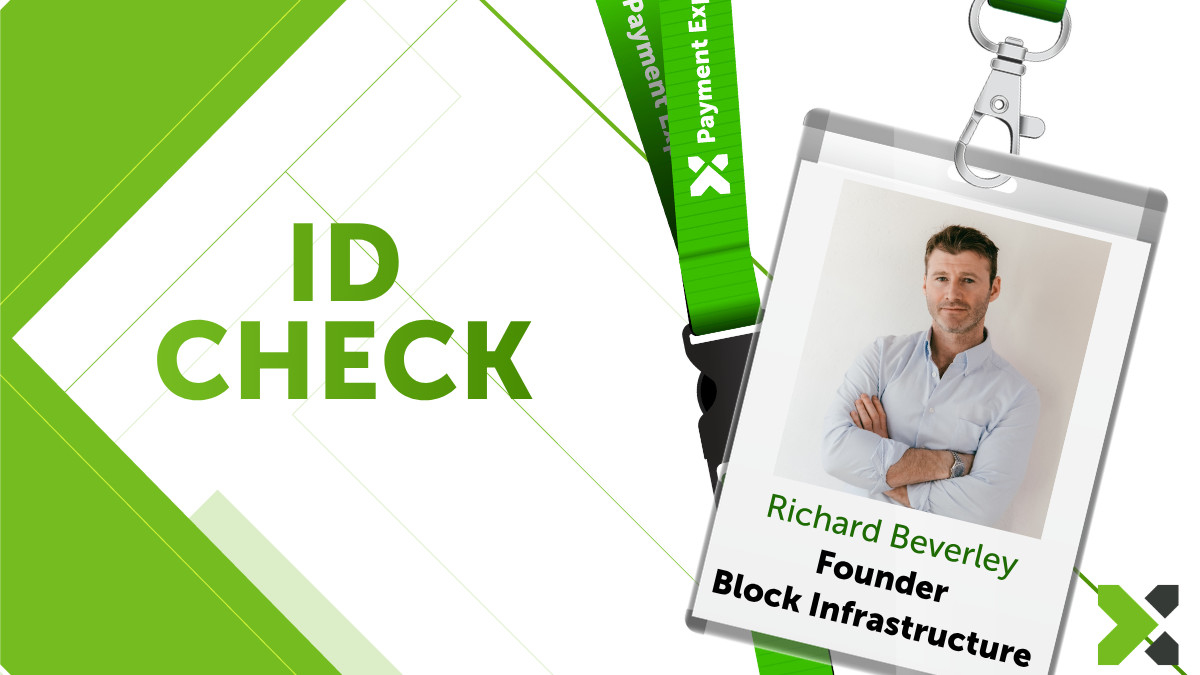
This week on ID Check: Payment Professionals, Richard Beverley, CEO of Block Infrastructure, journeys his career from Master’s graduate, to ClearBank, to becoming a founder of a startup in which he reveals the key lessons that keep on teaching him everyday.
Where did you go to university and what did you study? What impact did this have on your current journey?
I studied at Newcastle University, where I completed a Master’s degree in Chemistry over four years. If I’m honest, I realised quite early on that Chemistry wasn’t the career path I wanted to pursue. However, I knew it was a strong degree that would equip me with a broad range of transferable skills.
The greatest value I took from Chemistry was learning how to analyse and solve problems. It taught me to look at something that isn’t working, understand the root cause, and develop alternative approaches to achieve a better outcome. Those analytical and problem-solving skills have stayed with me since graduation and continue to underpin much of what I do in business today.
Chemistry also taught me the skills of communicating complex ideas and technical challenges effectively. One of the most important lessons I learned was that if you can’t explain how something works, or why it is flawed, in simple terms, then you probably don’t fully understand it yourself. That principle has remained with me throughout my career and is something I apply every day when discussing technology, strategy, and business problems with customers, partners, and investors.
What first drew you to the payments industry and why have you stayed?
After graduating, I was fairly certain that I wanted to build a career in financial services. My original ambition was to move into trading, but graduating into the middle of the global financial crisis wasn’t the ideal time to enter that market. As a result, I started my career in IT contracting, with the intention of moving into a different role later on.
What I didn’t expect was how quickly I would enjoy it. The freedom and flexibility that contracting provided early in my career were fantastic, but what I enjoyed most was the problem-solving aspect. I loved being presented with a challenge and working as part of a team to find a solution. I began in digital transformation before moving into KYC and compliance, and later into payments.
Throughout my career, the pattern was often the same: identify a problem, build a solution over a number of years, take it to market, and then move on to the next challenge. I found that incredibly rewarding.
After spending several years working with major banks, I joined ClearBank during a period of rapid growth and international expansion. There, I was responsible for building out the bank’s correspondent banking network. Through that experience, combined with my broader background in payments, it became increasingly clear to me that many of the inefficiencies within correspondent banking were not liquidity problems at all. They were technology, data, and compliance problems.
That realisation and idea ultimately led me to found Block Infrastructure. Traditional correspondent banking solves cross-border payments by deploying vast amounts of liquidity across the globe. While that approach has worked historically, it is increasingly unnecessary. Modern technology can solve many of the underlying challenges more efficiently, allowing trapped liquidity to be released and deployed more productively elsewhere.
Are there any lessons from your first role in the industry which you still draw on?
Absolutely. One of the biggest lessons I learned early in my career was that if you don’t know the answer to something, it’s your responsibility to go and find it. That might mean reading books, researching articles, speaking to subject matter experts, or simply asking more questions.
Nobody hands you all the answers at the start of your career, and some of the most valuable learning comes from being curious and taking ownership of your own development. What I found is that if you approach knowledgeable people with genuine interest and ask them to explain a problem or topic they understand, nine times out of ten they’re happy to help. Over time, you build your own expertise, and eventually you’re in a position to help the next person facing the same challenge.
That mindset of continuous learning, curiosity, and taking responsibility for finding solutions is something I’ve carried with me throughout my career and still rely on today.

When was your first big break in the industry? Why was this such a significant moment for you?
Looking back, my first real break in the industry was simply getting my first role in the City of London. That might sound like a modest answer, but for me it was a genuinely life-changing moment. I grew up in the North East, my mum was a hairdresser, and I lost my dad at a young age. Opportunities weren’t always obvious, and like many people, I wasn’t born into a world of finance or corporate connections. So when I landed my first role in the City, it felt like a huge achievement.
I still remember getting off the tube at Liverpool Street on my first day, walking out of the station, looking up at the skyscrapers around me, and thinking, “I’ve made it.” In many ways, I had. Up until that point, life had often felt uncertain, but that moment represented the beginning of a career, financial stability, and opportunities that I hadn’t previously imagined.
The reality, of course, was that the journey was only just beginning. The learning curve was incredibly steep. Coming straight from university into financial services and technology was like learning a new language. The industry seemed to run on endless acronyms and terminology that made everything sound far more complicated than it needed to be. Initially, it felt as though everyone around me knew something I didn’t. Over time, though, you begin to understand the fundamentals.
That first day in the City was significant because it opened the door to everything that followed. It was the start of a journey that eventually took me through digital banking, KYC, compliance, payments, correspondent banking, and ultimately to founding Block Infrastructure. Looking back now, it was the first step on a path that shaped both my career and my life.
Was there a moment you faced in the industry which really challenged you? How did you overcome this?
It may sound cliché, but starting a startup has been by far the most challenging experience of my career. When you first begin, it’s easy to believe that if you have a great idea, people will naturally be excited by it.
To succeed, you have to become incredibly resilient, persistent, and painfully stubborn. In the early stages, you’re not just the founder. You are effectively the marketing department, salesperson, product manager, finance team, strategist, recruiter, and sometimes even customer support. Every decision matters because the wrong choice today can create problems months or years down the line.
What makes it even more challenging is that you’re often doing all of this before the business generates a penny. In those early days, you’re largely running on caffeine and dreams, and the conviction that the problem you’re solving is worth solving. The way I overcame those challenges was by focusing on the long-term vision, surrounding myself with good people, and breaking seemingly impossible goals into smaller, achievable steps. If you hire people who make you stop and think, “They’re incredibly smart, I want to learn from them,” then I think you have a real chance.
Having spent much of my career in large financial institutions, I can also appreciate how different the experience is. In a corporate environment, your area of responsibility is often more defined, and the organisation provides structure, resources, and support. As a founder, there is nowhere to hide. You own every problem and every outcome. It’s incredibly challenging, but it’s also one of the most rewarding experiences I’ve ever had.
What are some of the skills you deem essential to starting in your industry and how have yours developed over the years?
Earlier in my career, I would have said that intelligence and the ability to solve problems were the most important skills. While those are still incredibly valuable, I’ve come to realise that communication is just as important.
Over the years, I’ve also learned that communication isn’t just about presenting ideas. It’s about listening, encouraging challenges, answering difficult questions, and being open to feedback. Sometimes that feedback reinforces your thinking, and sometimes it highlights a flaw or opportunity that requires you to adjust your approach. The key is being able to analyse the information, decide whether a change in direction is needed, and then communicate that decision clearly and confidently to everyone involved.
For me, strong analytical thinking and effective communication go hand in hand. The best leaders are often not those with all the answers, but those who can understand complex problems, bring people together around a shared vision, and guide a team towards the right solution.

Who was your biggest role model – inside or outside of your industry – who continues to inspire you in your current career?
The person who has probably had the greatest influence on me is Helen Mitchell. She was the person who gave me my first opportunity in the City and, in many ways, helped set my career in motion. Beyond that initial break, she’s always been someone I could turn to for advice and guidance whenever I’ve needed it.
What makes Helen so impressive is the breadth of her experience. She’s worked in large corporations, startups, and scale-ups, advised senior executives, built businesses, and helped countless people throughout her career. Her achievements speak for themselves, with recognition including the TechWomen 100, the Women in FinTech Powerlist, and Entrepreneur of the Year nominations, among many others. More importantly, she’s always been incredibly generous with her time and knowledge.
One moment that has always stayed with me came during my time at ClearBank. I remember sitting in a meeting with Charles McManus before the company had secured its major investment rounds and before the impressive offices that followed. At the time ClearBank were operating above an old McDonald’s, and Charles said something that has stuck with me ever since:
“Your job is to become as good as you can be at your job, so that every other payments business wants you. My job is to make you want to stay at ClearBank.”
I thought that was a remarkably confident and empowering way to lead a business. Rather than trying to retain people through obligation, the focus was on helping them become exceptional and then creating an environment where they wanted to stay. While I ultimately left ClearBank to pursue my own entrepreneurial journey, that philosophy has remained with me.
If you didn’t work in the industry, what other career option would you have pursued or would have loved to do?
100% a fighter pilot. My grandfather was a fighter pilot during World War II, and I’ve always been fascinated by aviation. In fact, before going to university, I explored joining the RAF with the ambition of becoming a pilot. Unfortunately, I was told that my hay fever would make me ineligible for a flying role, so that career path crashed and burned before it ever had a chance to begin.
I did briefly consider becoming an airline pilot, but if I’m honest, it was never commercial aviation that attracted me. It was the challenge, skill, and exhilaration of flying fast jets. I’ve always been drawn to speed and high-performance machines, which is probably why I spend much of my free time riding motorcycles. Looking back, if I hadn’t ended up in financial services and technology, I think aviation would have been an alternative career I would have pursued with the same passion and enthusiasm.
Lastly, what is some advice you would give to an aspiring person looking to get a start in your respective industry?
The obvious answer today is to learn how to use AI effectively. That’s where the market is heading, and if you can harness AI better than the person sitting next to you, you’ll put yourself in a strong position. This is especially important early in your career when you don’t yet have the domain expertise that comes from 10, 20, or 30 years of experience. AI can help accelerate your learning, broaden your knowledge, and increase your productivity.
My second piece of advice would be to stay curious. Ask questions, challenge assumptions, and work to understand exactly what is happening at the most fundamental level. It’s easy to learn processes and follow established ways of working, but the real value comes from understanding why things work the way they do. When you understand something at its core, you can identify weaknesses, inefficiencies, and opportunities for improvement.
That’s ultimately what led to the creation of Block Infrastructure. After years of working across compliance, payments, and correspondent banking, I began to see the fundamental inefficiencies in both how transactions are verified and how money moves around the world. It led me to continually ask a simple question: “Is there a better way to do this?” More often than not, the answer was yes.
So my advice would be: embrace AI, remain relentlessly curious, and always strive to understand the fundamentals. That’s where the best ideas usually come from.