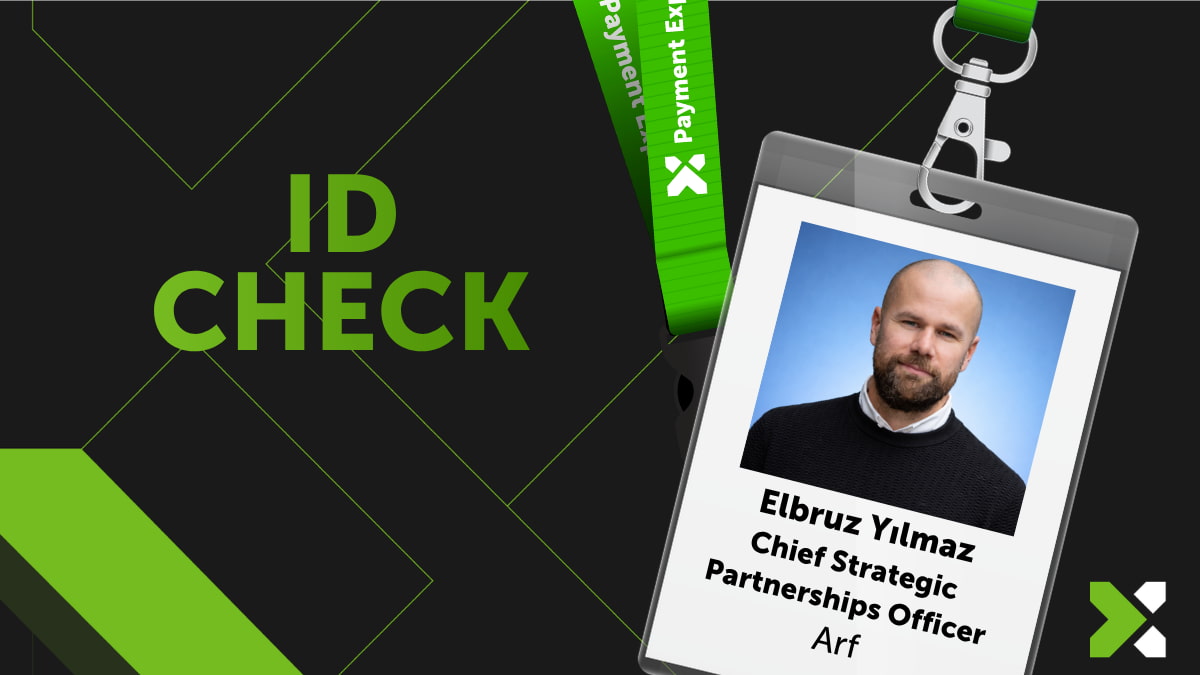
Payment Expert’s ID Check: Payments Professionals offers insight from industry leaders and experts on how they got their start in the financial industry, from their early years in education, to how they have been able to climb the corporate ladder.
This week, Elbruz Yılmaz, Chief Strategic Partnerships Officer at Arf, journeys his roles in payments, crypto and capital management, what sits at the intersection of all these elements, and why his father’s time in the Turkish army taught him the most valuable lesson to date.
Where did you go to university and what did you study? What impact did this have on your current journey?
I studied Economics at Ege University in Türkiye, then did an MBA at Pittsburg State University in the US. The MBA was the more formative part. I worked in the university’s tech commercialisation office, evaluating IP and startups spinning out of academic research, and learned firsthand what it takes to turn research into a real business.
From there I joined a seed fund, then an investment committee member pulled me into a startup he was building, a cash management platform for US retailers. We built it, exited it, and I went back to investing, this time as a fund manager with 3TS Capital Partners across the US, Türkiye, and Europe.
That exposure to fintech, and to crypto through a close friend, is what eventually pulled me into payments itself, first at Bitpanda, then Paysafe, and now at Arf. Looking back, every stop along the way, tech commercialisation, investing, operating, ended up feeding directly into how I think about payments infrastructure today.
What first drew you to the payments industry and why have you stayed?
At 3TS, I was exposed to a wide range of portfolio companies and, through them, their payment needs. As someone already curious about crypto, I wanted to understand how it could actually impact those businesses, not in theory, but in practice. That curiosity led me to the founders of Bitpanda, and after several years as an investor, sitting on boards, building and exiting businesses, I wanted to get back to operating. Joining them was the natural next step.
At Bitpanda, the structural problem became obvious: crypto businesses were locked out of large parts of the payment stack that traditional fintechs took for granted. Banking relationships were fragile, card networks were cautious, and regulation hadn’t caught up enough to support broader APM access. The bottleneck was access, not technology, and stablecoins made clear that blockchain was, in effect, built for moving money.
That understanding took me to Paysafe, leading crypto and then vertical growth, where I saw how differently payments behave across iGaming, gaming, and entertainment versus standard e-commerce.
All of that is why I’ve stayed, and why Arf is where it’s led me. Payments is as much a trust business as a technology one, and at Arf we’re solving the plumbing directly: liquidity and settlement infrastructure that lets payment companies move money the way it should have worked all along.
Are there any lessons from your first role in the industry which you still draw on?
The most enduring lesson is that technology only has value insofar as it solves a genuine problem. The strongest innovations are rarely built around the technology itself; they are built around removing friction and creating measurable value for the end customer.
I also learned early that payments is fundamentally a trust business. Reliability, relationships, and reputation compound over time, and there is little substitute for consistency.

When was your first big break in the industry? Why was this such a significant moment for you?
I wouldn’t point to a single breakthrough moment. It’s been a sequence of roles that built on each other: VC taught me how founders think, Bitpanda gave me direct exposure to digital asset infrastructure, and Paysafe deepened my understanding of high-volume payments across different verticals.
The significant moment was realising my role at Arf draws on all of that at once. It’s infrastructure that solves a real problem, built on blockchain, and it also brings me back to my asset management background: we raise capital from investors and extend credit to payment companies to expedite settlement.
In a way, everything I’ve done ends up represented in what we’re building.
Was there a moment you faced in the industry which really challenged you? How did you overcome this?
The crypto industry has been a demanding teacher, through both market cycles and regulation.
I experienced periods of extreme optimism and periods where confidence disappeared almost overnight. Those cycles taught me that markets change quickly, but fundamentals remain.
Regulation was its own version of that lesson. For years, banks and card networks treated crypto businesses as too risky to serve, often without a clear framework for evaluating that risk at all. That wasn’t malicious, it was rational under uncertainty: when regulation hasn’t caught up, the safest move for an incumbent is to say no. Waiting for clarity isn’t a strategy, because clarity arrives on its own timeline, usually slower than the technology does.
The companies that succeeded built compliant, bank-grade infrastructure early, before it was required, so that when regulation did catch up, they were already positioned to work within it rather than around it.
The way to navigate that kind of uncertainty, market or regulatory, is to focus on solving real problems. Technology trends come and go, but companies that create genuine utility will always win in the long run.
What are some of the skills you deem essential to starting in your industry and how have yours developed over the years?
Curiosity is probably the most important skill. Financial services change constantly, and the rules that govern them today won’t be the same in five years. The ability to keep learning, and to question assumptions you held even a year earlier, matters more than any specific expertise you start with.
Communication comes next. Payments sits at the intersection of technology, finance, regulation, and business, and each of those groups speaks a different language. A regulator, an engineer, and a commercial partner will each hear the same idea differently unless you translate it for them. Being able to do that, consistently, is what actually gets things built.
Finally, patience. Financial infrastructure takes time to build, partnerships take time to form, and trust takes time to earn. None of that can be compressed by moving faster. In my experience, the things worth building rarely are.

Who was your biggest role model, inside or outside of your industry, who continues to inspire you in your current career?
My father has been my most significant role model. He commanded a tank battalion during his career in the Turkish Army and retired as a Colonel. Active duty meant we moved constantly growing up, which was harder on me than it ever was on him. What he taught me, mostly by example, is that discipline equals freedom. The more structure and consistency you build into how you operate, the more freedom you actually have when things get hard. That’s stayed with me more than almost anything else.
From an intellectual standpoint, I have long admired Richard Feynman, for his curiosity and his commitment to genuinely understanding complex systems rather than accepting easy answers. He believed you didn’t really understand something until you could explain it simply. Between the two, discipline and curiosity, I’ve tried to carry both forward throughout my career.
If you didn’t work in the industry, what other career option would you have pursued?
Probably venture capital. I’ve never fully separated investing from operating, they’re the same instinct at different distances from the problem. Investing is pattern recognition: spotting a trend or a founder early, before the rest of the market agrees with you. Operating is testing whether that pattern actually holds once you’re the one responsible for building it.
Judgment compounds faster than capital does. That’s really what both are training for. Whether you’re investing in companies or building them, you’re ultimately trying to understand the future before it arrives.
Lastly, what is some advice you would give to an aspiring person looking to get a start in your respective industry?
Learn how a payment actually moves before you learn anything else. Sit with the flow of funds, end to end: where the money starts, who touches it, where it settles, and where the risk sits at each step. Most people in this industry never do that, and it shows.
Go work somewhere with real operational exposure early, even if it’s not glamorous. Reconciliation, compliance, banking relationships, this is where you learn what actually breaks and why. It’s a better education than any strategy role.
Get close to regulation instead of avoiding it. Read the actual rules, not just summaries of them. Understanding regulatory intent, not just the letter of it, will save you years later when you’re building something new.
Interested in sharing your experiences from the industry and passing on advice to the next-generation for ID Check? Contact: [email protected]