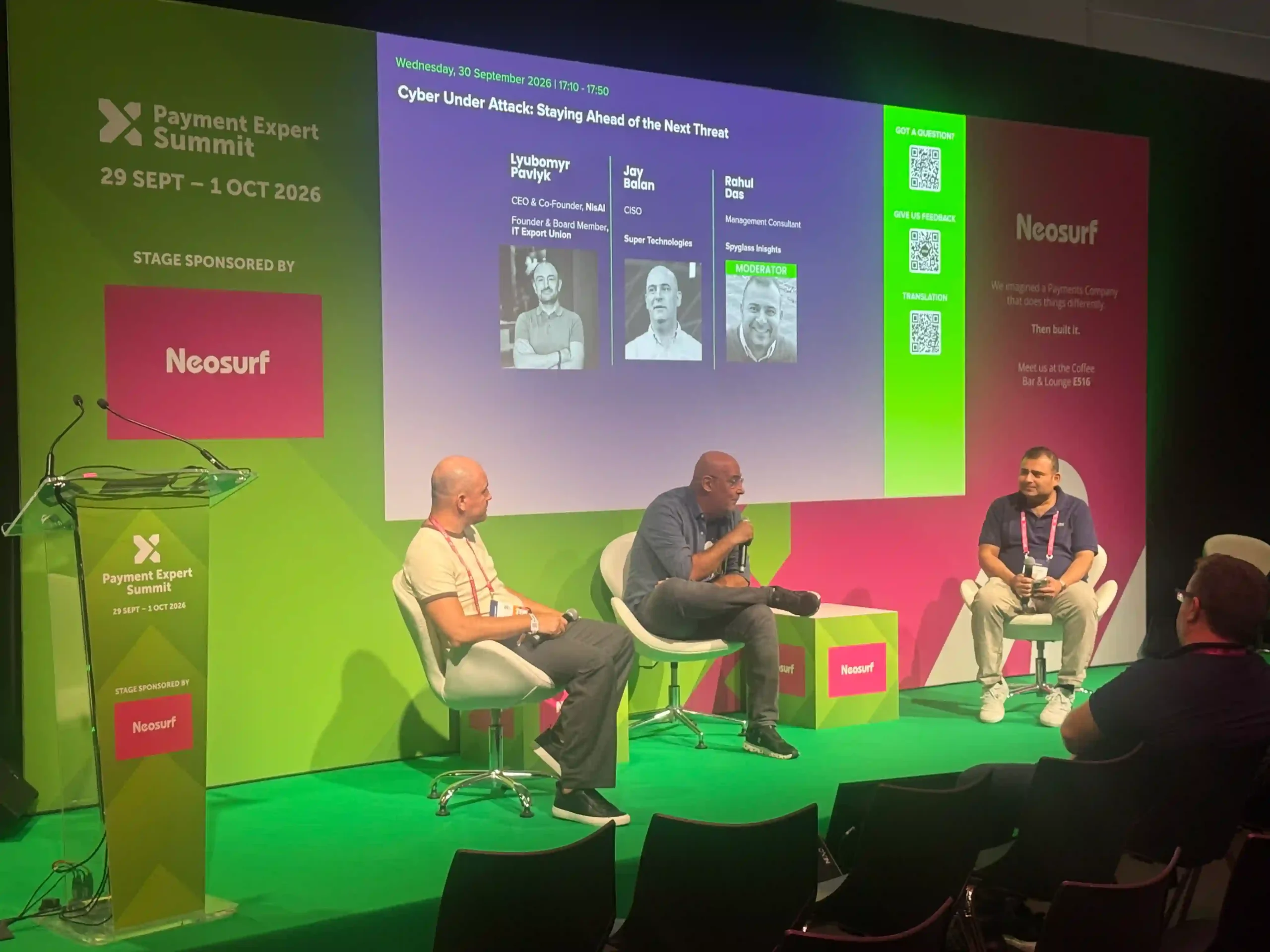
During a panel discussion at the Payment Expert Summit – part of SBC Summit 2026 in Lisbon – a conversation broke out around the importance of data in building resilient payment infrastructure, which hinges on how much data is being used, what it is being used for and how AI is now automating manual data processing.
The importance of data
Data continues to become an integral part of the payment processing journey, helping operators understand a customer’s preferences and favoured payment methods.

This is particularly important for gaming operators, who more often than not will obtain a customer’s payment data through third-party providers, relying on APIs and backend settlement reports to ensure they have the infrastructure to support multiple customer needs for a smooth user experience.
But data collection and requests can also be quite burdensome for customers, and from Maksym Gaidaienko’s perspective, operators “are asking too much from the user”, which could ultimately lead them to drop the operator altogether.
Gaidaienko, Head of Payments at Sharkscode, told the Payment Expert Summit audience he believes that operators “should have as much data as possible”, but not just to idly collect it, but to understand the route of some transaction friction that may be affecting the customer experience.
“You need to collect as much (data) as possible about the routes and providers to understand exactly where the problem is with what you can work with,” said Gaidaienko.
“You need to dive deeper into providers, every channel, route to understand why it is performing worse.
“So data here is the main point to work with payments. Without data, you are like a blind man.”
The balancing act of data analysis

Sean Spiteri, Head of Payments at Prime Entertainment Group, acknowledged, however, that too much data can often be “nothing but noise”.
He believes that while having a lot of payment, conversion, approval ratio, etc., data is not necessarily a negative, Spiteri said data should be compartmentalised into specific sections in order for an operator to gain the best payment service provider partner.
“If you look at every single data point that you have, it’s nothing but noise,” said Spiteri
“You’re trying to make spurious correlations, when in reality, you don’t truly understand what the question really is.
“Finding the right balance is interrogating the right data points. You’re looking at things at a deeper level.”
Spiteri wants more operators to find gaps in data and achieve the best possible outcome for a payment service.
AI’s role on the payment data journey
AI’s impact on almost every industry cannot be overstated, and in payments this is no different.
Daniel Holden, General Manager, UK and Ireland, at Bridgerpay, reiterated a sentiment from the industry 10 years ago, when some believed payment methods would go extinct and act as a utility for consumers.
But the sophistication of AI has enabled gaming operators and payment processors to adopt smarter data, which, in Holden’s view, is “disintermediating” players as AI models become more efficient at identifying player behaviours.
AI is also boosting efficiency for the payment processors and orchestrators. Holden revealed Bridgerpay’s AI model, Kanji, is utilising natural language searching for what is the best optimised routing for each particular transaction an operator or consumer is querying.
“That is what operators are demanding,” said Holden.
“They do not want just plug-and-play in specific methods anymore, and that is going to accelerate.
“The cashier is becoming less of a valuable asset, because the AI and agentic solutions are skipping that process and if it can enable the operator to have an amazing conversion for their players, that is ultimately what they want to do.”