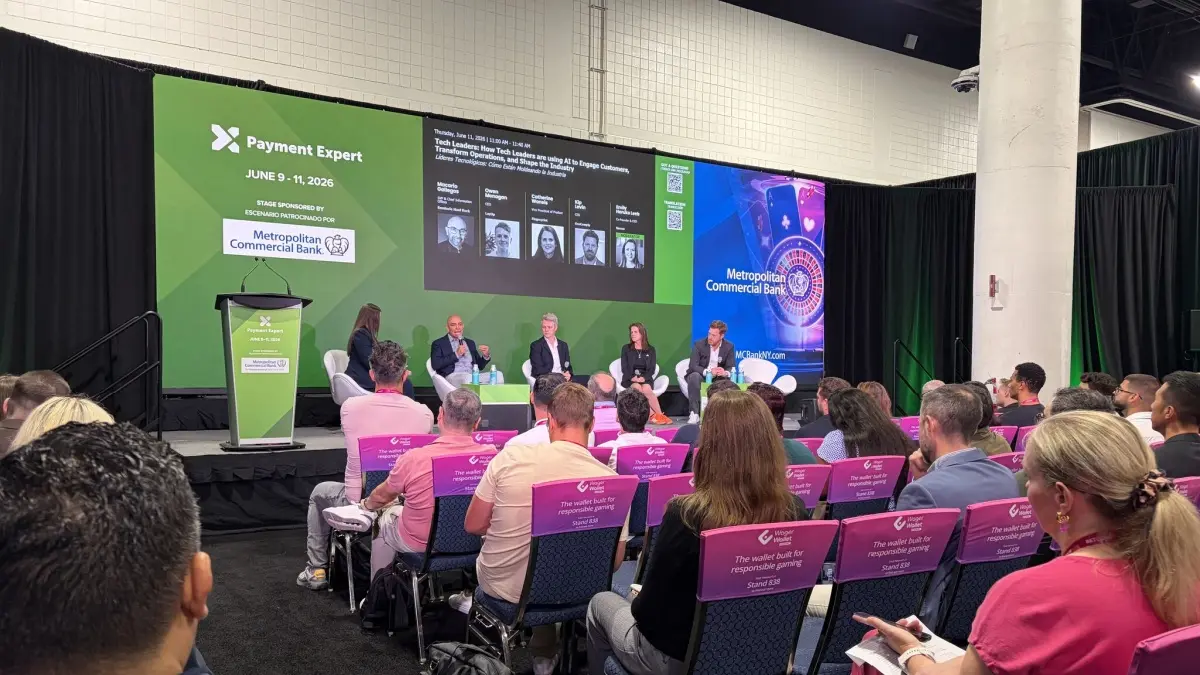
AI‑driven attacks are intensifying across gambling payment flows, speakers said at the Payment Expert Summit at SBC Americas.
Kip Levin, CEO of GeoComply, told the audience that organised groups are using AI to accelerate attacks on regulated betting platforms, creating new pressures around deposits and withdrawals.
“We see a huge ramp up in sophistication around how entities are attacking the industry in the US,” he said, noting that GeoComply now processes “anywhere between two and three billion location checks every month.”

Levin said operators are being forced to rethink how they manage risk at account creation and throughout the movement of funds.
“Ten years ago, it was okay to let somebody come in the front door, deposit money with stolen identities… you just had to stop them before they got to the withdrawal,” he explained. “AI has accelerated the whole path of getting bad users and actors into the system.”
When discussing how sophisticated these attacks have become, Catherine Woneis, VP of Product at Fingerprint, said device spoofing and anti‑detect tools are now central to how fraudsters bypass controls on betting platforms.
She noted that attackers use single devices to imitate multiple users, manipulate browser signals or mask their location to evade state‑level restrictions.
“Is this device trying to pretend to be multiple different people? Are they using an anti‑detect browser? Are they tampering with their browser signals?” she asked, adding that operators must be able to detect these behaviours before funds move.
Compliance, data and the infrastructure gap
Like many sectors, payments is intertwined with tech, meaning that as soon as new innovations are introduced, the industry is quick to use them to its advantage. However, bad actors always seem one step ahead.
This is soon to be a reality, if not already, when it comes to agentic payments. What is set to bring a whole new meaning to speed and convenience is likely to be a headache for fraud teams because they are bound by regulations and data‑sharing rules that fraudsters can ignore.
Macario Gallegos, SVP and Chief Information Officer at Seminole Hard Rock, said many of the systems underpinning gambling operations have been running for decades, making it difficult to simply bolt AI onto existing infrastructure and expect meaningful results.

“AI won’t fix a bad data problem. It will actually make it worse faster,” he warned, arguing that operators need platforms that modernise their systems before they can extract real value from AI.
He stressed that operators are held back by fragmented systems and slow information flows, creating delays in decision‑making across payments, onboarding and responsible gambling checks.
State‑level rules continue to change, but many compliance teams are still working with legacy technology that struggles to keep pace. The risk, Gallegos suggested, is that fraudsters move faster than the infrastructure to stop them.
The cost conflict
While legacy systems are holding parts of the industry back from responding to fraud, Levin stressed that operators still need to invest in automation and predictive models to keep pace with the speed of attacks.
He emphasised that the need has become more urgent as the rise in sophistication coincides with headcount reductions, widening the gap between the scale of attacks and the resources available to stop them.
“When I was running FanDuel, we had a huge team of analysts who spent all day looking at data to work out whether someone was a bad actor,” Levin said. “Now everyone’s pulling back on headcount, and at the same time the attacks are getting more sophisticated.”
Those same investments in automation, however, are also driving some of the reductions.
Gambling.com Group recently cut around 25% of its workforce while transitioning to what executives described as an “AI‑first operating model”, with the technology now generating roughly 80% of its new engineering code.
Levin said it leaves operators in a conflict where they must save money to improve their defences, yet still need the team and expertise to oversee those defences.