Breeden trails a near-term consultation to hard-wire payments-grade stablecoins, move tokenised markets into supervised trading, and manage transition risks.
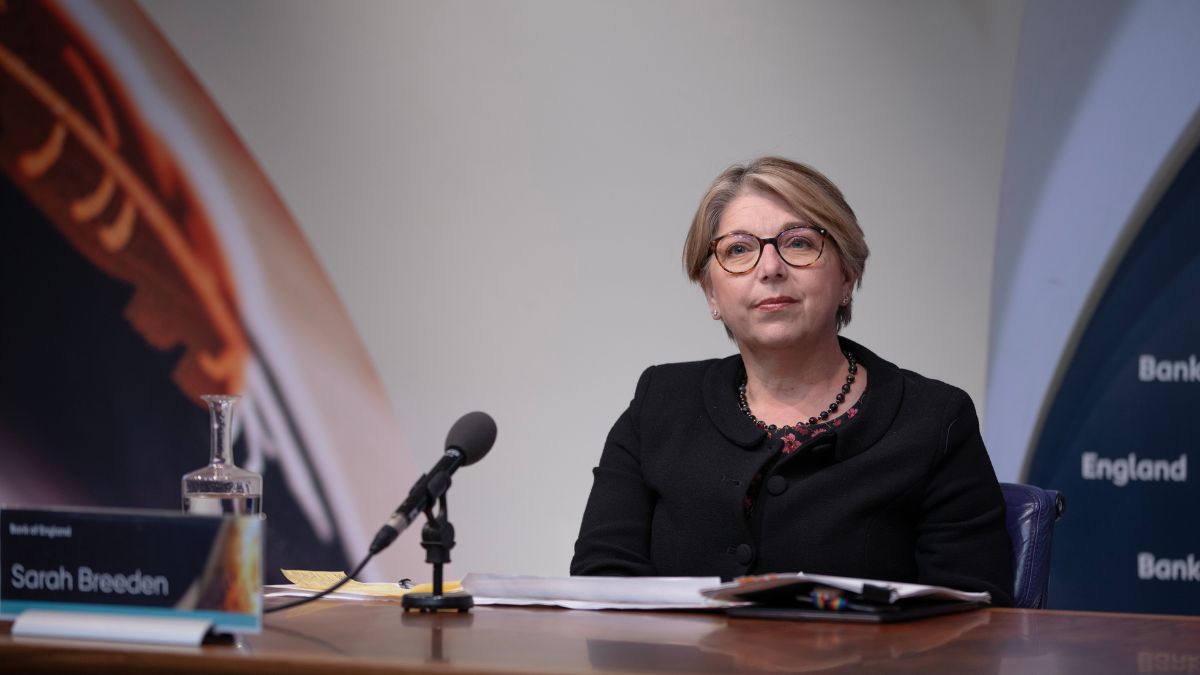
The Bank of England will next set out detailed proposals for regulating sterling stablecoins used in “real-world” payments, with Deputy Governor Sarah Breeden signalling plans for the central bank to offer accounts to systemic issuers and to let part of their reserves earn a return in short-term gilts, alongside a potential liquidity backstop.
Speaking at DC Fintech Week 2025 on October 15, Breeden said the consultation will be published in the coming weeks, with final rules targeted next year. The approach is designed to hard-wire at-par convertibility between different forms of money in the UK’s “multi-money” system.
“We would provide accounts at the Bank of England for systemic stablecoin issuers,” she said, adding that the Bank will “allow a proportion of [backing assets] to be invested in short-term UK government debt,” and is “considering… a liquidity facility to… support meeting redemption requests.” These measures are proposals to be consulted on rather than settled policy.
Breeden emphasised the Bank’s objective that regulated stablecoins used for payments must operate at the same robustness as commercial bank money and cash. The aim, she said, is that “a pound issued by a regulated stablecoin issuer is worth the same as a pound issued by a commercial bank and a banknote issued by the Bank of England.”
To manage risks during any rapid shift of deposits into stablecoins, the Bank will consult on temporary holding limits to protect credit transmission while the system adjusts. The speech referenced previously signalled ranges “in the region of £10–20k for individuals and £10mn for businesses,” with possible exceptions for the largest corporates. The Bank stressed these would be transitional tools, removed once risks subside.
Rolling out the pilots
Alongside the stablecoin regime, the Bank is moving tokenisation from pilots to supervised markets. Fifteen firms, including established infrastructures and new entrants, are preparing to launch trading and settlement venues inside the Digital Securities Sandbox across equities, bonds and funds.
“These won’t merely be prototypes or experiments; they will be real-world transactions,” Breeden said. The sandbox will run with issuance caps for up to five years while a permanent framework is developed.
On market plumbing, Breeden said the Bank’s new wholesale core, RT2, already supports key building blocks. “Omnibus account functionality is live,” she noted, adding that a Synchronisation Lab will open for real-world use-case testing, with a call for participants issued this week.
The UK push is tied to international work on interoperability to avoid fragmented liquidity. Breeden highlighted the Bank’s participation in the Monetary Authority of Singapore’s Global Layer 1 standards effort, interest from US authorities in the UK sandbox, and the new UK–US Transatlantic Taskforce on tokenised markets.
Breeden closed by urging firms to engage as the policy and infrastructure pieces come together. “The tools are there for industry to use,” she said. “I encourage you all to bring your creativity to bear in developing innovative use cases with them.”