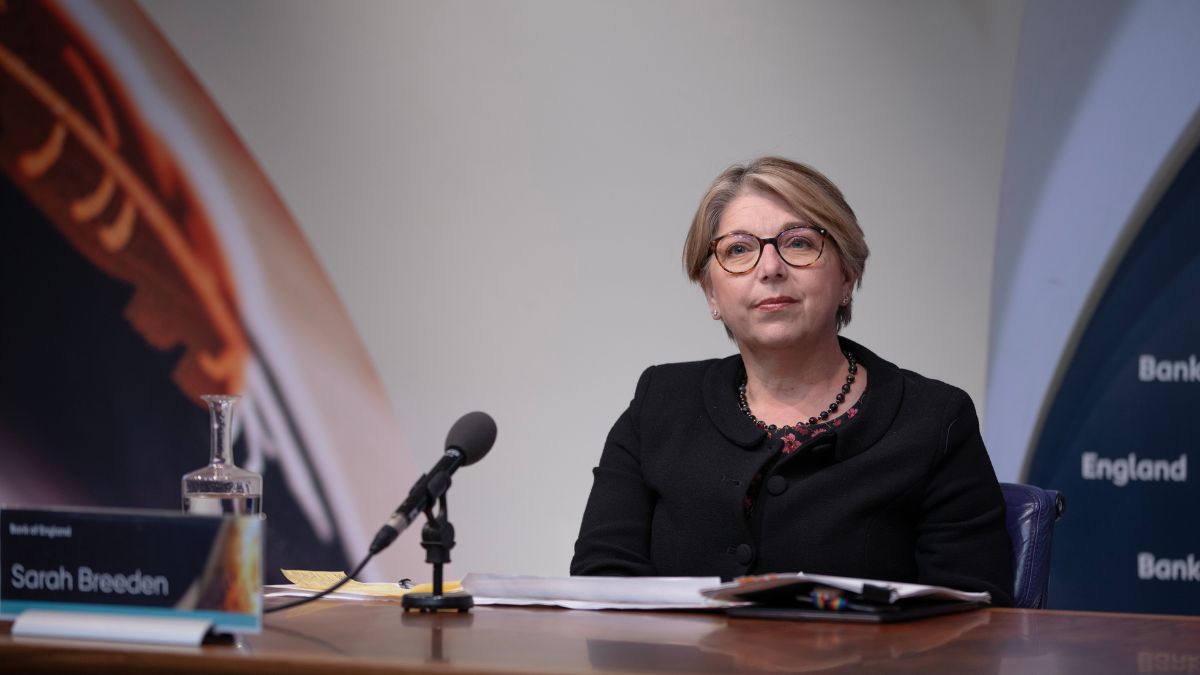
The Bank of England has signalled it may soften key parts of its proposed stablecoin framework, as officials reconsider controversial holding limits and reserve requirements following months of industry criticism.
The Bank of England has indicated it may revise parts of its proposed stablecoin framework after months of criticism from crypto firms, academics, and lawmakers who warned the rules risked undermining the viability of sterling-denominated stablecoins.
In comments reported by the Financial Times and Reuters, Sarah Breeden, Deputy Governor for Financial Stability at the Bank of England, said policymakers were “looking very hard” at alternative approaches to some of the regime’s most contentious measures.
The remarks mark the clearest indication yet that the Bank may soften elements of its proposed prudential framework for systemic sterling stablecoins, particularly around holding caps and reserve composition requirements.
The debate has become one of the most closely watched digital asset policy discussions in the UK, as regulators attempt to balance financial stability concerns with ambitions to position Britain as a competitive hub for digital finance.
From consultation to reconsideration
The BoE first outlined its proposed regime for systemic stablecoins in November 2025, including temporary holding limits of £20,000 per individual coin holder and £10m for businesses.
Under the framework, issuers would also be required to hold at least 40% of backing assets in unremunerated deposits at the Bank of England, with the remaining 60% held in short-term UK government debt.
At the time, the BoE argued the measures were necessary to limit the risk of sudden deposit flight from commercial banks into stablecoins during periods of financial stress. However, the proposals quickly drew criticism across the digital asset sector, with opponents arguing the rules would make sterling stablecoins commercially unattractive and difficult to scale internationally.
The issue of holding limits became particularly contentious during a House of Lords Financial Services Regulation Committee hearing earlier this year, when academics questioned whether regulators were overcorrecting for hypothetical systemic risks.
Simon Gleeson, Visiting Professor at the University of Oxford and former Clifford Chance partner, described the proposed limits as “absolutely bonkers”.
In March, Breeden already hinted the Bank was willing to reconsider aspects of the framework, telling the same committee regulators were “genuinely open to other ways of achieving the objective”. The latest comments suggest that consultation feedback may now be feeding directly into the final shape of the regime.
Industry argues UK must avoid overcorrection
The BoE’s proposals arrived as jurisdictions globally continue to take diverging approaches to stablecoin oversight.
The European Union’s Markets in Crypto-Assets Regulation (MiCA) framework has already introduced restrictions on certain stablecoin activities, while lawmakers in the US continue debating federal stablecoin legislation through proposals such as the GENIUS Act.
For some in the industry, the UK’s original proposals risked placing sterling stablecoins at a competitive disadvantage before the market had fully developed.
Carl Grimstad, Chief Executive Officer and Co-Founder of Lydian, argued the Bank’s latest signals represented a broader acknowledgement that stablecoins are increasingly becoming part of mainstream financial infrastructure.
“Regulators have spent years in a defensive crouch when it comes to stablecoins,” Grimstad said.
“But the Bank of England’s move to rethink those holding limits is a true reality check. It’s the first real admission we’ve seen that the old closed-loop financial model is effectively dead.”
Grimstad also suggested the debate should move beyond framing stablecoins as competitors to banks.
“In truth, the crypto vs banks debate has become a distraction,” he said.
“We’re already living in a multi-ledger world. While traditional institutions are still stuck in the sandbox testing tokenised deposits for back-end efficiency, the $4 trillion digital asset market is out here moving real money on public chains every day.”
He added that strict limits had reflected regulatory concerns around visibility and systemic oversight rather than the underlying technology itself.
“The bottleneck was never the asset,” Grimstad said. “It was the capacity of the rails.”
Stability concerns remain central to BoE approach
Despite the softer rhetoric, the Bank of England has not indicated it plans to abandon its broader financial stability concerns around stablecoins. Officials have consistently argued that widespread adoption of privately issued digital money could weaken traditional bank funding models if consumers rapidly moved deposits away from banks during periods of market stress.
During March’s committee hearing, Breeden warned banks currently provide around 85% of household credit in Britain and rely heavily on customer deposits to fund lending activity.
“If that funding is not replaced in banks, we are in danger of seeing a precipitous drop in credit,” she told lawmakers at the time.
The BoE has also repeatedly stressed that its systemic regime is designed for a future payments environment where programmable and tokenised forms of money become significantly more embedded within the wider economy.
What remains unclear is how far the Bank is willing to move from its original proposals, and whether revised rules would materially alter the economics of issuing a sterling stablecoin in the UK.