The FSB has asked governments for national action plans after finding that the remaining barriers sit in domestic data, licensing and fraud rules
Retail cross-border payments became slower over the past year and their cost has not fallen since 2023, the UK’s Financial Stability Board (FSB) said, a year before the G20’s end-2027 targets fall due.
The share of retail payment services which credit recipients within one business day fell to 59.8% in 2026, from 67.3% in 2025 and 74% in 2023, according to the FSB’s annual progress report on the G20 Roadmap for Enhancing Cross-border Payments, published on 16 November.
The G20 target is for 75% of retail payments to arrive within one hour, and the current share by the FSB’s measurement is only 32.9%. The FSB measures retail speed from the information providers publish before a payment is sent, not from completed transactions.
These measurements found average retail costs range from 1.5% for business-to-business payments to 2.7% for person-to-person payments, which is unchanged since 2023 but still above the G20 target of 1%. The share of payment corridors costing more than 3% fell to 15.1% from 18.3% a year earlier, but the FSB said the fall was too small to lower the global averages.
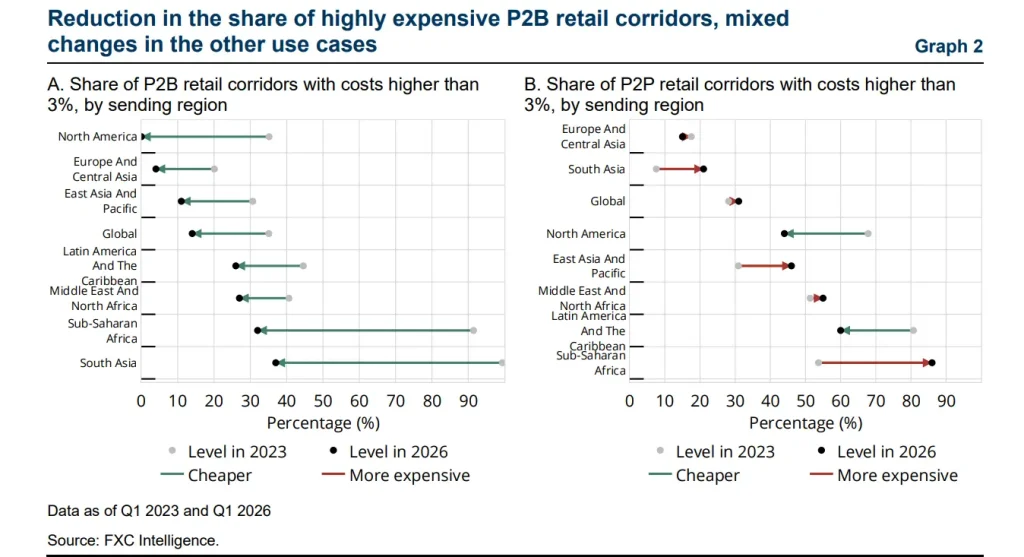
The average cost of sending a $200 remittance fell to 5.7% from 6.5% in 2025, but the FSB added almost all of the decline since 2023 came from adjusting the local-currency equivalents of its $200 and $500 benchmarks in seven countries for exchange rate movements. Without this adjustment, the cost would have been 6.2%, compared with 6.3% in 2023.
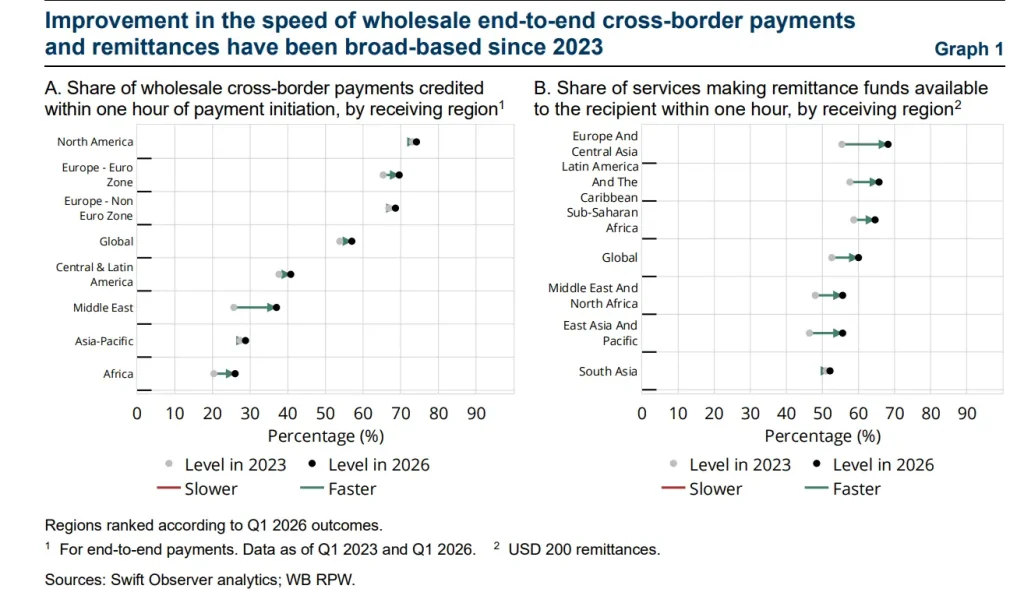
More promisingly, on the Swift network, 57% of wholesale cross-border payments were credited within one hour in 2026, up from 53.8% in 2023.
The FSB said the gain came from faster crediting by receiving banks, and Swift linked it partly to better data quality after the industry’s migration to ISO 20022 messaging in November 2025.
Swift had set a deadline to phase-out unstructured postal addresses in those messages but recently postponed this deadline has postponed the phase-out of unstructured postal addresses in those messages at industry request, saying progress towards structured messaging was “slower than expected”.
The FSB said the international policy work under the roadmap was largely complete but had “not yet translated into the desired level of measurable improvements” for end users. It echoes the sentiment from its 2025 report, which predicted the 2027 cross-border payments targets were unlikely to be met on time.
The organisation believes further progress depends on action by individual jurisdictions, and its survey of national authorities found gaps in their data, licensing and fraud rules.
FSB report finds gaps in national rules
In fact, the share of jurisdictions restricting where payments data can be held rose over the year, with 48% of respondents to the FSB’s survey with the Committee on Payments and Market Infrastructures reporting data localisation policies, up from 31% in 2025.
Eight of them had no legal route for moving payments data abroad, and only three jurisdictions plan to create a mechanism for privacy-protected cross-border data transfers by end-2028.
A third of responding jurisdictions had not issued or updated regulatory expectations for payment service providers since 2020, and 57% had not carried out risk assessments covering both bank and non-bank providers.
The FSB said some licensing regimes were set up many years ago, have not been updated and therefore do not reflect current risks.
Jurisdictions did not make much progress in 2026 on sharing fraud data across borders either. The FSB said differing privacy rules slow or discourage sharing between banks, telecoms companies and social media platforms, and suggested legal safe harbours for specific uses. The Financial Action Task Force (FATF) has made fraud a priority under its UK presidency for 2026 to 2028.
Following the report’s release, the FSB has asked jurisdictions to set out the steps they will take through end-2027 in national action plans, and almost all G20 members have said they will produce one.
Its Standing Committee on Standards Implementation will also review in 2027 how FSB members have applied its 2024 recommendations on regulating payment service providers and on data frameworks.