
Swift’s ISO 20022 delay leads to questions about industry readiness and what banks should do next.
Swift has delayed ISO 20022 payments changes due in November 2026 in reaction to industry concerns over readiness.
The payments network said progress towards structured addresses has been slower than expected, with “large parts of the industry across all regions” unable to meet the requirement.
Under the original timetable, financial institutions and corporate clients would have been required to stop using unstructured postal addresses in ISO 20022 payment messages from November as part of Standards Release 2026.
Swift will now defer all payments changes included in the release while it consults banks, central banks, payment market infrastructures, market practice groups and corporates on a revised timetable.
The network hasn’t set a new deadline yet, with an update on the structured address requirement expected by December at the latest.
More than 98% of payment instructions are sent using ISO 20022, according to Swift, following the transition from the MT standard last year.
Bank of England follows
The Bank of England confirmed it would also delay its November 2026 RTGS standards release soon after Swift announced the extension. The release, which includes messaging standards for CHAPS payments, will be deferred entirely.
A statement by the Bank of England read: “Maintaining global alignment is important to preserving interoperability and to avoid the introduction of new implementation risks”, adding that it had worked with Swift and other major market infrastructures on a coordinated approach.
It also said attempting to separate individual changes at this stage could create additional challenges for the Bank of England and the wider industry.
“We will continue to engage with Swift, other market infrastructures, and RTGS participants directly on next steps, while also providing broader updates at ISO 20022: Implementing the global payments messaging standard within CHAPS and RTGS to support organisations in amending their own planning as further detail on revised timelines becomes available,” the statement concluded.

Was the extension predictable?
Research published by RedCompass Labs in March found 44% of banks were not on track to meet the structured address deadline despite significant investment in ISO 20022 programmes.
The research, which surveyed 308 senior payments professionals across Europe and North America, found that an average of 32% of customer address records were unstructured.
At the same time, 60% of institutions reported gaps in core banking systems needed to support structured address fields.
Larger banks appeared to face particular challenges, with one in five institutions with more than $250bn in assets describing the November structured address deadline as unrealistic, compared with 5% of smaller banks.
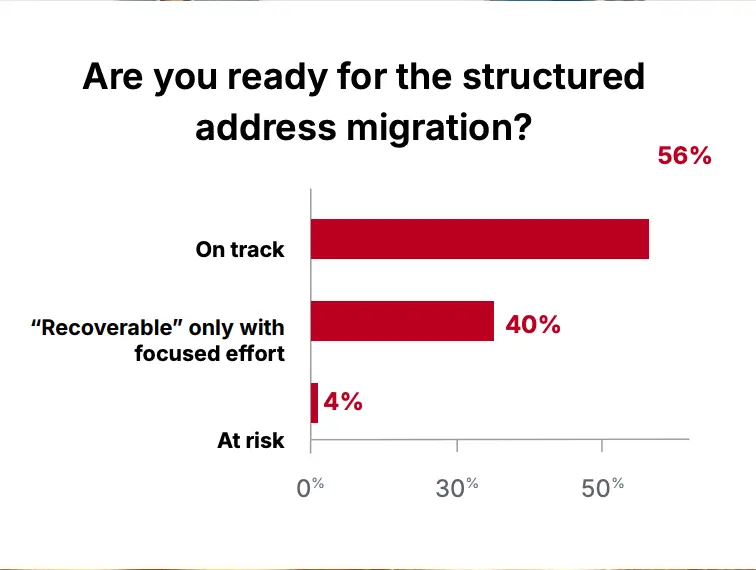
for November 2026?’ report
Banks haven’t been sitting still, however. Institutions have invested a lot of time and funds in preparation, spending around $20m on average, with larger institutions committing more than $30m.
Pratiksha Pathak, Head of Payments at RedCompass Labs, said Swift’s decision confirmed concerns that were voiced earlier in the year.
“Swift’s decision not to proceed with the entire Standards Release 2026 as planned, not just the unstructured address requirement, shows how much of a mountain this migration is,” she tells Payment Expert.
Showing how much work is still to be done, Pathak adds that Swift data from April showed around 61% of payments still used unstructured address data.
Banks warned not to ease ISO 20022 preparations
Despite the extension, Pathak warns financial institutions against treating the revised timeline as an opportunity to slow down.
Due to structured and hybrid address formats supported under Standards Release 2025, banks can continue migrating before a new mandatory deadline is announced.
“Yes, there is more breathing room,” Pathak said. “Banks should use that time to close data gaps and address limitations in legacy systems. But they should not stop.”
Swift has also encouraged domestic payment market infrastructures and financial institutions to continue adopting structured addresses despite the extension.
“Financial institutions that have made upgrades to meet the requirement can already gain benefits, because structured addresses can today flow seamlessly across the Swift network,” said Swift.
“In that context, Swift strongly encourages domestic payment market infrastructures and financial institutions to continue pressing ahead, because domestic adoption of structured addresses is a critical enabler of cross-border progress.”