WORPT hands tourists the keys to Thailand’s QR payment network, allowing them to convert stablecoins into Thai Baht.
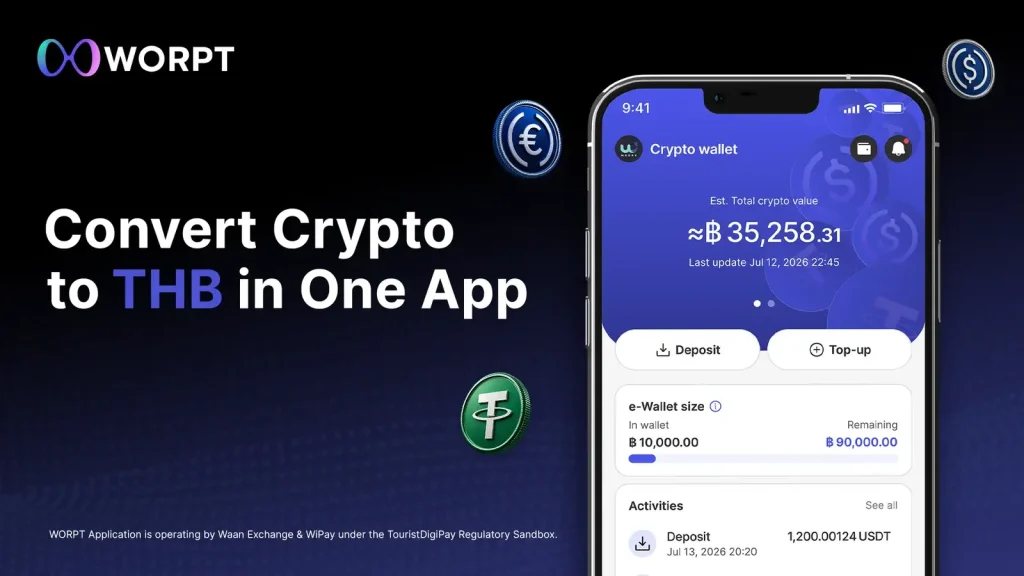
Thailand has launched WORPT, an app that tourists can use to convert crypto into baht and spend via PromptPay QR codes and prepaid cards.

WORPT, developed by Waan Exchange (Waanx) and e-money provider Wipay, looks to be the country’s latest initiative to encourage tourism and increase spending at local merchants.
Pavin Jittiwongsamarn, Co-founder of WORPT, said it enables international visitors to use the cryptocurrencies they own while visiting Thailand.
“We have therefore focused on connecting the entire process, from converting digital assets into Thai Baht to making payments for goods and services, providing travellers with greater convenience and more payment options throughout their journey,” said Jittiwongsamarn.
The initiative works by allowing tourists to deposit supported stablecoins, currently USDT and USDC, convert them into baht and make payments by scanning PromptPay QR codes or a prepaid Visa card.
Merchants will never come into contact with crypto because they receive payments in baht through existing payment rails.
According to the WORP website, physical Visa prepaid cards launch on 28 November 2026, followed by virtual cards in early 2027. These link to the app’s existing wallet, allowing tourists to use either QR or card whenever they please.
Didn’t Thailand ban crypto payments in 2022?
In 2022, Thailand’s Securities and Exchange Commission (SEC) introduced rules banning crypto firms from supporting or promoting digital assets as a payment method.
However, WORPT doesn’t fall under this because it operates under the SEC’s Tourist DigiPay sandbox, an 18-month initiative to test converting digital assets into baht for foreign tourists to spend.
Merchants never accept cryptocurrency directly because WORPT converts a user’s digital assets into baht and loads the funds onto a Wipay e-money balance regulated by the Bank of Thailand, ensuring all retail transactions are in fiat currency.
In order to use the app, foreign visitors must complete in-app identity verification by submitting their passport, personal and travel details and completing a facial recognition scan.
Spend like a local using Visa and PromptPay
Thailand’s payments landscape, like many countries in the region, is run on QR code transactions. Citizens using digital money scan standardised QR codes at checkout to transfer funds between bank accounts or e-wallets.
Launched in 2016, PromptPay is Thailand’s national real-time payment infrastructure, which boasts a QR network estimated to cover more than 6 million merchants.
If QR codes aren’t supported, tourists can use WORPT’s physical and virtual Visa cards. These cards will be accepted wherever Visa is supported across the country.
The initiative could also reduce the amount of visitors using cash, helping them avoid poor exchange rates and ATM withdrawal fees, as well as aligning with Thailand’s national push toward a more digital economy.
Other countries have introduced similar tourism schemes. Last year, Bhutan launched a government-backed initiative with Binance Pay and DK Bank, allowing international visitors to pay with over 100 cryptocurrencies using QR codes.
In Brazil, several fintech platforms and exchanges, including Binance Pay, RedotPay and WanderWallet, allow visitors to scan the country’s Pix QR codes without needing a local bank account. These apps convert stablecoins such as USDT into Brazilian reais at checkout.