Real USDC transfers across ten corridors cost between 0.30% and 8.96%, with fiat on- and off-ramps – not the blockchain – driving the expense
The Bank of Italy (Banca d’Italia) has found stablecoins offer no systematic cost advantage over traditional remittance channels, after its researchers executed real USDC transfers across ten international corridors and recorded total costs ranging from 0.30% to 8.96% of the amount sent.
The findings appear in Are Stablecoins Efficient for Remittances? Evidence from a Mystery Shopping Exercise by Banca d’Italia, published on 30 July in the central bank’s Markets, Infrastructures, Payment Systems series.
The authors describe it as the first mystery shopping exercise on stablecoin remittances conducted by a major central bank, carried out through the Bank of Italy’s network of overseas representative offices and financial attachés. The views expressed are the authors’ own.
Researchers sent 200 USDC – the World Bank‘s standard amount for measuring remittance costs – on 24 and 26 March 2026 along bidirectional corridors linking Italy with Argentina, Brazil, South Africa, the UAE and Japan, using Binance and Kraken in Italy and local exchanges elsewhere.
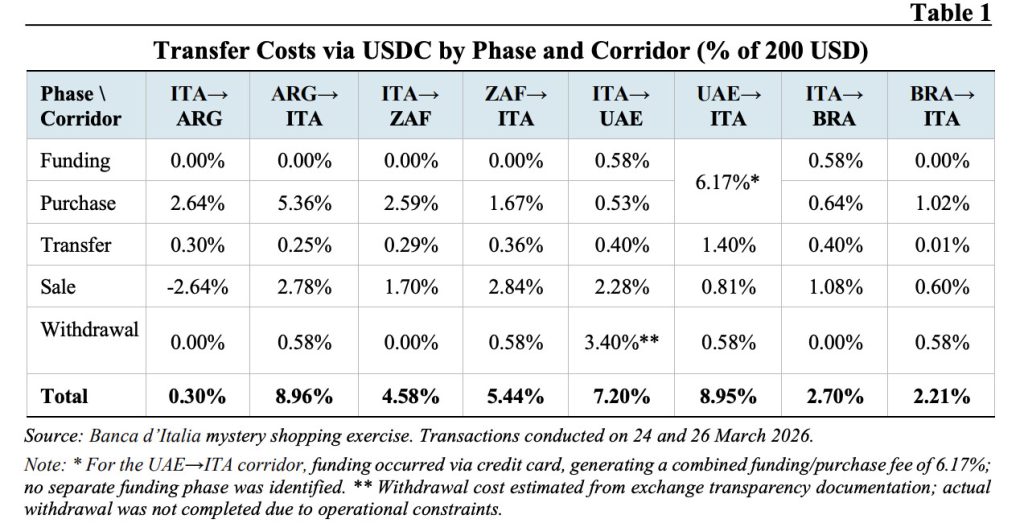
USDC was selected because it could be legally accessed both in the EU under MiCA and in Japan’s regulated market, unlike USDT. Each transfer was broken into five phases: funding, purchase, on-chain transfer, sale and withdrawal.
Stablecoins: On and off ramps drive costs up
The blockchain leg was consistently the cheapest component, averaging 0.4% of the transferred amount and falling as low as 0.01% on the Brazil-to-Italy corridor. The dominant costs sat at the fiat conversion points – the on- and off-ramps – which the paper identifies as the main source of both cost and transfer duration.
On the UAE-to-Italy corridor, where a credit card was the only available funding method, a 3.8% surcharge pushed the total cost to 8.95%.
The report cautions against reading the 0.30% Italy-to-Argentina result as evidence of efficiency, because the figure
The figure reflects the gap between Argentina’s official exchange rate and the rate implicit in USDC transactions, which stood roughly 3% above the official benchmark on the day of the transfer. The same distortion contributed to the 8.96% cost recorded on the reverse corridor.
Cheaper than the global average, not always cheaper than Wise
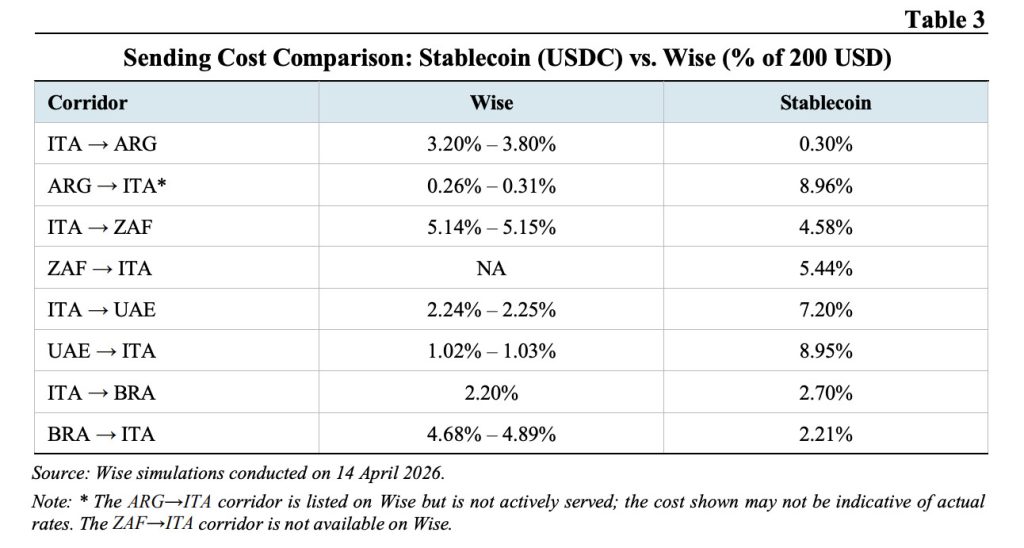
Stablecoin transfers beat World Bank averages in most sending countries: 2.21% against 9.96% from Brazil, and 5.44% against 15.23% from South Africa. The UAE was the exception, at 8.95% against a 2.65% average.
A comparison with Wise across the same corridors produced a more mixed result – USDC was cheaper in three corridors and more expensive in four, including Italy-to-Brazil, where Wise’s 2.20% edged the 2.70% USDC cost.
Speed depended on domestic payment infrastructure rather than the blockchain. Where instant payment systems operated – Italy’s TIPS, Brazil’s PIX, Argentina’s Transferencias 3.0 – end-to-end settlement completed in under 20 minutes.
South Africa, which relies on standard bank transfers for funding and withdrawal, produced settlement times of one to two business days. The authors conclude stablecoin remittances and instant payment systems are complements, not substitutes.
Regulation shapes what users pay
Japan was treated as a separate case study. Its rules restrict retail access to dollar-pegged stablecoins to a single domestic operator, which does not permit direct outbound transfers, forcing the researchers to route funds through an un-hosted wallet. The corridor cost 1.6% but required fragmented transfers the authors deem incompatible with ordinary retail use.
Excessive rigidity, the paper states, pushes users toward offshore platforms and decentralised finance, while outright prohibitions in markets such as China and Egypt fail to suppress demand and increase money laundering risks.
The paper lands amid continued industry claims positioning stablecoins as the answer to remittance costs, which averaged 6.4% globally in 2025 against a UN target of 3% by 2030.
The authors state the fiat reconversion requirement is the single greatest constraint on efficiency, and note savings would rise if recipients could spend stablecoins directly – an outcome they say would carry implications for monetary sovereignty in dollarising economies.