Stablecoins are the most widely used instrument among the 422 business leaders surveyed; 64% want banks to serve as a central integration point for tokenised money networks.
Most large enterprises are either using or testing tokenised money: 88% of the companies surveyed by DBS indicate they are already implementing it or exploring it through pilot projects.
The Singapore-based bank surveyed 422 business leaders across 11 markets for its report, “The Great Rewiring: Money in a new order”. Respondents revealed they are deploying tokenised money to manage liquidity, accelerate payments, and support expansion into new markets.
Some 63% of respondents said stablecoins are the most frequently used instrument, followed by tokenised deposits (53%) and tokenised money market funds (52%).
Most respondents expect to see results within two years, with improved auditability and traceability identified as the primary benefit by 72% of respondents, followed by real-time cross-border payments (71%).
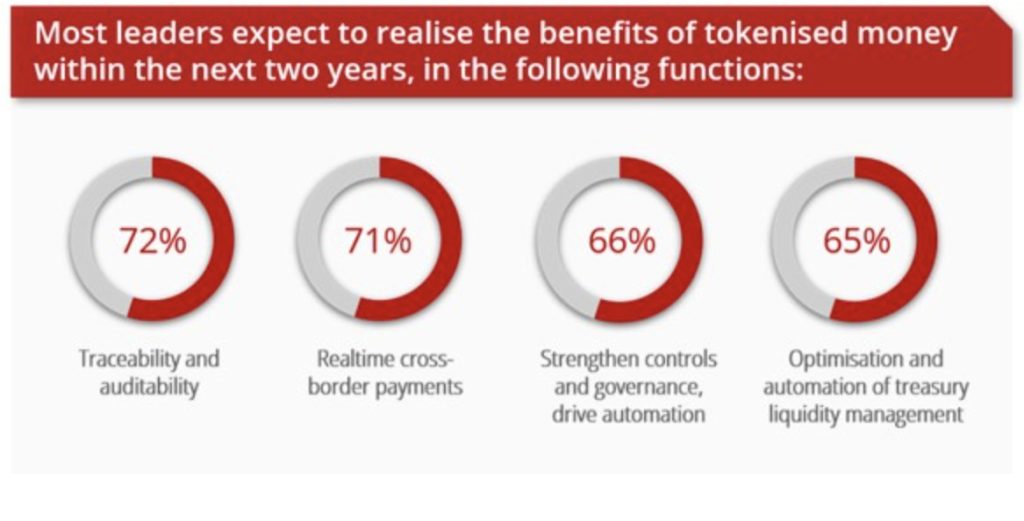
Stronger internal controls and governance (66%) and better liquidity management (65%) are also cited as key advantages.
Han Kwee Juan, Group Head of Institutional Banking at DBS, said companies are “operating in a world shaped by shifting trade corridors, new architectures of money and the rapid advancement of AI.”
According to him, business leaders must rethink how they deploy AI and tokenised products, as well as how they manage liquidity, currencies and cross-border capital flows.
“The organisations that succeed will be those that can turn complexity into optionality, adapt with agility, and capture opportunities in a rapidly changing world,” says Han.
DBS: supply chain shifts drive companies toward new markets
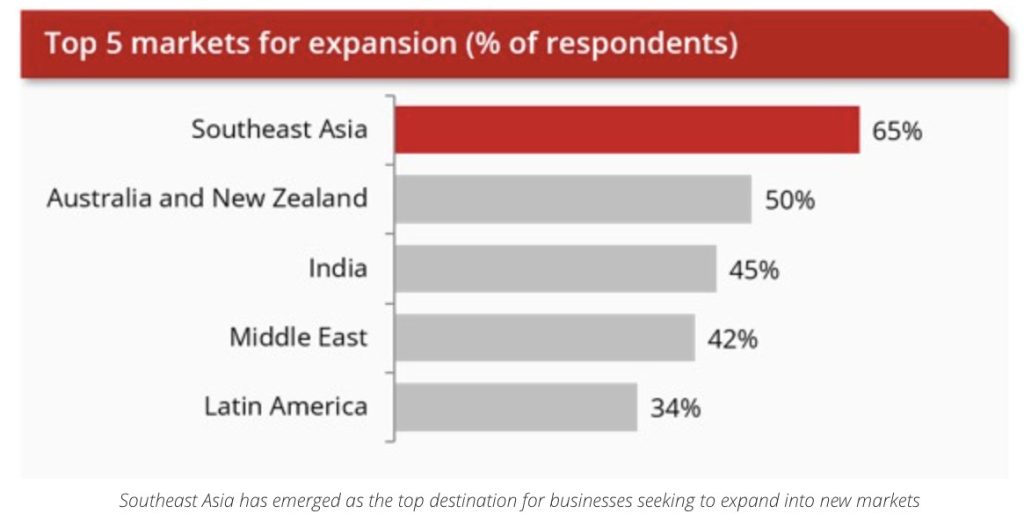
More than three-quarters of respondents said changes in supply chains have compelled them to adapt their business operations and enter new markets – with Southeast Asia being the most popular destination.
An equally large proportion also reported increased volatility in exchange rates and energy prices over the past 12 months, alongside less predictable transaction settlement processes.
Furthermore, companies are increasingly settling transactions in a wider variety of currencies.
Research by DBS shows 78% of respondents have reduced their reliance on traditional settlement currencies by gaining exposure to currencies used in alternative trade routes.
Only 2% indicated they were not considering any other currencies.
Approximately three-quarters of respondents stated that artificial intelligence (AI) has already contributed – or is expected to contribute within two years – to improvements in areas such as cash and liquidity forecasting, payment inquiries, post-settlement issue resolution, payment reconciliation, and anomaly detection.
Companies seek access through banks
Respondents identified various obstacles to the adoption of new technology within their treasury departments.
These challenges include uncertainty surrounding regulation and compliance, data security and operational risks, a lack of internal expertise and the complexity of integrating new systems.
Companies expect banks to help them overcome these barriers. For instance, 64% of respondents want a bank to act as a central integration point for networks involving tokenised money, while 63% seek support with pilots, proofs of concept and integration processes.
An equally large proportion desires access to the technology and infrastructure provided by banks to scale the use of AI.
According to DBS, the results indicate that banks are increasingly acting as partners in their clients’ technology projects, extending beyond their traditional roles in financing and transaction processing.
Lim Soon Chong, Group Head of Global Transaction Services at DBS, said cross-border finance would go “beyond improving speed and cost, to moving value intelligently and securely.”
Lim said many new settlement networks were being built in parallel. “For companies, fragmentation may add complexities and compliance obligations,” he said. “The future will be defined by new forms of money and technology, and also shaped by trusted anchors who can orchestrate value movement across multiple networks.”
DBS’s initiatives in the field of tokenisation
DBS is one of 17 banks working on live pilots using Swift’s blockchain-based ledger for tokenised deposits – a system that, according to Swift, has been ready for initial use since July.
In September, it was reported DBS and Citi reported they executed a payment in US dollars between Singapore and New York using tokenised deposits on the Swift platform.
According to DBS, the transaction took only a few minutes, compared to the two business days typically required for a traditional cross-border payment.
Furthermore, the bank is collaborating with Kinexys by JP Morgan on an interoperability framework for transferring tokenised deposits between public and permissioned blockchains.