Orbital’s H1 2026 index finds global crypto app usage down almost 40%, but steady or growing in markets with weak currencies and limited dollar access
Stablecoin usage held up in a quarter of the world’s markets through the 2026 crypto downturn, concentrated in economies where people use crypto to hold and move dollars, according to Orbital’s H1 2026 Stablecoin Retail Payments Index.
Global crypto app usage fell almost 40% between January 2025 and June 2026, but 19 of the 80 markets Orbital tracked held their users or grew. Venezuela expanded 55.1% and Angola nearly doubled its user base.
The steepest falls hit markets known for speculative retail trading: Nigeria down 59.6%, Brazil down 53.6%, the United States down 50.9%, Türkiye down 49.6%, the United Kingdom down 48.6% and Pakistan down 46.5%.

“Rather than killing crypto usage outright, the bear market has cleared out the hype and left behind the parts people actually use,” said Luke Wingfield Digby, Co-founder of Orbital. He said the base of utility is likely to serve as the floor for the next cycle, with speculative demand building on top of it later.
The split comes as stablecoins scale as payment rails. Total stablecoin supply stood at about $310bn in mid-2026, near record levels, according to DefiLlama, and most flows run outside the United States.
Payment networks are settling on the same rails: Visa’s stablecoin settlement pilot grew from a $3.5bn annualised run rate in November 2025 to $7bn by April 2026, up 50% on the prior quarter, and Mastercard added settlement in regulated stablecoins in June 2026.
The United States enacted the GENIUS Act in July 2025, and the European Union’s MiCA rules reached full application across member states by mid-2026, while adoption in dollar-scarce emerging economies has run ahead of local regulation.
An EY–Parthenon survey found 13% of financial institutions had put stablecoins into production by 2026, with 54% planning to within a year.
Currency stress, not inflation
The markets that held were not the highest-inflation economies, according to the index. They were places where currencies are unstable, banking access is limited or US dollars are hard to obtain.
Some high-inflation markets kept their users while some lower-inflation markets grew, which Orbital said points to currency instability and dollar access as the stronger drivers rather than headline inflation.
Stablecoins in these markets increasingly serve as payment infrastructure to work around what Orbital called “broken” local currencies. Venezuela now has one of the world’s highest crypto app penetration rates, at 21.3% of its internet-enabled population.
Orbital said the steep declines elsewhere came in markets most exposed to speculative retail activity, and the gap between the two groups marks the divide between hype-driven and utility-led adoption.
Crypto app monthly active users peaked in January 2025 and declined steadily after, the index found. Usage had already fallen about 15% by the time Bitcoin reached its October 2025 record high, so consumer attention turned before the market price did.
How the index is built
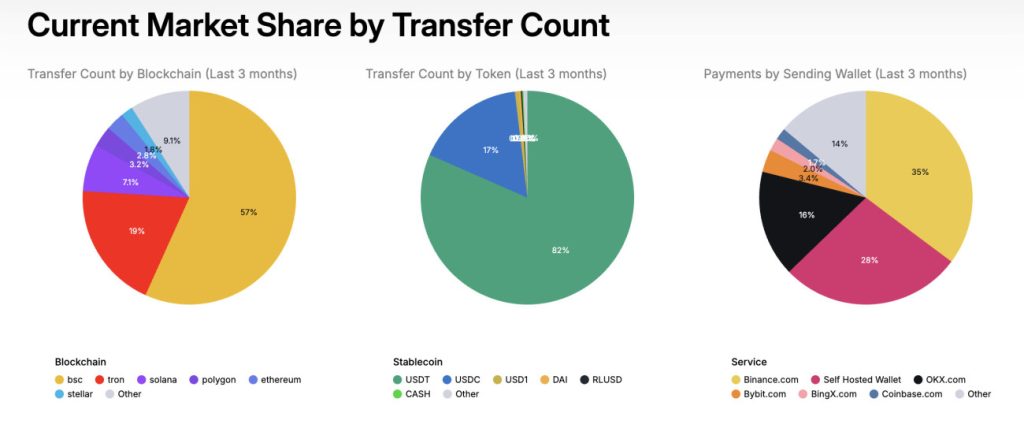
Orbital built the index with blockchain data firm Artemis and app intelligence firm Sensor Tower, filtering for consumer payments under $10,000 to exclude trading, cross-border transfers and institutional flows. The filter is meant to isolate retail payments – peer-to-peer transfers, remittances, merchant payments and payroll – from speculative activity.
The H1 2026 edition is the fourth in the series. Orbital’s Q4 2025 snapshot, published in February, reported that retail-sized stablecoin use had risen more than tenfold across 2025, with daily active users doubling to 2.6 million from 1.3 million.
The company has published the full H1 2026 report on its website.
Orbital is a payment orchestration platform that routes transactions across stablecoins and traditional payment rails.