Midnight Foundation’s Fahmi Syed and Monument Bank’s Mintoo Bhandari say privacy and tokenisation are drawing decentralised and traditional finance together.
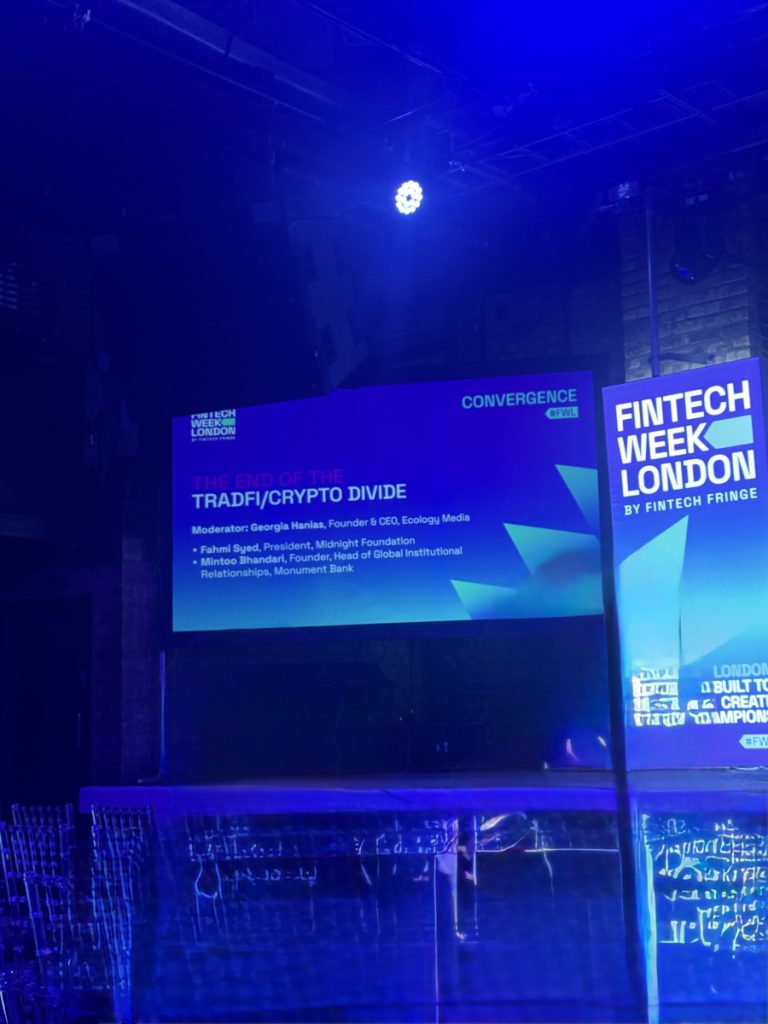
Large financial institutions will not place client assets on public blockchains because those networks expose every transaction, Fahmi Syed, President of the Midnight Foundation, told a panel at Fintech Week London 2026 on the convergence of decentralised and traditional finance.
Syed spent two decades in hedge funds before moving into blockchain. Hedge funds trade, settle and margin assets privately between the firm, its broker and its custodian, he said, while public blockchains make equivalent activity visible to anyone.
Midnight, which he described as a privacy-focused blockchain, lets users keep data “on their side of the firewall” and present cryptographic proofs on-chain instead of the underlying records. Users can then make selective disclosures, either publicly or privately between two parties.
Private blockchains do not keep institutional data private on their own, Syed said. Banks including JP Morgan and Citi run blockchain teams and internal ledgers which work for tracking balances across their own entities, but those systems become silos. Connecting one private chain to another requires a bridge, he said, which leaks data or metadata.
Transacting tokenised assets or stablecoins forces banks onto public chains such as Ethereum or Solana, at which point observers can identify the institution behind a wallet.
Regulation in the United States under the current administration had reversed earlier federal hostility towards crypto, and Syed says growth in stablecoins and tokenisation supports demand for the US dollar and Treasuries. The underlying technology has existed for 15 years, he said, and banks now recognise its value for treasury flows and round-the-clock settlement.
Syed said salary payments show the privacy problem, because paying staff in stablecoins on a public chain exposes the amount each person receives, alongside every other payment leaving the same wallet on the same day.
“You never talk about how much you got paid,” he said of office norms. A privacy-enabled chain can process payroll, apply tax deductions and still disclose to a regulator or tax authority when required, while keeping individual amounts hidden from other employees.
Tokenisation brings private assets within smaller reach
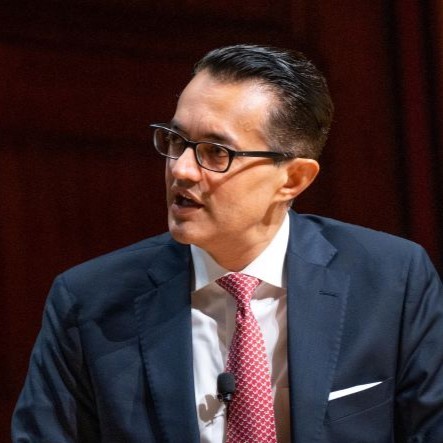
Mintoo Bhandari, Founder of Monument Bank, said the same technology lets banks open private-market investments to smaller customers. Monument holds a full UK banking licence and targets “mass affluent” clients – professionals, entrepreneurs and business owners – whom Bhandari said mainstream banks underserve.
He gave the bank’s balance sheet as about £7.5bn and said Monument reached £5bn within 36 months of launch, which he said made it the UK’s fastest-growing bank over its first three years.
Private equity funds typically require minimum commitments of £500,000 to £2m, and tokenisation can fractionalise those funds into subscriptions of £1,000 to £10,000, said Bhandari.
He added software that can handle drawdown notices, distributions and calculations inside a banking app, noting one fund due to be offered on the platform had returned 12% net of tax a year over several years, against about 2.5% on the best UK savings accounts.
The Monument-Midnight partnership runs in phases, the panellists said. Monument will first tokenise cash deposits, starting at £250m, into a controlled zone on Midnight where the bank sets who can see what.
Later phases will bring tokenised private equity, treasury and hedge fund units into that zone, and then let customers borrow against their holdings. “Good technology is invisible,” Syed said, adding that clients need not know a blockchain is involved.
Legacy architecture slows the traditional banks
Established banks will struggle to follow, Bhandari said. He said about 99% of the world’s banks still run on COBOL mainframes and software dating to the 1970s, with mobile apps layered over architecture built before the internet. Cloud-native banks launched from around 2015, including Monzo, Starling, Revolut and Brazil’s Nubank, can adapt faster.
Custody remains a hurdle, Syed said. Monument is a bank but not a digital custodian, and few institutional-grade digital custodians exist. Compliance on public chains relies on transparency, which a private chain removes, so the partners are working with a custodian to attest to the provenance of funds without disclosing the details.
Bhandari said future banks will be built on three technologies: cloud, blockchain and AI. A “coreless, fully blockchain-based agentic bank” does not yet exist, he said. Institutions should combine the trust of a regulated bank with technology that removes inefficiency, without sacrificing trust, Syed added.