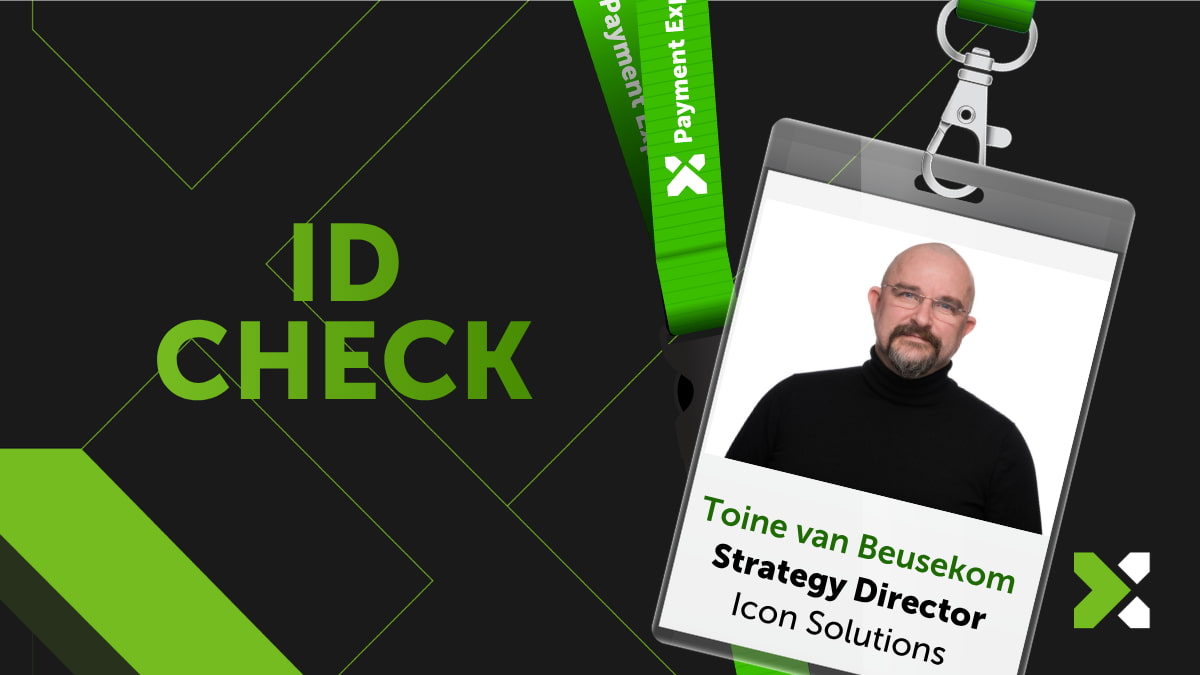
Payment Expert’s ID Check: Payments Professionals offers insight from industry leaders and experts on how they got their start in the financial industry, from their early years in education, to how they have been able to climb the corporate ladder.
This week, Toine van Beusekom, Strategy Director at Icon Solutions, details how his stumble into payments has seen him work for the likes of Capgemini and IBM with admitted luck, but also through his pursuit of understanding the “why” of why payments function.
Where did you go to university and what did you study? What impact did this have on your current journey?
I went to university in The Hague in the Netherlands, where I studied Business Administration. That experience has had a lasting impact on my career.
It shaped the way I approach problems and opportunities – I naturally look at things through a business lens, always thinking in terms of value, whether that’s revenue, cost or overall commercial impact. When evaluating technology, I focus on the underlying business case: how it drives revenue, reduces costs, or supports a sustainable operating model.
That perspective has stayed with me throughout my career. Even in the mid-90s, when it wasn’t always a common mindset in tech and payments, I kept coming back to the same core questions: What’s the business case and how does it translate into a viable, scalable way to run a business?
What first drew you to the payments industry and why have you stayed?

To be honest, there’s no romantic story behind it. I didn’t grow up dreaming of working in payments – I more or less fell into it.
I started my career at Capgemini, working in financial services, and my first assignment was with ABN AMRO. That project happened to be in payments, where we were building a corporate banking solution. From there, it just stuck.
What really hooked me was the intellectual challenge. Payments made me question why things worked the way they do, and that curiosity kept me engaged from the start.
As for why I stayed, there’s simply never a shortage of things to do. Payments has traditionally been a bit under the radar, but that also created an opportunity.
Over time, I’ve been able to help shift the perception, from payments being seen as a back-office function to something much more central. It’s fundamentally about liquidity, about how money moves, the lifeblood of any company or bank. As the industry began to recognise that, I felt like I was growing alongside it, which made it all the more rewarding to stay.
Are there any lessons from your first role in the industry which you still draw on?
One of the biggest lessons I learned early on, especially working in a large bank, is that success isn’t just about having the right idea, it’s about understanding how decisions actually get made.
There’s a significant amount of internal alignment and informal discussion that happens before anything ever reaches the decision table. If you assume that a strong idea will “speak for itself” once formally presented, you’ll often find it doesn’t land the way you expect. You need to bring people along early, build consensus, and navigate the internal dynamics.
The key takeaway for me has been the importance of stakeholder management, engaging early, aligning perspectives, and ensuring that by the time something is formally presented, the groundwork has already been done. It’s something I learned early, and honestly, it’s a skill I’m still refining today.
When was your first big break in the industry? Why was this such a significant moment for you?
I think it is important to be honest – nobody gets anywhere without a bit of luck. You can have the strongest CV in the world, but sometimes you still need the right opportunity at the right moment.
For me, that break came early on in my career when I was working in consulting at Capgemini, on the project I mentioned with ABN AMRO. The person leading the role on the client side moved to the US, and I was given the opportunity to step into his position.
That was a pivotal moment. It gave me a seat at the table much earlier than I would have expected, and the chance to take on real responsibility. It also helped me to build a strong foundation of skills and experience that I carried forward into later roles – including positions in fintech like Clear2Pay, IBM and JPMorgan Chase.

Was there a moment you faced in the industry which really challenged you? How did you overcome this?
One moment that stands out was during my time at IBM, when I was involved in a consultancy project around insourcing capabilities within a clearing and settlement infrastructure.
The situation was complex. You had senior stakeholders from both a bank and a clearing and settlement mechanism (CSM), each with strong views and significant influence. There were big ambitions on the table, particularly around whether certain banking functions could be effectively insourced by the CSM. But there were also strong egos and competing agendas on both sides.
At that point in my career, I was relatively junior compared to the people in the room. Yet I was the one tasked with presenting the findings, which clearly showed that what they were trying to achieve wasn’t viable. In simple terms, it would have been a costly mistake.
That was a challenging position to be in. You’re effectively telling very senior, experienced people that their strategy doesn’t stack up.
The key to handling it was structure and discipline. We agreed upfront that there would be no immediate debate or reactions in the room after the presentation. That created space for the message to land without turning into a defensive discussion.
Looking back, it reinforced an important lesson: sometimes your role is to bring clarity, even when it’s uncomfortable. And how you deliver that message can be just as important as the message itself.
What are some of the skills you deem essential to starting in your industry and how have yours developed over the years?
I don’t think the fundamentals are industry-specific, but there are a few core skills that are essential. You need a solid enough understanding of technology, but more importantly, you need to always start with the why.
There’s a lot written about this, particularly the idea of “start with why,” popularised by Simon Sinek, and I think it really holds true. If you don’t understand why you’re doing something, you can’t define what good looks like, and you can’t work out how to get there.
I tend to think in a simple framework: why, what, how (Why do I need to do something, What does good look like and How do I get there). If you apply that consistently, it creates a natural structure for problem-solving. You’re never really lost for direction, because you understand the purpose before you start executing.
Who was your biggest role model – inside or outside of your industry – who continues to inspire you in your current career?
I’d probably be a bit of a cop-out and say that inspiration doesn’t come from a single individual. In my experience, there isn’t one person who represents the complete package I would aspire to.
Instead, I try to learn many things from many different people, some have exceptional communication and presentation skills, others have deep technical or industry expertise, and others demonstrate strong strategic vision. I take elements from each of them and build my own approach over time.
I also enjoy talking to a wide range of people across the industry, because I’m constantly looking for new perspectives and ways of thinking. That ongoing exchange of ideas is, in many ways, what keeps me inspired.

If you didn’t work in the industry, what other career option would you have pursued or would have loved to
I’ve always had a strong interest in science and space. If I hadn’t gone into this industry, I think I would have pursued something in physics or astronomy, something in the realm of understanding galaxies, black holes, and how the universe works.
Even now, I still find myself drawn to it. I enjoy documentaries about topics like cosmology and theoretical physics, it’s both intellectually stimulating and a form of escapism. Books like ‘A Brief History of Time’ by Stephen Hawking, really shaped that interest for me.
There’s something fascinating about trying to understand the fundamental mechanics of the universe. It’s that same curiosity, trying to understand complex systems, that I think also carries through into how I approach my work today. But it really starts to shine if you can combine it with human nature, so that’s why I would always recommend reading Sapiens – a brief history of humankind by Yuval Harari, next to Hawking.
Lastly, what is some advice you would give to an aspiring person looking to get a start in your respective industry?
I’d always start with why.
Before getting too deep into technical details, formats, standards, or protocols like ISO 20022 – and at one point you do need to understand that stuff -, it’s far more important to understand the underlying business model. In payments, that means asking: how does money actually flow, where does liquidity sit, who benefits from friction, and why does that friction exist in the first place?
You can learn the “how” quite quickly, and increasingly, tools like AI can accelerate that even further. But what really matters, and what will continue to matter, is understanding the “why” and the “what good looks like.”
At the same time, I do think AI will reshape parts of the “how” significantly. It’s already becoming very effective at writing code, processing information, and supporting analysis. But even then, it still needs human judgment, particularly when it comes to context, intent, and decision-making.