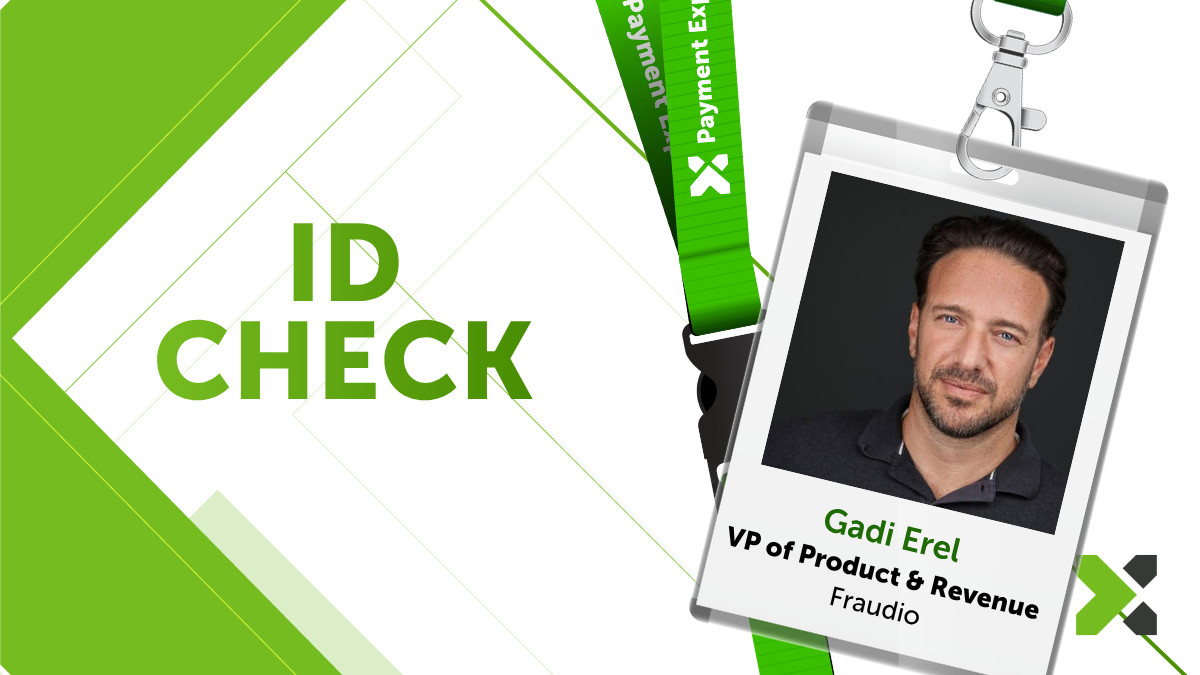
Payment Expert’s ID Check: Payments Professionals offers insight from industry leaders and experts on how they got their start in the financial industry, from their early years in education, to how they have been able to climb the corporate ladder.
This week, Gadi Erel, VP of Product and Revenue at Fraudio, reveals how a career spanning the creative arts and New York real estate provided a unique perspective on human behaviour and risk. He also discusses the mission to democratise advanced fraud intelligence and why the future of fintech belongs to operators who prioritise execution over hype.
Where did you go to university and what did you study? What impact did this have on your current journey?
My education hasn’t followed a strictly conventional path. I studied Acting and Directing in Los Angeles and graduated at the New York Real Estate Institute years later. While that might seem a world away from payments, it inadvertently paved the way for my current journey. Screenwriting and acting are fundamentally about understanding human behaviour, motivation, and the why behind an action.
In payments, we are essentially doing the same thing; analysing data to understand behaviour and intent in real time. It taught me that behind every data point is a human story, and that perspective helps me bridge the gap between complex product depth and commercial reality.
What first drew you to the payments industry and why have you stayed?
Honestly, when I first started in payments I had no idea I would love it so much. The sheer scale of it is mind blowing. Payments are the backbone of the global economy, yet the infrastructure protecting them is often rigid and inaccessible to those who need it most. I saw an opportunity to move beyond the fintech hype and focus on execution; turning fraud management from a necessary burden into a competitive advantage for our clients.
I’ve stayed because the industry is constantly evolving. We aren’t just moving money anymore, we are building trust at scale. The mission to democratise high-performance fraud intelligence for underserved markets is what keeps me motivated every day. I have to say, the payments industry is uniquely collaborative. It’s probably the only sector where you’ll find mortal enemies working together amicably to process a single transaction.
Are there any lessons from your first role in the industry which you still draw on?
My first major foray into the commercial sector was in New York real estate. The biggest lesson I learned there was that if you don’t find a way to work with others, the road to success is incredibly long and painful. But with the right partners and a fair revenue share, it becomes a fast-moving joyride.
In real estate, focusing too much on the commission split usually backfires. By cutting out other agents, you’re just making your own job slower and more difficult. Success comes from collaboration—when you’re willing to share the deal, you close more often and create more value for everyone. That’s how you build the reputation that makes landlords trust you with their entire portfolio.
I apply that same mindset at Fraudio. Whether you’re selling a luxury apartment or a fraud solution, the core principle is the same: you have to solve the most pressing problems as quickly as possible for everyone involved. By focusing on transparency and working through strategic partners, we can take that efficiency and immediately compete on a global scale.
When was your first big break in the industry? Why was this such a significant moment for you?
Undoubtedly, my big break was joining Fraudio as VP of Product and Revenue. It was a significant moment because it allowed me to operate at the intersection of two areas that are usually siloed. In most companies, product and sales are often at odds, whereas at Fraudio, they are interconnected.
Being able to influence and steer how our product scales across the payment ecosystem, while ensuring the strategy aligns directly with revenue outcomes, has arguably been the most defining period of my career.
It proved that you can build sophisticated results technology that is also incredibly easy to deploy, and most importantly, drive value that the industry actually wants, as opposed to a conceived value that’s developed behind closed doors.
Was there a moment you faced in the industry which really challenged you? How did you overcome this?
The biggest challenge is always mindset. For many in the payments space, there is a reluctance to move away from legacy systems they’ve used for decades, even if those systems are failing them. Overcoming this requires more than just a sales pitch, it requires demonstrable value.
We overcame skepticism by letting the data speak for itself; showing, not just telling, how our network effect can exponentially lower false positives. It taught me that in a world of hype and buzzwords, product depth and results from day zero are the only way to truly disrupt a legacy market.
What are some of the skills you deem essential to starting in your industry and how have yours developed over the years?
You need a mix of technical curiosity and common sense. You have to understand risk and data, but also the commercial realities of the people using your tools, or the people they work for. Knowing how to steer focus towards a commercial reality is imperative.
Over the years, my skills have shifted from purely selling to designing solutions. I’ve learned that the most successful operators in this space are those who can shorten the time between integration and deployment, pain and value, loss and protection. Execution is the only skill that matters at the end of the day, everything else is just noise.
Who was your biggest role model – inside or outside of your industry – who continues to inspire you in your current career?
I don’t necessarily look to standard industry icons. My inspiration comes from people who maintain calm in high-pressure environments where the stakes are real. I saw that at Fraudio with our CEO, João. He has an incredible ability to stay level-headed and make the right calls when the pressure is at its peak.
But my deepest inspiration is my sister. Watching her raise her children and find ways to thrive while living through the reality of war puts everything into perspective. It’s a reminder that as the world accelerates, our most important skill is the ability to adapt and keep moving.
If you didn’t work in the industry, what other career option would you have pursued or would have loved to?
Given my background, I would probably reinvent myself and move to an NGO; creating genuine value for those who need it most. Now more than ever, storytelling requires a clear vision. I’d focus on showing people how the narratives we believe dictate our outcomes.
The coming years will bring many opportunities, but also significant challenges. Humanity is at a major turning point, and it feels like a critical moment to help shape the systems that will define our future.
Lastly, what is some advice you would give to an aspiring person looking to get a start in your respective industry?
Stop chasing hype, start looking for the pain. Focus on where systems are broken or underserved, and think about how you can deliver sustained, tangible value. The payments industry is moving fast, but there’s still a massive gap to close; there are plenty of places where you can make a genuine impact.
Most importantly, always remain fair and true. The world of payments is small, and people tend to stay because, at its core, it’s a great industry to be in. Coming in like a cowboy may bring short-term success but it won’t last.
One thing I learned in Hollywood that holds just as true in payments: work with people you actually like. Be a real friend, consistently and without agenda. When you build that foundation, relationships stick. You have their back, and they have yours. Like film, payments is a people-driven business; it takes a network of great individuals to get anything meaningful done. So, along the way, just remember to stay human.