A panel at Money20/20 discussed how domestic payments are racing ahead across Asia, while cross-border transactions prove stubbornly challenging.
Cross-border payments in Asia remain hindered by a lack of standardisation and coordination, industry leaders said today (21 April) on the opening of Money20/20 Asia, despite the region’s reputation for cutting-edge domestic payment systems.
Thailand, for example, is considered one of the “most advanced in the region” for payments, according to Warotai Kosolpisitkul, International Economic Advisor at the Ministry of Finance of Thailand. Yet that progress does not always translate across borders.
Shiven Madan, Senior Director of Payments Partnerships at PayPal, illustrated the gap with a personal example. While travelling, he was forced to leave his watch and credit card as collateral at a restaurant while searching for an ATM to withdraw cash. After multiple failed attempts, unexpected ATM fees and foreign exchange costs discovered mid-transaction, he eventually settled the bill.
The anecdote drew laughter from the audience, but underscored a broader issue – even as domestic payment systems across Asia become faster and more embedded, cross-border transactions remain inconsistent and costly.
Domestic strength, cross-border fragmentation
Across Asia, domestic payment systems are already fast, low-cost and deeply embedded in everyday transactions. QR codes, real-time transfers and digital wallets have significantly reduced friction within individual markets. The challenge, panellists said, emerges when those systems meet across borders.

Wenhui Yang, CEO of TenPay Global, attributed the issue less to technology and more to coordination. “There is a lack of consensus in the industry on how to make this happen,” he said. “The lack of consensus eventually translated as a lack of standardisation.”
From a merchant perspective, this lack of alignment continues to create friction across the payment chain. “There are issuers and acquirers playing in this ecosystem, but they don’t talk to each other,” said Jacob Hu, Co-founder and UK CEO at TripLink, pointing to failed transactions and inconsistent user experiences.
Hu added that card payments still deliver the highest success rates in cross-border scenarios, despite the rapid adoption of alternative payment methods across the region.
While merchants now offer a broader mix of payment options, that expansion has also made seamless acceptance more difficult to achieve at scale. Cards, though less visible in day-to-day consumer behaviour, remain a key part of the cross-border infrastructure. Often embedded within digital wallets and local payment interfaces, they continue to underpin transactions behind the scenes.
China opens its doors

China was repeatedly cited as an example of how large, closed domestic payment ecosystems are beginning to open up to cross-border flows through partnerships. One recent development came in February, when Visa and UnionPay International agreed to create a corridor for cross-border payouts into mainland China via Visa Direct.
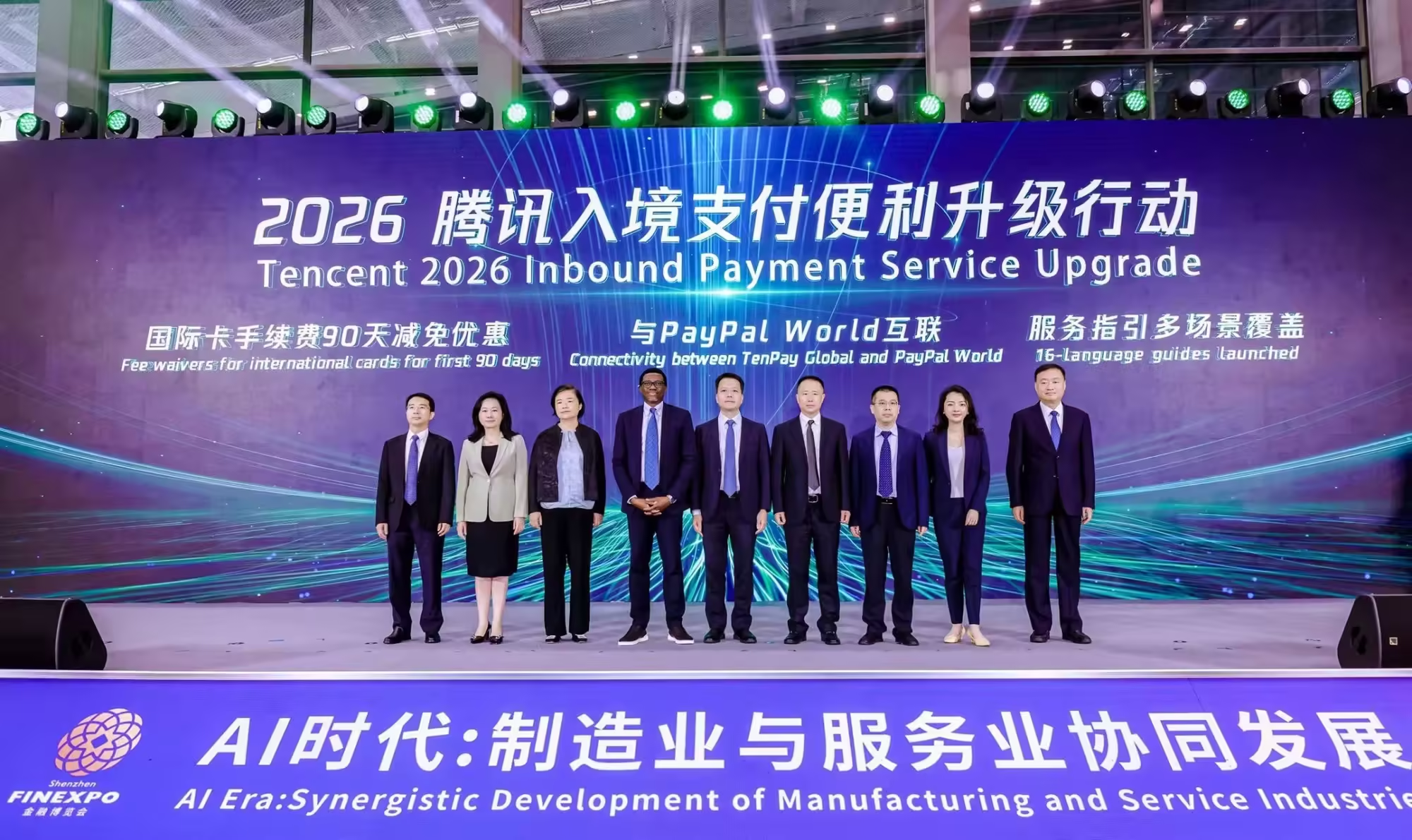
The partnership connects Visa Direct with UnionPay’s MoneyExpress platform, allowing remittances and business payments to reach more than 95% of UnionPay debit cardholders in the country. Panellists pointed to similar efforts to bridge systems. Yang referenced his company’s partnership with PayPal as part of a broader push to expand cross-border acceptance.
He noted that domestic networks are increasingly enabling users to link cards to apps and use QR-based systems internationally, but stressed that progress depends on greater coordination between ecosystems.
“We need to be open enough to contribute whatever we have in exchange for the things that your friends have,” Yang said.
The significance of such partnerships has been underscored by regulatory scrutiny. The TenPay–PayPal agreement, for example, came close to collapsing after US lawmakers raised concerns over anti-money laundering safeguards, highlighting the additional complexity facing cross-border integration.
A modern problem worth solving
While panellists stopped short of identifying a single solution, there was broad agreement that the next phase of cross-border payments will be built on top of existing domestic systems rather than replacing them. The focus, they suggested, is on enabling interoperability between networks, allowing consumers to use familiar local payment methods while transacting across borders.
This approach would support the concept of “paying like a local” internationally, without requiring a wholesale shift in infrastructure.
Emerging technologies are also beginning to shape the conversation. Panellists pointed to the potential role of artificial intelligence in simplifying payment flows, particularly as systems become more complex. However, this remains at an early stage, with speakers noting that any meaningful impact will depend on how effectively AI can be integrated into existing payment ecosystems.
Despite the challenges outlined, there was a shared view that fragmentation is not solely a barrier, but also a reflection of rapid innovation across the region. Yang argued that increasing complexity is, in part, the result of growing choice and adoption of new payment methods, signalling a competitive and evolving market rather than a stalled one.