Merchant Payment Ecosystem (MPE) 2026 gathered payment service providers and merchants alike to descend on the InterContinental in Berlin to theorise where the next opportunities and challenges lay ahead.
From the ever-evolving sophistication of AI, to the range of European digital wallets, both local and cross-border, these are Payment Expert’s top five key takeaways from MPE 2026.
1. Agentic commerce: Know your agent (KYA)
Heading into MPE this year, the overarching theme many delegates were expecting was the rise of agentic commerce and, unsurprisingly, it was.
Agentic commerce was discussed from a range of verticals and perspectives, from its ability to perform agent-to-agent transactions, to its role in being able to be deployed across multiple stacks to perform multiple functions, such as compliance, customer onboarding, and risk assessment.
However, the governance and security of agentic commerce were the most important aspects of the technology. Know your agent (KYA) was a term quickly popularised on the showroom floor, deriving from know your customer (KYC).
As autonomous as AI is, can both the payments and merchant industries securely understand who the customer is and verify this while using those same agents to assist them throughout the full commerce lifecycle?
During a panel discussion, Niklas Harzheim, a Founding member of OpenAI’s DACH team, revealed that not just one agent, but all the sub-agents working in tandem to deliver a more autonomous shopping experience, need governance and oversight on each role they are performing.
In order to mitigate fraud and mitigate risk levels, Harzheim outlined three key responsibilities agents must perform: identity, authority, and governance.
“It is important to understand the architecture. An agent is not a single agent, but a couple of sub-agents. Each of those agents have different guardrails and function, recommendations, searching, etc,” said Harzheim.
With the likes of OpenAI and Google’s agentic commerce protocols building their own standardised frameworks as those models evolve, it may not be too long before policymakers begin to place their regulatory oversight over a solution that is rapidly becoming more popular not just with consumers, but merchants too.
2. Is Wero Europe’s best answer to Visa/Mastercard?
Europe wants to be more independent and less reliant on overseas payment rails and card networks. The European Payments Initiative’s (EPI) answer is Wero.
Launched in 2024, and now available in three countries – Belgium, France and Germany – Wero is an account-to-account (A2A) payment method that has the support of at least 16 European banks.
As Wero’s A2A payment rail bypasses the traditional payment process used for card payments, this means no interchange fee attached for whenever a consumer makes a purchase, bound to be a positive for merchants’ balance books.
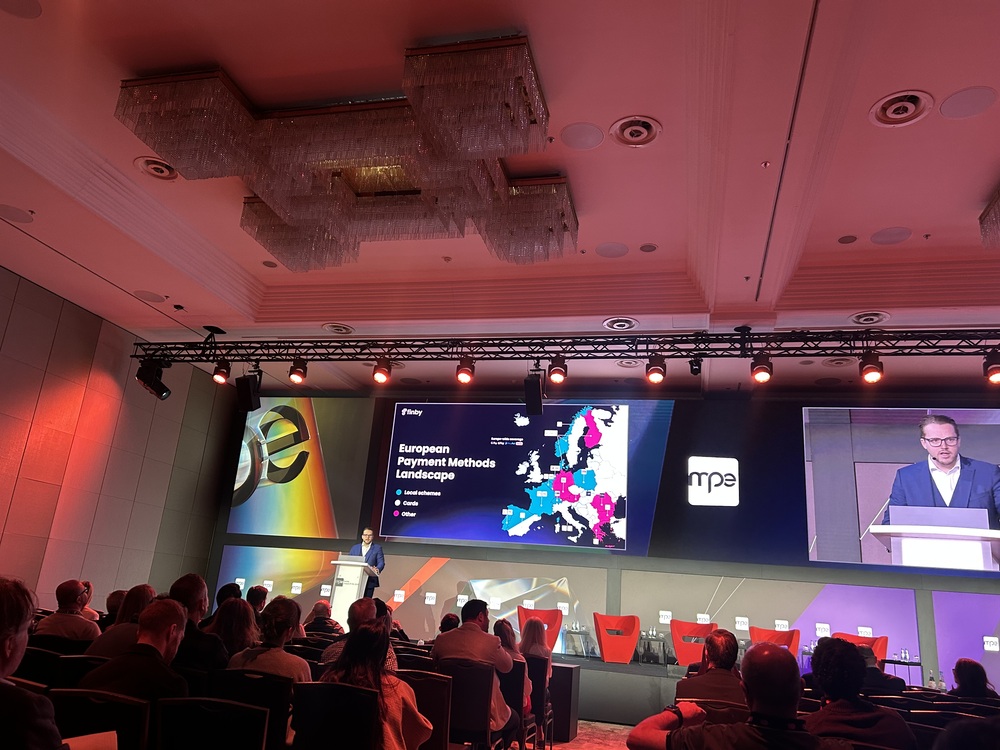
What makes Wero a viable, true contender to the giants of Visa and Mastercard is due to the backing and support it has had from the outset, which was displayed during a keynote presentation from David Rintel, CEO of Finby.
“(Wero) is not exactly starting from zero,” he said. All the previous attempts have not been successful, so why is this different?
“Wero is starting with very strong backing of key retail banks across three large markets – Belgium, France and Germany, and they will have a true cross-border presence from day one.”
But just like any new upstarting businesses looking to challenge the status quo and disrupt a perceived duopoly of a market, it requires mass scale adoption from both the merchant and the consumer.
European consumers have been used to Visa and Mastercard cards for decades due to the overwhelming trust they have in either companies’ debit and credit cards. As retailers and policymakers have become increasingly more frustrated with both companies’ interchange fees, the onus falls on them to make Wero one of the most popular payment methods in the region.
3. A2A’s local positives and cross-border challenges
While Wero could be viewed as the consolidated account-to-account (A2A) payment method to become Europe’s standard bearer, there are local payment methods that are not just competing with Visa and Mastercard, but have overtaken them.
In markets such as Poland, BLIK has now become the most popular payment method as consumers are realising the benefits of faster bank transfer payments. Bizum in Spain is on a similar trajectory, with more than 26 million users and a market share of up to 50% in the peer-to-peer segment.
Consumers have found their answer to faster, more seamless payments in specific markets, while merchants are benefitting from a more cost-effective solution. But not one size fits all.
While pay by bank is growing in popularity in the UK, with more than 35 million transactions in January 2026, card payments continue to dominate the market. A2A’s use cases pertain to specific markets for specific customer preferences.
Where methods like BLIK and Bizum have struggled is scaling across different markets, and Eric Tak, Head of Product Proposition Division at the European Central Bank, outlined why during a panel session.
“We are a bit less convinced with the interoperability of the European schemes, because without reach, you do not get scale, you need to add complexity and cost for interoperability,” said Tak.
“We believe there could be two or three that have the number of translations and unit costs, but no more than 10.”
For as beneficial A2A payments appear on the surface, with more methods being developed and launched each year, scaling across borders remains a fundamental challenge and if they are market specific payment methods, then that may just be enough.
4. Digital or payment wallet fragmentation?
The surge in different payment methods across different markets also raised fragmentation issues widely discussed during MPE this year.
Merchants can be forgiven if they do not see the value in adding as many payment methods as possible due to fears over handling various operational and interchange costs, as well as making the checkout interface look clunky creating friction.
Digital wallets like Apple Pay have been praised for their seamless approach to the checkout experience, but how many digital wallets, or payment wallets, is too many, and what is the right wallet for both the merchant and the consumer?
To make the checkout process as seamless as possible, customers typically want a wallet that encompasses all of their personal information under one roof. This does not just mean payments, but also IDs, tickets and more.
“There are two forms of fragmentation,” said Yuriy Kostenko, Partner at Flagship Advisory Partners.
“The wallet will act as a consolidator for the multiple features. We don’t want it to act as a payment terminal, it can act as an ID storage, licenses, etc., for multiple purposes.”
While many consumers prefer everything in the same consolidated wallet, others prefer their payments and other personal information to be separated. While this brings an opportunity for digital wallet providers to gain market share, this can also lead to fragmentation.
Kostenko continued and said regional fragmentation will continue but not because the wallet providers are failing to capture customers, but because customers across Europe inherently behave differently.
“Regional fragmentation will remain,” he said.
“Every EU region is very different. BLIK is so successful because customers were so used to bank to bank payments. Fragmentation will continue because by nature, we behave very differently.”
5. The stablecoin debate is nothing new
Circling back to some of the talking points before MPE, digital currencies, in particular stablecoins, were expected to be one of the key themes yet again as they were during the 2025 event circuit last year.
However, despite the digital euro and a potential euro-backed stablecoin receiving a few mentions, digital currencies did not take the spotlight. Was this due to disinterest from merchants and their customers’ lack of knowledge, or perhaps because this was nothing new?
David Birch, Global Ambassador at Consult Hyperion, delivered a keynote presentation at MPE drawing back on some of the same adoption, governance and usage debates digital currencies are currently having with the Sterling way back in the 1700s.
He argued that while the themes may repeat, the outcomes will differ, shaped by more advanced technology and broader use cases that will ultimately redefine both the language and infrastructure of money.
“Stablecoins are creating rails for a new kind of digital asset, the stablecoins themselves don’t really matter, in the long run, the institutions they created did, we will see the same thing,” said Birch.
While stablecoins exploded in use cases and promised a faster, cheaper global payment network for years to come, it can be argued they have yet to even reach the consciousness of retailers and merchants, let alone consumers.
But Birch summarised they will gain traction because the technology that underpins a USDT or USDC will dictate where money goes next, as he pointed out “the money of the old economy will not work in the new economy”.