Payment Expert’s Callum Williams has been on the ground at Merchant Payment Ecosystem (MPE) in Berlin. Read all the developments, key talking points, and industry views from day two.
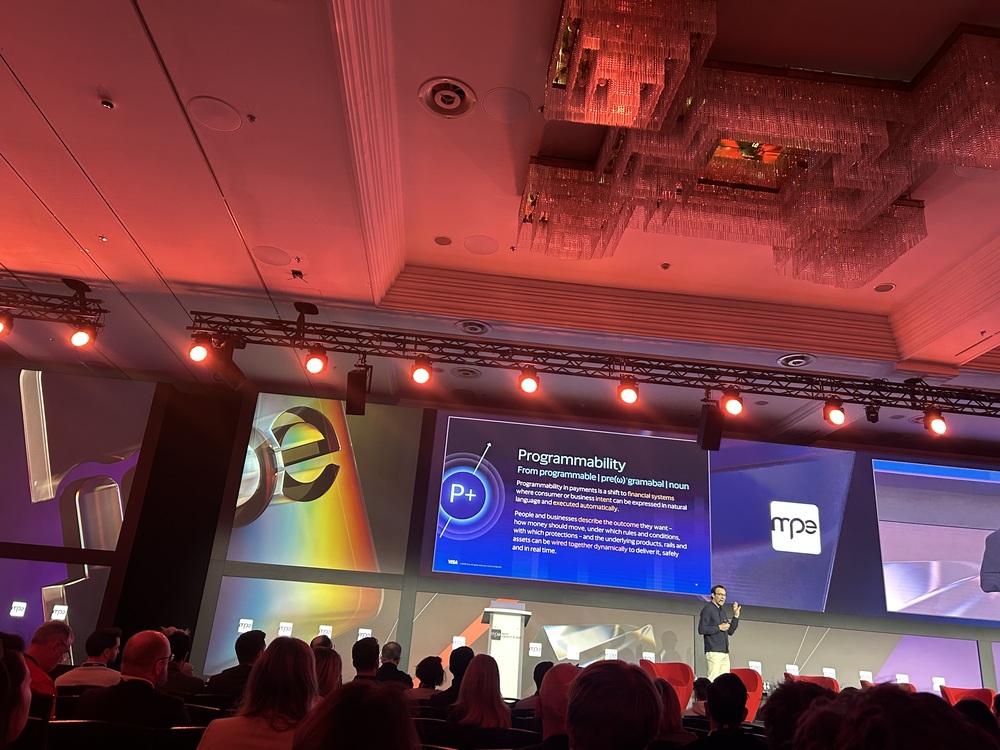
Day Two of MPE in Berlin kicked off with a keynote speech from Mathieu Altwegg, Head of Product and Solutions at Visa Europe, on why money is becoming programmable.
He highlighted a convergence of three key principles to the merchant payment lifecycle; identity, choice and experience, and how AI agents have programmed the next evolution of this experience.
Altwegg revealed the challenges adopting these principles for a programmable AI infrastructure consists of adding personalisation without the risk of fragmentation, while offering it at scale without compromising security and trust.
He outlined that the experience of adopting agentic models like OpenAI’s Agentic Commerce Protocol (ACP) or Google’s Universal Commerce Protocol (UCP) will naturally breed knowledge of how to deploy these models to their customers with confidence.
The adoption of verifiable credentials to confirm identity stages will also build trust for merchants, according to Altwegg. Verifiable credentials will enable an agentic experience to act on behalf of the consumer with intent, existing within the merchant’s guardrails to provide the human oversight needed for early-stage agentic models.
This process involves confirming security protocols across multiple parties and agents to happen online with the same security measures the merchant already has in place.
“This shift of paradigm is enabling us to take advantage of the new AI capabilities without code. This is the biggest unlock since the graphical user interface,” said Altwegg.
“What does this mean for businesses and consumers? We already programme our lives: curate playlists, monthly wires to one account to the next, while the user interface has evolved. We are in a state of high interactivity, not really configurable and not yet autonomous, as this mind enters the picture, we are moving from payment users, to programmers in our daily lives.”
He also confirmed Visa is set to launch the Visa Merchant Partner Program, adding in these programmable protocols to shift from a payment process, to a programmable one.
Know Your Agent (KYA) to build agentic trust
Following on from Altwegg’s keynote, several industry leaders descended to discuss the trust and governance methods happening in parallel to agentic commerce’s rise.
Know-your-customer (KYC) has been the standard for payment service providers and processors in a traditional sense for decades. However, AI agents pose new questions over autonomy and responsibility in being able to securely onboard and checkout customers leveraging agents to perform transactions.
This is otherwise known as know-your-agent (KYA), which Niklas Harzheim, founding member of OpenAI’s DACH team based in Germany, will be all too familiar with. He explains that agents and subagents all have different roles and functions. When all these agents work in tandem, they create a KYA process to mitigate risk levels and ensure merchants’ transactions are secure.
“It is important to understand the architecture. An agent is not a single agent, but a couple of sub agents. Each of those agents have different guardrails and function, recommendations, searching, etc.”
Harzheim referenced three key responsibilities agents must perform. The first was identity, identifying who the customer is and itself to facilitate the journey. The second is authority, what the responsibility is and what rights does it hold in relation to other agents. The third is governance, what each agent does in case of risks arising to mitigating this, which is the rise of shadow agents.
Ashley Paulus, Head of Commercial for UK and Europe at Checkout.com, was asked what are the current governance procedures in place for agentic commerce still in its relative infancy.
“Once it goes beyond schemes, moving into localised alternative payment methods, that is going to ask a much broader regulatory question, but that is a phase two question,” she said.
“Right now, for a card protocol system, we are quite confident in the regulatory schemes being built.”

As those regulatory schemes begin to develop and become more refined in the next several years, that will naturally build trust not just for the merchant, but for payment service providers and consumers alike.
Having launched the Visa Intelligence Commerce solution late last year, Eddie Onaga, VP of Growth Products and Partnerships at Visa, shared how the company had trust at the forefront of the product before launch.
“For the Visa Intelligence Commerce, we have a registration process, able to identify the agents and audit them to hold them accountable,” said Onaga.
“One big gap is the agent trust level within the Visa network. Before an agent interacts with a merchant, the merchant needs to trust this. This is the Trusted Agent Protocol: agents that can provide information through existing rails to enable merchants to let these agents in.”
Wero: the best EU payment scheme to challenge Visa/Mastercard?
Local payment schemes are no longer competing with Visa and Mastercard in their respective markets; they are taking over the market and moving everybody else out. This was according to David Rintel, CEO of Finby, who delivered a keynote on the growth of European payment schemes such as BLIK, iDeal and Bizum and their cross-border ambitions to scale even further, but with constraints that continue to remain.
“The general trend is that Visa and Mastercard are no longer the preferred payment network,” said Rintel. “It’s an eclectic mix of local card schemes, account-to-account (A2A) solutions like iDeal in Netherlands, as well as various mobile payments, and a plethora of cash delivery and so many Buy Now, Pay Later (BNPL) solutions.

“You do see more markets now following what was happening in Poland with BLIK a few years ago, and is now happening in Spain with Bizum.”
But while these payment schemes have grown exponentially locally, ambitions to grow cross-border remain, and Rintel shared his opinion on why.
“I would argue that this is due to the ownership structure,” he said. “They are largely bank-backed with a version of interchange fees to keep issuing and acquiring banks happy.”
If schemes like BLIK are unable to grow beyond Poland, is there a European scheme that already has the cross-border capabilities to challenge Visa and Mastercard’s dominance?
In theory, Wero aims to address this by providing an A2A payment scheme that is already backed by large-scale banks such as Deutsche Bank and BNP Paribas. It has already launched in several countries and has the backing of shareholders, according to Rintel.
“(Wero) is not exactly starting from zero. All the previous attempts have not been successful, so why is this different? Wero is starting with very strong backing of key retail banks across three large markets – Belgium, Netherlands and Luxembourg, and they will have a true cross-border presence from day one.
“The current geopolitical climate will give them some form of EU support from certain shareholders.”
However, Wero comes with its own risks and challenges, particularly its commitment in providing chargebacks. Rintel labelled this as “a true novelty to European schemes and A2A payments”. While consumer-friendly, chargebacks come with higher merchant fees, slower settlement times, and force acquirers to attach premiums to pricing.
Mastercard focused on collaboration as a means of competition
Following on from Rintel’s keynote, Anne Marie Dentz, VP of Acceptance Business Development at Mastercard, shared her thoughts on the multiple competing payment schemes challenging Mastercard and Visa in Europe.
“It’s too fragmented at the moment,” said Dentz.
“You were talking before about the different wallet options, the local schemes, the merchant cannot integrate all of that. They need integration, they need us to help them to simplify what it needs.”
For competitors like BLIK and Bizum to be competitive with giants like Mastercard, capturing their local markets appears to be the first stage of continental growth and expansion.
But Dentz rephrases what it means to be competitive, simply taking it back to basics. She highlights that above all else, consumers fundamentally care about a seamless payment experience with limited friction as possible and for this to be settled just as quickly.
“Whether it’s online, or in-store, consumers want a transaction that needs to be easy and it needs to go through, that is non-negotiable,” said Dentz. “So to stay competitive, we need to make sure that that flow is sleek, the pipes need to work. That is the core base fundamental.”
As opposed to simply competing upwards with Mastercard, Dentz believes in order for the whole ecosystem to progress, this means collaboration, from Mastercard to BLIK, to Bizum and Wero.
“I think to be competitive and to really help the whole ecosystem, what’s important is to measure the front end and simplify all aspects with orchestration,” added Dentz
“We need to make it simple for all managers to adopt, and we really need to all work together to develop an ecosystem, based on trust. At Mastercard, that’s really what we are focusing on.”
The A2A Payment conundrum: Too many methods or not enough?
Account-to-account (A2A) payments have undergone a proliferation of sorts in recent years, but many within the industry insist the payment method has yet to reach its full potential.
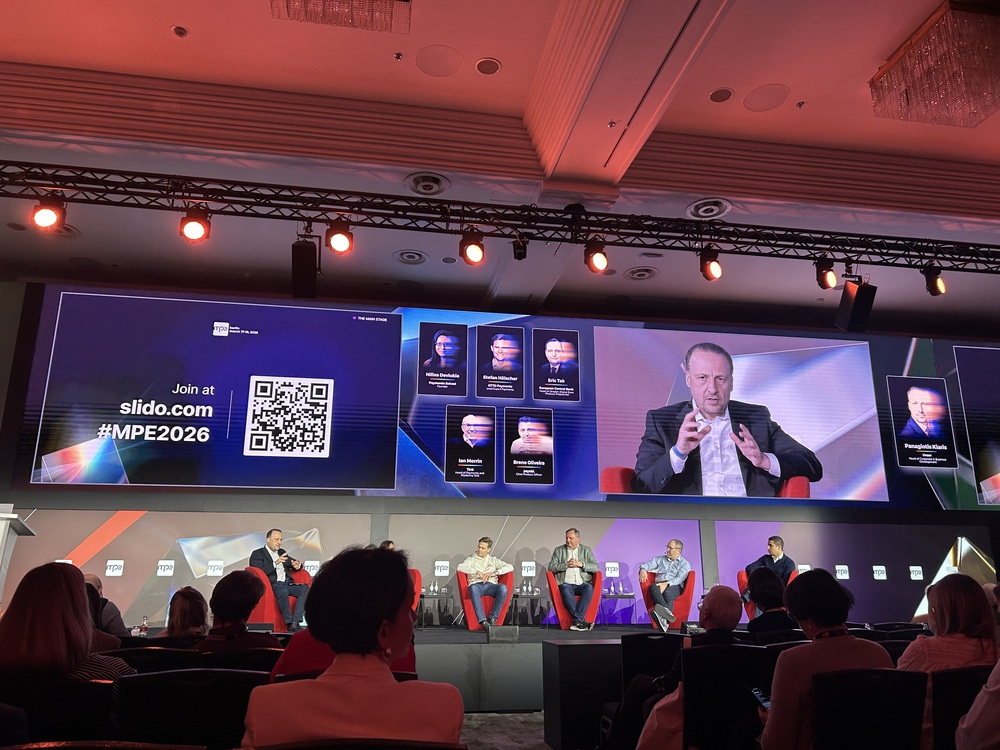
Some, including moderator Panagiotis Kriaris, Head of Corporate & Business Development at Unzer, believe there is no defining A2A payment scheme in Europe. While there may be none at the scale of Unified Payment Interface (UPI) in India, or Pix in Brazil, A2A rails have begun to emerge.
“The rails are very similar across the European markets, but the way it is being adopted is different to the market,” said Ian Morrin, Head of Payments at Tink.
“In Sweden, Kivra is a mailbox where all your bails are to, 80% of the population uses that via Open Banking. In Germany, some of the biggest growth we’re seeing is in e-commerce.”
In the UK, we can see that in January, there were 35 million in transactions, but 5 million were sweeping Variable Recurring Payments (RPs). You have a very different set of use cases.”
Once again, Wero was highlighted as a solution to solve Europe’s search for a consolidated A2A payment method that can reduce the dependency on largescale US networks.
Eric Tak, Head of Product Proposition Division at the European Central Bank (ECB), admitted the ECB is a fan of Wero. “We think it should be there”, he said. However, he cautioned whether or not Europe has prepared multiple A2A rails ready to become interoperable with existing channels.
“We are a bit less convinced with the interoperability of the European schemes, because without reach, you do not get scale, you need to add complexity and cost for interoperability,” said Tak. “We believe there could be two or three that have the number of translations and unit costs, but no more than 10.”
Fragmentation can then often become a challenge for merchants and small businesses when looking to scale their operations cross-border, while realising the cost-effective benefits of A2A.
But if Pay by Bank is not as popular in Spain for instance, as it is in the UK, choice ultimately affords merchants the benefit of not having to integrate as many payment methods as possible if most are not needed.
“What we see with successful A2A use cases, our research showed if the checkout is more than 10 seconds, they give up on the purchase,” said Breno Oliveira, Chief Product Officer at payabl.
“It is the balance of what the consumer wants, and the commercial aspect.”
So, in a bid to reduce fragmentation, is Wero the answer? The payment method has already grown amongst B2B payments, according to Oliveira, but is the next step in its growth to impact the retail checkout and to become popularised amongst consumers?
“Is it for sure? Nobody knows right now,” said Oliveira.
“If we are experimenting with Wero, it is still developing and we need to take in many considerations and ask users how this is used.”
To read all the developments and key talking points from MPE Day One, click here.
Stay tuned for more developments in merchant payments, emerging technologies and digital currencies during Payment Expert’s coverage of MPE Day Three.