Payment Expert’s Callum Williams has been on the ground at Merchant Payment Ecosystem (MPE) in Berlin. Read all the developments, key talking points, and industry views from day three.
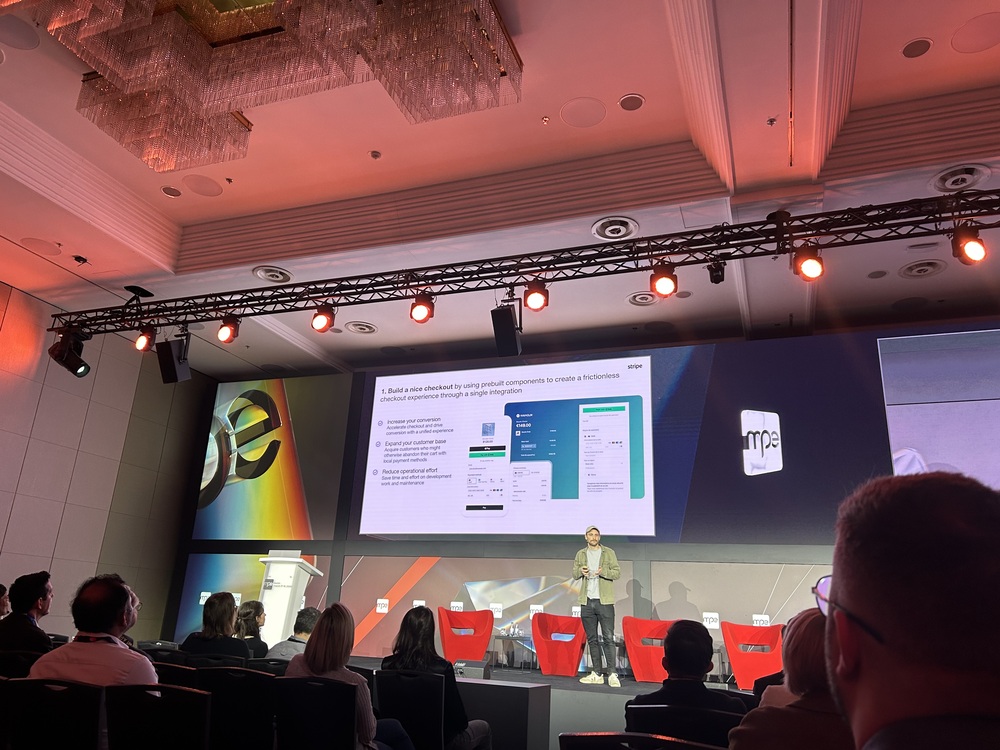
The final day of MPE kicked-off with Julius Danek, Head of Product (DACH) at Stripe, delivering a keynote presentation on simplifying the checkout process by applying Stripe’s full-stack checkout solution system.
He emphasised the need for merchants and payment services to “get the basics right”. This mantra, which Stripe applies to many of their partners (such as OpenAI and Anthropic), revolves around three key factors.
The first approach involves building a checkout using pre-built components. Danek emphasised that, to accelerate the checkout process, it must be simple, seamless, and easy for customers to use. This can be achieved by creating a unified experience that increases conversion rates, incorporates local payment methods, and leverages fast, reliable backend infrastructure—such as Stripe’s—to reduce the need for manual maintenance. He also noted that a clunky or fragmented user interface can quickly deter consumers.
The second factor centres on thinking globally while acting locally. Danek explained that merchants should dynamically present the most relevant payment methods –both local and global – tailored to each market, using real-time signals to determine what customers are most likely to use. According to Stripe data, dynamically surfacing an additional payment method beyond cards in checkout interfaces led to an average revenue increase of 12% among some of its partners.
Lastly was currency conversion. In an increasingly digital world, moulded by stablecoins and central bank digital currencies (CBDCs), Danek viewed this as a customer’s next choice vehicle and merchants need to begin to assess whether digital currencies would add value to their checkout.
He concluded by revealing that Stripe’s backend model is “continuously evolving” to meet these merchant and consumer needs, and are “future proof preparing for agentic commerce”.
Real-world use cases, for real-time Open Banking payments
Open Banking was also on the agenda today, with panellists noting its payment offshoots have increasingly become a valuable proposition for merchants. Katharian Luschnik, VP of Open Finance for Mastercard Europe, and Corina Metternich, Head of Business Product Payment Methods at Deutsche Bank, revealed how this is happening in real-time retail settings.
In June 2025, Deutsche Bank integrated Mastercard’s Open Banking technology to facilitate pay-by-bank to its European merchants. “We have one client that has said it has changed the way we perform payments,” said Metternich.
This merchant was revealed to be AIDA Cruises. Metternich said Mastercard and Deutsche Bank’s offering enabled the company to issue and process 2.5 million invoices last year.
The basis for adopting pay-by-bank was the seamlessness of the transferring of bank data and customer information, allowing customers to authorise bank transfer payments faster and with less reconciliation time.
“(Customers) can hand in the data they need for a smooth reconciliation because the solution is so easy to adapt to client needs. Then the treasury can reconcile it and does not need to bring in new processes,” added Metternich.
The risks of finding a BNPL partner
Later on in the day, buy now, pay later (BNPL) became the topic of conversation. Two views were brought to the table – the first being a value proposition for merchants and retailers seeking to maximise their customer base by enabling flexible instalment-based payments to secure customer retention.
On the flip side, the risks associated with the payment method have become increasingly under the regulatory microscope. But the grey area merchants seem most concerned with is whether the consumer misses a payment. What does this mean for their bottom lines, and what are the risk policies when it comes to outsourcing BNPL partners?
Matthias Terlau, Partner at GÖRG Partnerschaft von Rechtsanwälten, said this is “obviously a big issue and a very important topic,” referencing to merchants the importance of enquiring about the missed payment policies to BNPL companies.
“One of the main goals of outsourcing BNPL providers is the concern of outlining the risks of customers not paying,” he said. “The provider must assess the risks and the enforcement of claims.”
Stefan Holscher, Lead Expert Payment at OTTO Payments, believes this is a key difference between whether a consumer is able to make an instalment, or just doesn’t want to. This could be a blessing in disguise, he notes, as a trusted customer could still be retained if the policy is more lenient.
“You have to differentiate if the consumer is unable or unwilling to pay,” said Holscher. “If it’s a good customer, the merchant has to decide to treat the customer and offer options to extend the due date with a small fee attached. This is what our customers love.”
The outsourcing of BNPL providers for merchants can also have an impact on customer information and data. This is due to merchants obtaining customer data differently from traditional card payments, such as credit risks and financing. However, Sabrina Flunkert, CEO of Ratepay, believes there is a solution to this issue.
“The consumer is being transferred into the ecosystem by the provider,” she said. “If you go with a white label provider, you keep control, as the customer information belongs to the merchant.”
How Europe & UK can capture embedded finance’s “white spot”
As the final day of MPE began to wind down, attention turned to embedded finance, where it was revealed the US are leading the way; with many SaaS and tech providers realising their value ahead of the European counterparts.
Charlotte Al Usta, Senior Manager at Flagship Advisory Partners, outlined how payments and fintech services make up the majority of traditional software US companies, such as Shopify and Bill, revenues.
“For software platforms, increasing revenues, higher customer retention, increasing the lifetime value of the customer, and the potential of embedded payments, has been proved in many industry verticals,” said Al Usta.
Shopify was identified as one of the leading software vendors which exemplified the shift to becoming, in Al Usta’s words, a “fully-fledged” fintech.
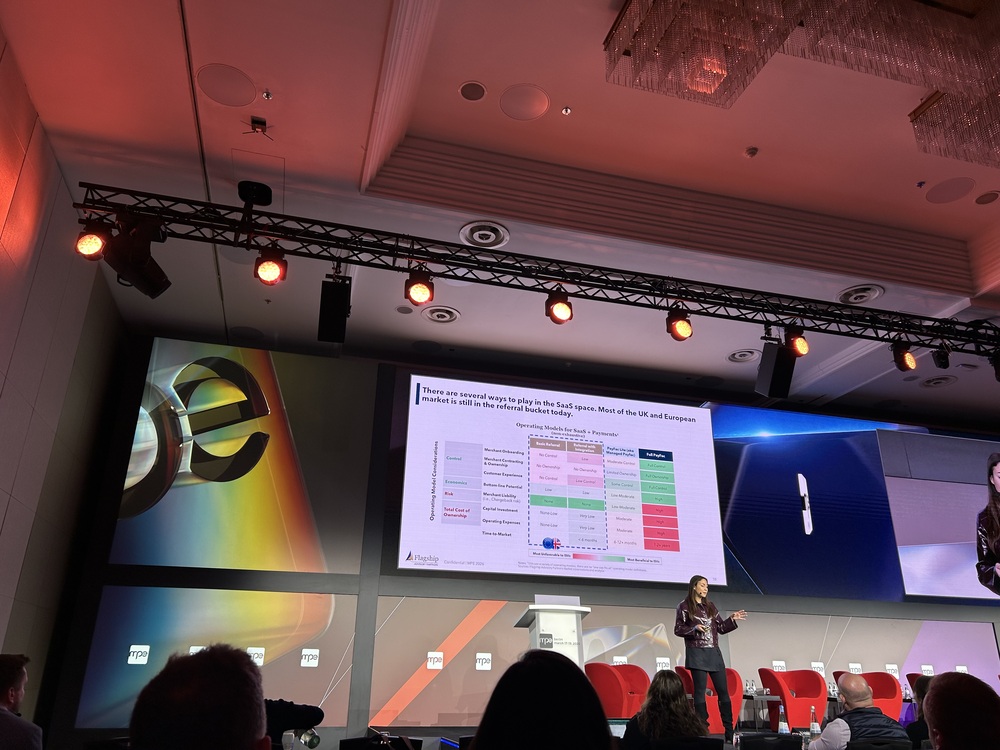
“We usually see a software platform have relatively loose integrations, but quickly realise they can make a lot of money in payments, and then move into the integrated payment buckets,” said Al Usta. “We see a scale of maturity in the embedded payment journey, effectively owning the customer through the journey, and then, operating as a fully-fledged fintech.”
“Shopify was one of the first to launch embedded payments, which started with its own branded payment proposition, and then waited eight years before launching the next use case, which was merchant cash advance. It has effectively changed their business model; they are good at selling software, but adding payments adds a whole new revenue driver.”
While US software companies appear to dominate the embedded finance market, the reality is that it remains open to a wide range of players, as non-payment companies can integrate services such as lending and banking into their offerings. This creates an opportunity for businesses in the UK and Europe to regain momentum. Al Usta noted that 80% of small businesses purchase embedded payment services from the first vendor they encounter, highlighting the importance of early engagement.
She also pointed to the significant “white space” that both payment providers and merchants can still capitalise on in these regions, while emphasising the structural and regulatory differences between the UK, Europe, and the US.
“There is a massive opportunity for payment service providers as there is a lot of white space,” Al Usta added. “For webshop platforms, like Shopify, that is already highly mature and that ship has already sailed for payment service providers. But there is still a lot white space to be captured.
“This is equally the same across regions. Yes there is a lot of revenue to be captured but it is slightly fragmented, with different payment mixes – Europe is bank centric – and from a regulatory perspective, going down the route of a full PayFac system, you need to register as an EMI in Europe.”
Has consumer adoption caused both digital wallet growth and fragmentation?
The final topic of discussion was digital payment wallets, which have become the most popular method of payment, with the likes of Apple Pay gaining a large share of the market.
Over the past few years, however, there has been a surge in localised payment wallets in certain regions – notably Europe; from BLIK to Poland, to iDeal in the Netherlands and now, a new pan-European wallet in Wero aiming to capture some of that market share back from Apple.
Fragmentation then becomes a question. How do regulators define the wallets we use, and are they tailored to the customers in specific markets and now, customers of a specific brand? Yuriy Kostenko, Partner at Flagship Advisory Partners, believes there are two forms of fragmentation; wallets that act as a consolidator, and the volume of wallets within a region.
“There are two forms of fragmentation. The wallet will act as a consolidator for the multiple features. We don’t want it to act as a payment terminal, it can act as an ID storage, licenses, etc., for multiple purposes. Regional fragmentation will remain. Every EU region is very different. BLIK is so successful because customers were so used to bank to bank payments. Fragmentation will continue because by nature, we behave very differently.”
Across Europe, policymakers have begun to develop their own native digital wallets in a bid to protect their sovereignty. A consortium of European banks launched Wero in 2024, and now Canada is aiming to do the same with Interac. Shenela Tavarayan, Director of Product Development at Interac Corp., revealed how many major financial institutions in Canada have been pushing for Interac’s arrival.
“Interac shareholders are banks,” said Tavaryan. “We currently have five banks live with the wallet. Expectation is to have an additional 9% of market share this year to then have 60% in total once it becomes affordable.”
But what does the surge in digital wallets mean when companies such as Wolt, a food delivery service, begin to launch their own wallets?
Danish Kanojia, Payments Product Lead at Wolt, shared how the company’s native wallet is built for its customers on loyalty, and ultimately, retention. “When the consumer is at the checkout page, we do not want them to access their digital wallet, we want them to store their money within our wallet,” said Kanojia.
Whether they are used for a specific market need, or to retain customer loyalty, digital wallet growth lies within the hands of the consumers, as Nick Dobson, CEO of Unetix, pointed out.
“There have been so many attempts to do things driven by cost savings, but we forget we’re all consumers,” he said. “Apple Pay has become so dominant in the UK as it began to become integrated in TFL, paying contactless on the underground in London.”
To read all the developments and key talking points from MPE Day One, click here.
To read all the developments and key talking points from MPE Day Two, click here.