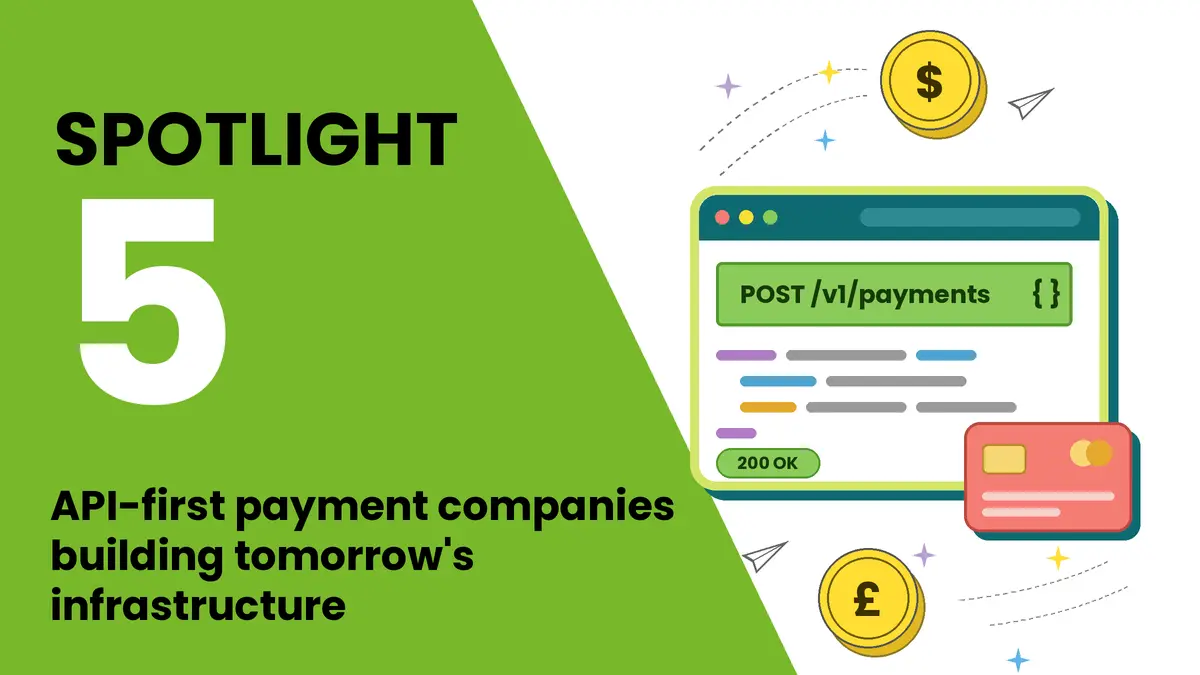
Payment Expert spotlights five API-first companies and explores what each does best.
In the late 1990s, the term application programming interface (API) would likely have raised questions for everyone but the most technically equipped members of a bank’s IT team.
Fast forward three decades and the marketing teams at banks and payments companies can likely give you a detailed explanation of the several uses of an API.
In case you don’t yet know, an API is a way for software systems to communicate with one another. A business can use an API to connect to an existing service, share data or launch new services on its platform.
It has become especially important in payments for accessing payment processing, account information and fraud prevention, and it is about to become even more ingrained in the sector.
Agentic payments, as well as alternative payment methods such as pay by bank, are making APIs a necessity for connecting businesses, financial institutions and consumers.
Given how vital APIs have become, they’ve become a competitive battleground for fintechs. Payment providers are slapping the term ‘API-first’ on their offerings more and more.
However, as with many technology terms that gain momentum, their meaning can become blurred.
What “API-first” actually means (and what it isn’t)
In payments, being API-first means tailoring the payment infrastructure around programmatic interfaces from the start. This does not mean developing a merchant portal or internal banking system, adding an API later.
The same capabilities available through a provider’s dashboard should also be accessible to developers through code.
However, API-first doesn’t mean offering a modern REST API or removing the user interface.
Some providers might add APIs to legacy infrastructure, which makes their services accessible. Therefore, the question is how deeply it is integrated, not just whether they have an API.
The five companies and what each does best

Airwallex
What is it?
Founded in 2015, Airwallex is a global fintech platform that provides payment processing, multi-currency accounts, foreign exchange, payouts and card issuing through a suite of APIs.
What it does best
Airwallex is attractive to businesses operating across multiple markets and currencies because its APIs support international payment acceptance, global transfers and embedded financial services.
Nium

What is it?
Founded in 2014 and rebranded as Nium in 2019, the company is a global payments infrastructure provider that makes it possible for businesses to send and receive money across different regions.
What it does best
Nium specialises in cross-border money movement, with its infrastructure allowing banks, fintechs and enterprise platforms to integrate international payouts and other financial services without individual banking and payment relationships in every market.
Moov

What is it?
Founded in 2018, Moov is a payments infrastructure platform that helps developers and businesses build money movement into their applications.
What it does best
Moov focuses on handing platforms control over the payment experience, with its infrastructure allowing marketplaces, software providers and fintech businesses to onboard users, accept payments and move funds through their own products.
Column

What is it?
Founded in 2019, Column is a nationally chartered US bank created around providing financial infrastructure through APIs. It offers programmable bank accounts, ACH transfers, wire payments, real-time payment capabilities, card programmes and other banking services.
What it does best
By operating its own banking core and connecting to payment networks, it offers fintechs and payment companies access to banking capabilities through a developer-first model.
Volt

What is it?
Founded in 2019, Volt is an open banking payments provider that connects domestic real-time payment systems.
What it does best
Volt specialises in pay by bank and real-time account-to-account payments. Its infrastructure helps merchants and payment providers integrate bank payments into checkout experiences, with API-only, hosted and embedded integration options.
Why merchants and platforms are moving to modular stacks
Merchants and payment platforms have relied on all-in-one systems to manage payment operations for the best part of 30 years. However, businesses are starting to migrate to modular payment stacks.
Monolithic systems require merchants to rely on one provider for multiple services, including payment processing, routing, fraud prevention and reconciliation.
If one part of the infrastructure experiences an outage, it can disrupt the rest of the payment operation. Merchants are also tied to a provider’s pricing structure and technology, making it difficult to negotiate fees or introduce new services.
API-first infrastructure means businesses can connect individual services through payment APIs. Checkout, payment routing, fraud detection and reconciliation can operate separately, so upgrading or replacing is much easier.
Businesses looking to expand to new markets can also use modular stacks to integrate local payment methods, alternative payment options and regional providers through APIs.
Modular stacks are also likely to become more important as AI enters commerce, with agentic shopping assistants requiring access to real-time payment and customer information to initiate transactions.