Calls for wider action on fraud are becoming Groundhog Day for the financial industry.
Santander UK has challenged other UK sectors to do more to tackle fraud as authorised push payment (APP) scam losses jumped 22% in the first half of 2026.
Chris Ainsley, Head of Fraud Prevention at Santander UK, made the call in comments following the publication of UK Finance’s Half Year Fraud Report 2026 today (25 November).

Covering fraud trends between January and June 2026, the report put APP fraud losses at £316m across 138,345 recorded cases, a 25% rise from the same period last year.
Unauthorised fraud losses fell by 2% to £343.5m, with banks preventing £810.5m in attempted fraud, which is equivalent to 70p for every £1.
Speaking on these figures, Ainsley said: “These figures show that households are being bombarded with fraud attacks and scam content every day – and losing ever-growing sums.
“It’s encouraging to see that banks are helping to protect customers by preventing more money being stolen than is being lost to fraud. But it’s clear that other sectors must step up to help cut scams off at source.”
Fraud prevention requires teamwork
Ainsley’s comments are similar to those of Ruth Ray, Managing Director of Economic Crime at UK Finance, who said the financial services industry invests in protecting consumers but “cannot tackle this threat alone”.
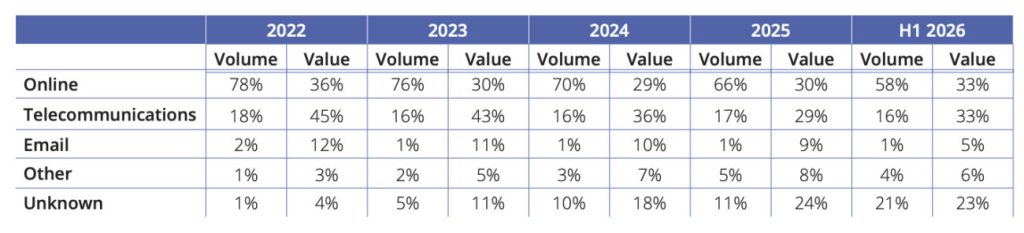
The latest report found that 58% of APP fraud cases originated online and a further 16% began through telecommunications networks. Both channels accounted for 33% of APP losses, highlighting the role these sectors play in housing scams.
However, the figures are also starting to feel like Groundhog Day for the UK financial industry.
In June, UK Finance’s Annual Fraud Report found that 66% of APP cases originated online and 17% through telecommunications.
Ray said at the time that the financial services sector “cannot be the only line of defence”, calling for “stronger, enforceable responsibilities” to be placed on technology and telecoms companies.
Regulators are starting to respond, although some measures that aim to tackle fraud at source are still being developed or phased in.
In July, Ofcom published draft Fraudulent Advertising Codes of Practice, proposing additional requirements for major online platforms, including stronger checks on advertisers and financial promotions as well as measures to identify and tackle fraudulent adverts.
The regulator plans to publish its final statement by mid-2027, meaning the proposed requirements are not yet in force.
Ofcom did, however, finalise new rules in July requiring mobile operators to identify and block scam messages, introduce volume limits for pay-as-you-go SIM cards and check businesses using branded messaging services.
Despite these actions, people in the industry still feel more needs to be done in terms of collaboration, such as George Ralchev, Head of Risk at emerchantpay.
He said: “Greater collaboration is also needed across sectors to stay ahead of the growing threat, alongside consumer education to empower them to better identify high-risk transactions.”
“Merchants must do more to build safety into every transaction, partnering with payment service providers to give customers confidence that their payments are protected. There is a commercial need to boost security too – businesses that fail to keep pace with the evolving fraud landscape risk losing both customer trust and ultimately revenue.”
Reimbursement isn’t a defence
One of the biggest talking points around APP fraud is the Payment Systems Regulator‘s mandatory reimbursement regime, introduced in October 2024, which requires payment service providers to reimburse eligible victims on a 50:50 split by the sending and receiving firm.
The rule was viewed as controversial ahead of its implementation by some in the industry, who argued that social media and telecommunications companies should also be held accountable and shoulder some of the financial responsibility.

In 2024, Woody Malouf, then Head of Financial Crime at Revolut, said: “These plans are baby steps, when what the industry really needs is giant leaps forward.
“Victims and financial institutions still ultimately bear the cost. These platforms share no responsibility in reimbursing victims, and so they have no incentive to do anything about it. A commitment to data sharing, albeit needed, simply isn’t good enough.”
UK Finance has repeatedly made the point that reimbursement aims to protect consumers after they have been scammed and not prevent fraud in the first place.
Jonathan Frost, Director of Global Advisory for EMEA at BioCatch, said banks were “spending 29% more on reimbursing victims while APP fraud losses have risen 22%”. He added: “The UK’s experience shows that changing who pays for fraud is not the same as preventing it.”
AI raises the stakes for fraud prevention
The challenge is likely to increase as criminals have begun to leverage more sophisticated AI models and agents to make scams cheaper, more convincing and easier to commit at scale.
Speaking at the Singapore FinTech Festival last week, which Payment Expert attended, industry experts warned that advances in technology are changing the scale and sophistication of fraud and creating new challenges for security measures.

Aishwarya Jayakumar, Head of Risk & Security Intelligence Solutions, Value-Added Services, APAC at Visa, said AI hadn’t fundamentally changed the nature of deception, but had increased the “volume, the velocity and the variety” of fraud.
Iain Armstrong, Executive Director of FCC Strategy at ComplyAdvantage, warned that stronger cryptography and authentication will come in handy, but fraudsters will likely adapt their tactics and target victims through APP fraud.
“Cryptography can tell you who is making the call, but it can’t tell you what they have been told to do by a fraudster,” he said.