Payment Expert’s ID Check: Payments Professionals offers insight from industry leaders and experts on how they got their start in the financial industry, from their early years in education, to how they have been able to climb the corporate ladder.
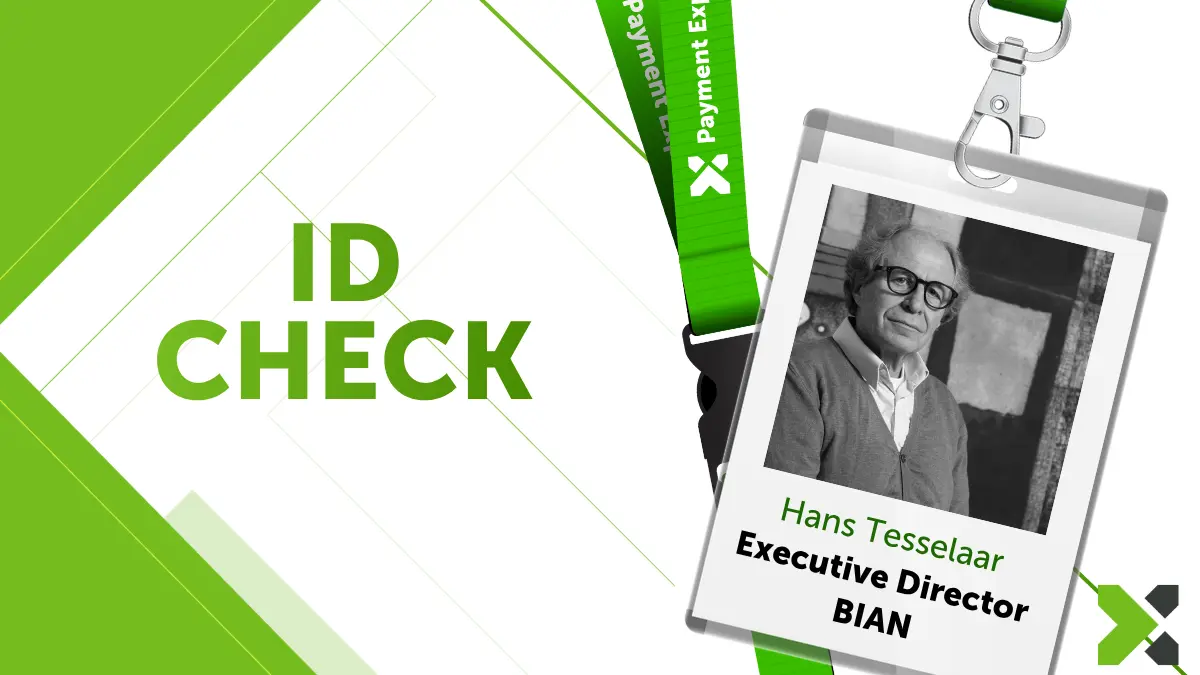
This week, Hans Tesselaar, Executive Director at Banking Industry Architecture Network (BIAN), delivers insights into how researching standard software in the US gave him his first big break, why he had to take a pragmatic approach to innovation at ING Insurance when the business still ran on legacy technology, and why clear standards and consistent frameworks have shaped his work since he started as a programmer at Dutch Postbank.
Where did you go to university and what did you study?
I completed a part-time MBA in Business Automation, followed by executive study at Stanford University and Saïd Business School in Oxford.
What impact did this have on your current journey?
My studies gave my career a boost. When I was later asked to take responsibility for IT strategy and innovation at ING Insurance, my strong theoretical background in business helped me step into the role and succeed.
I’ve also served on several boards, from the Banking Industry Architecture Network (BIAN) to banking software solutions platform Zafin, where my role has been to help businesses bring products to market quickly and easily, with a focus on revenue growth.
What first drew you to the payments industry and why have you stayed?
I started my career as a programmer at Dutch Postbank, and over the past 30 years, I’ve worked across the financial services sector, including banking, insurance and pensions.
During that time, I spent eight years in management roles at ING, progressing from Chief Architect to Director of Sourcing, Innovation and Governance. I was also a managing partner at a Dutch ICT consultancy specialising in financial services.
What I find interesting is how changes can seem quite small at the time, but when you look back over 30 years, you realise just how much has changed.
Now, as Executive Director at BIAN, I’m still really interested in where the industry is heading, especially with technologies like AI changing the way banks operate.
A big part of that is looking at how banks can work better together, and with other industries, to keep up with these changes.
Are there any lessons from your first role in the industry which you still draw on?
The lesson I still draw on is to always prepare for the unexpected. If you have a plan to counter potential risks, that’s the best-case scenario, whether in consulting or banking.
I’ve also always believed in the importance of clear standards and consistent frameworks, as they play a key role in delivering quality work. This focus on quality has stayed with me from the very beginning of my career.
When was your first big break in the industry? Why was this such a significant moment for you?
My first big break came when I carried out research in the United States into the availability of standard software. At the time, this knowledge wasn’t readily available in the Netherlands, so the research gave me a substantial competitive advantage. This access to knowledge made it a significant moment in my career.
This has had a domino effect on my career and the opportunities that I’ve gone on to have. For example, my first client as a consultant was someone I met during my studies in the US, and this was a breakthrough moment in my career as a consultant.
Was there a moment you faced in the industry which really challenged you? How did you overcome this?
A particularly challenging moment came when I became responsible for IT strategy and innovation at ING Insurance, as it was called in those days. Banking and insurance, as you know, haven’t always been the quickest to embrace new technology, especially compared to industries like tech and telecoms.
So, when I was asked to take on a role focused on ‘innovation’, I had to deploy a pragmatic approach to bringing change to industries operating on legacy technologies.
What are some of the skills you deem essential to starting in your industry and how have yours developed over the years?
I think one of the most important skills is being able to see the bigger picture while still having a good understanding of the details. It’s about finding that balance between technical knowledge, strategic thinking and people skills, especially as you take on more responsibility.
For me, those skills have developed naturally over the years. I was lucky to have a mentor who helped me build my management skills, and since then, I’ve gained experience in everything from business strategy and enterprise architecture to innovation, people development and organisational change.
I’ve also worked with organisations around the world to help shape their digital strategies and make sure they have the right technology and people in place to support them.
Who was your biggest role model – inside or outside of your industry – who continues to inspire you in your current career?
My previous CIO, who I’m sure would prefer to remain unnamed, was my biggest role model. He gave me opportunities and supported my development throughout our time working together.
If you didn’t work in the industry, what other career option would you have pursued or would have loved to?
I would have pursued a technical role in the telecommunications industry. My first real job was in telco as a telephone exchange designer, which is, of course, now completely obsolete knowledge. However, the technology in the sector has moved at such a high speed that it would have been great to be a part of it.
Lastly, what is some advice you would give to an aspiring person looking to get a start in your respective industry?
My advice would be to make the most of every opportunity that comes your way, even if you’re not entirely sure what it will involve. Over the years, I’ve accepted roles I didn’t feel a hundred per cent ready for, but I’ve always seen them as a chance to learn, challenge myself and develop new skills. Sometimes you just have to take that leap, grow into the role and prove what you can do.
Interested in sharing your experiences from the industry and passing on advice to the next-generation for ID Check? Contact: [email protected]