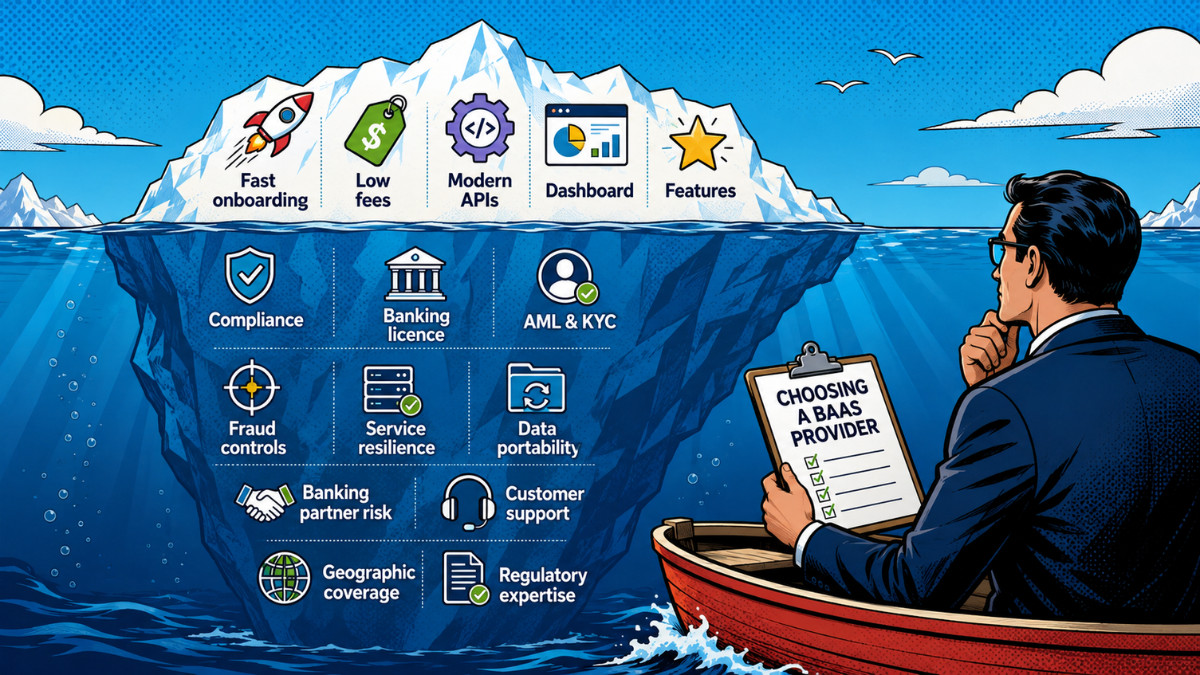
Non-bank brands can offer regulated accounts, cards and payments through a licensed bank’s infrastructure, without a licence of their own. How BaaS works.
Banking-as-a-Service (BaaS) lets a non-bank company offer regulated banking products – accounts, cards, payments, lending – without holding a banking licence of its own.
The company connects to a licensed bank’s infrastructure through application programming interfaces (APIs) and presents the resulting products to customers under its own brand.
The three parties behind every BaaS deal
A licensed, regulated bank sits at the base of the model, holding the deposits and carrying the balance-sheet and regulatory obligations.
A BaaS provider, or platform, operates the middleware – the APIs, onboarding, compliance tooling and transaction processing that connect the bank to the outside company. A non-bank brand – a retailer, marketplace, fintech or software firm – embeds the products into its own app or checkout.
Tom Bentley, Chief Commercial Officer of VODENO, previously described the split of work to Payment Expert: “The BaaS provider works behind the scenes to deliver the underlying technologies, balance sheet requirements and compliance needs to ensure the smooth operation of the product, leaving the client to focus on improving every other aspect of the end-user experience.”
A brand’s app sends a request – open an account, issue a card, move money – to the provider’s platform, which routes it to the bank and returns the result to the customer in real time.
Know-your-customer and anti-money-laundering checks, ledger management and payment rails run through that same layer. The customer sees the brand while the bank and provider stay in the background.
Products built this way are usually white-labelled, carrying the brand’s name rather than the bank’s. Bentley pointed to decoupled debit as one case: a decoupled debit card is a branded card a retailer offers its customers, linked through Open Banking APIs to the user’s existing bank account so it draws funds without manual top-ups.
Embedded accounts, branded cards, Buy Now Pay Later (BNPL) and merchant financing follow the same pattern. Bentley noted that merchant financing suits SME retailers because credit limits are based on turnover history rather than the financial-statement approach used by traditional banks.
BaaS, open banking and embedded finance

BaaS is distinct from open banking, though both rely on APIs. Open banking governs the regulated sharing of account data and payment initiation between banks and third parties, mandated in the UK and EU by rules such as PSD2.
BaaS supplies the banking products themselves, while embedded finance describes what the customer experiences – a financial product placed inside a non-financial journey – while BaaS is the infrastructure delivering it.
Max Chuard, CEO of core-banking firm Temenos, previously told Payment Expert the company offers “a unique end-to-end BaaS proposition, which can power the technology needs of all BaaS ecosystem participants”.
Provider models vary; some are licensed banks offering direct access, while others are technology platforms sitting between brands and partner banks. Some combine both.
Why companies use BaaS
Obtaining a banking licence takes years and heavy capital. A BaaS integration lets a firm launch financial products in months by using the licence and infrastructure of a partner.
Companies outside financial services can add banking features to platforms their customers already use – a marketplace paying out sellers, a gig platform paying workers instantly, a software firm giving business users accounts and cards.
The licensed bank remains accountable for regulatory compliance even when a partner operates the programme, and regulators in the US and UK have scrutinised bank-fintech BaaS partnerships where oversight of downstream programmes proved weak.
Brands using BaaS depend on their provider’s systems and licence, which concentrates operational risk in the partner. A firm which embeds banking products still carries obligations for how those products are marketed and monitored.