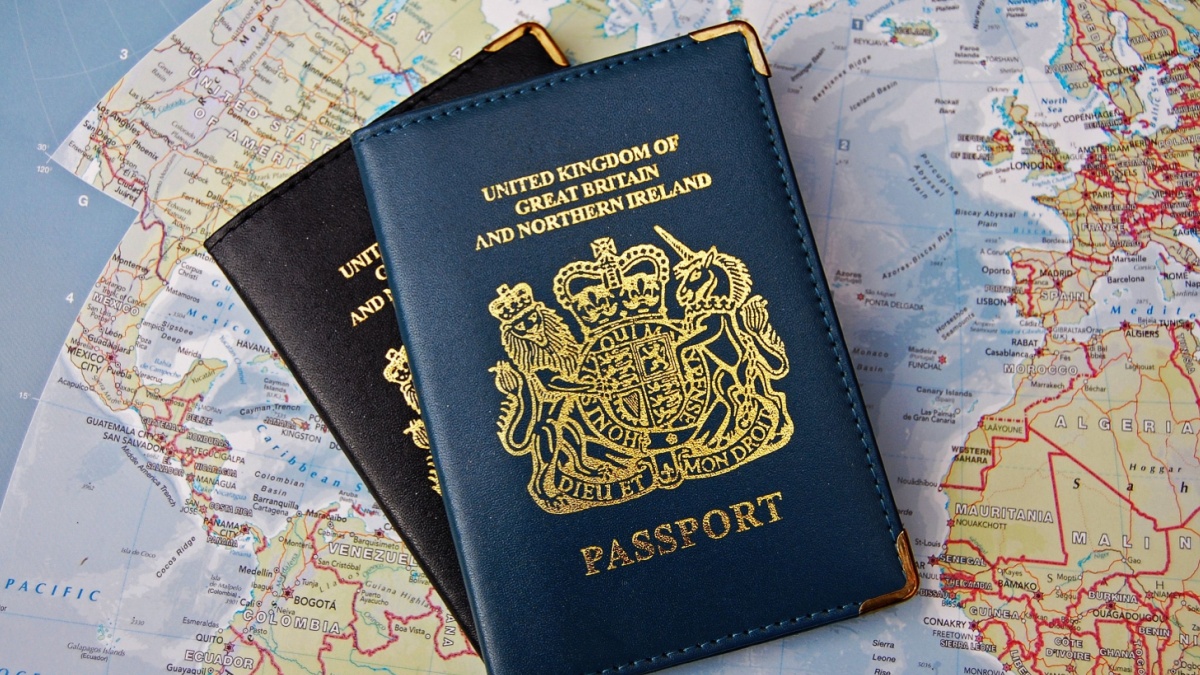
Andy Burnham may be hoping to bring some stability to the UK as the fifth Prime Minister in five years, but his policy changes are already creating confusion.
The new UK Prime Minister hasn’t taken much time getting stuck into his role, having already reversed the Labour Party’s national digital ID scheme within the first few hours of him moving into 10 Downing Street.

The policy, introduced under Keir Starmer, looked to create a government‑issued digital ID credential for identity verification and right‑to‑work checks. It was hugely controversial and attracted more than 3 million signatures opposing the idea.
It was also set to be expensive, with the Office for Budget Responsibility estimating annual costs of around £600m.
The cost, and perhaps the need to win over the public quickly, led to Burnham’s decision to shelve the scheme, branding the move as part of a “reset of priorities”, with funding redirected towards tackling the cost‑of‑living crisis.
The headline about the scrap has caused quite the stir. Some people may be happy to see the scheme abandoned, noting data‑privacy concerns, while others who believe digital identity could help solve a range of financial and fraud‑related challenges may be dismayed.
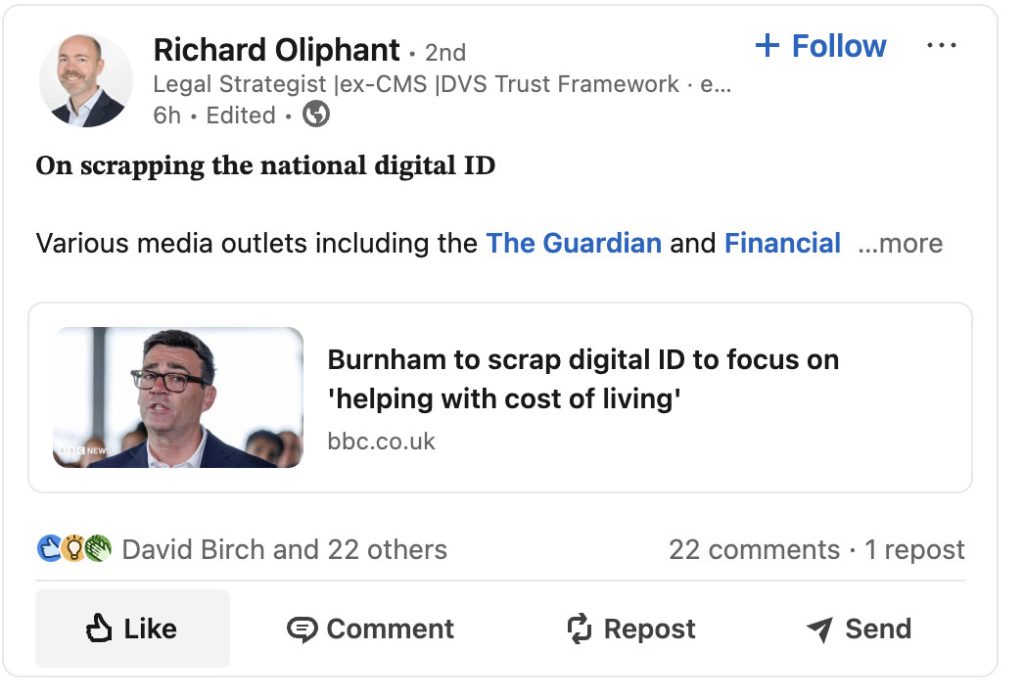
However, digital identity experts such as legal strategist Richard Oliphant have taken to LinkedIn to explain that much of the commentary “is missing the mark”, because while the national digital ID credential is gone, the country’s wider digital identity ecosystem is still in place.
What has been scrapped?
If it had gone ahead, the national digital ID scheme would have introduced a government‑issued credential for identity verification, initially pitched as a mandatory requirement for immigration control which would later be tied to right‑to‑work checks.
The proposal was backed by senior figures including former UK Prime Minister Tony Blair, who had previously overseen a similar and failed identity card programme, with ministers describing the system as the “bedrock of the modern state”.
However, after opposition from other parties and civil rights organisations, Starmer watered down the proposal, stating that digital ID would only be mandatory for right‑to‑work checks and not for access to public services.
Therefore, the scheme would have created a single, centralised government credential that employers would be required to check before hiring someone
What has not been scrapped?
Despite the headlines, the UK is not abandoning digital identity altogether. GOV.UK Wallet and the Digital Verification Services Trust Framework are two programmes that will continue to be developed.
GOV.UK Wallet
The GOV.UK Wallet is launching this summer and will allow people to access digital versions of credentials such as passports and driving licences. These verifiable credentials contain many of the same attributes as a digital ID, including name, date of birth, nationality and a biometric photo.

However, they sit within a separate and decentralised workstream that has been in development for several years.
In his LinkedIn post, Oliphant says that he has seen no suggestion that the GOV.UK Wallet will be scrapped, adding that it should continue to be rolled out once the development is complete.
Tony Craddock, Director General of The Payments Association, told Payment Expert last year that digital identity is essential for unlocking programmable money, real-time cross-border payments and secure open banking.
Craddock also highlighted its role in tackling authorised push payment (APP) fraud and money mule activity and said a reliable identity layer is needed to support the next phase of payments innovation.
DVS Trust Framework
The DVS Trust Framework is now on a statutory footing and includes more than 45 certified identity providers such as Yoti, Entrust, Digidentity and OneID. The framework underpins reusable digital IDs across the private sector and, in February, HM Treasury confirmed that DVS can be used for know your customer checks under anti-money laundering rules.
Oliphant also wrote that scrapping the national scheme has no bearing on the DVS Trust Framework, adding that the government must promote adoption across financial services, conveyancing and other regulated sectors.
Where UK digital ID stands
Digital identity is still expected to play a massive role in the UK’s fight against fraud and financial crime.
Payments leaders have repeatedly argued that stronger identity verification can play a key role in reducing APP fraud, which is the UK’s most prevalent form of financial crime despite industry focus in recent years.
The EU is also moving ahead with its own digital identity scheme, where all EU Member States are required to provide at least one interoperable EU Digital Identity Wallet to all citizens and residents by the end of this year, creating pressure for the UK to keep pace.
Because of this, Burnham’s recent action is more nuanced than the headlines might initially suggest.