
The Mills Review, authored by Financial Conduct Authority (FCA) Executive Sheldon Mills, says the UK’s retail sector will be transformed with AI by 2030, and reveals the seven recommendations the country needs to apply now in order to achieve this
The UK’s Financial Conduct Authority (FCA) has found that AI will have a transformative impact on retail financial services by 2030 in a new report authored by Executive Director, Sheldon Mills.

The report, titled ‘The Mills Review’, was published today (6 July) and draws from 140 written submissions from senior figureheads in UK financial services, technology, regulation and academia sectors analysing how AI and agentic AI will play a pivotal role in retail payments in four years time.
By analysing the written submissions, the report outlines that retail consumers are shifting from human-led, episodic financial activities, to AI-enabled services that are automated and are continuous to carry out queries and payments.
As large companies such as OpenAI, Google and Visa have issued their own agentic commerce protocols, AI agents are rapidly becoming a go-to for consumers for a curated retail experience that is now enabling payment settlement.
The Mills Review defines this with a five-level ‘spectrum of autonomy’:
- Level 1 – The operator: where the human uses AI as an on-demand tool
- Level 2 – The collaborator: where the human and AI communicate, plan and act together
- Level 3 – The consultant: where the AI leads by comparing retail options and recommending actions while the human provides acceptance
- Level 4 – The approver: where the AI prepares or initiates actions while the human signs off on key steps
- Level 5 – The observer: where the AI executes continuous actions within pre-set limits while the human aggregates the outcomes
“The overarching takeaway is a fundamental transition from human-led, episodic financial activities toward retail services that are AI-enabled, continuous, and heavily delegated,” the report stated.
“This evolution will impact how financial products are designed, distributed, monitored, and governed, creating unprecedented opportunities to address historical market weaknesses such as advice gaps, protection gaps, low switching inertia, and financial exclusion.”
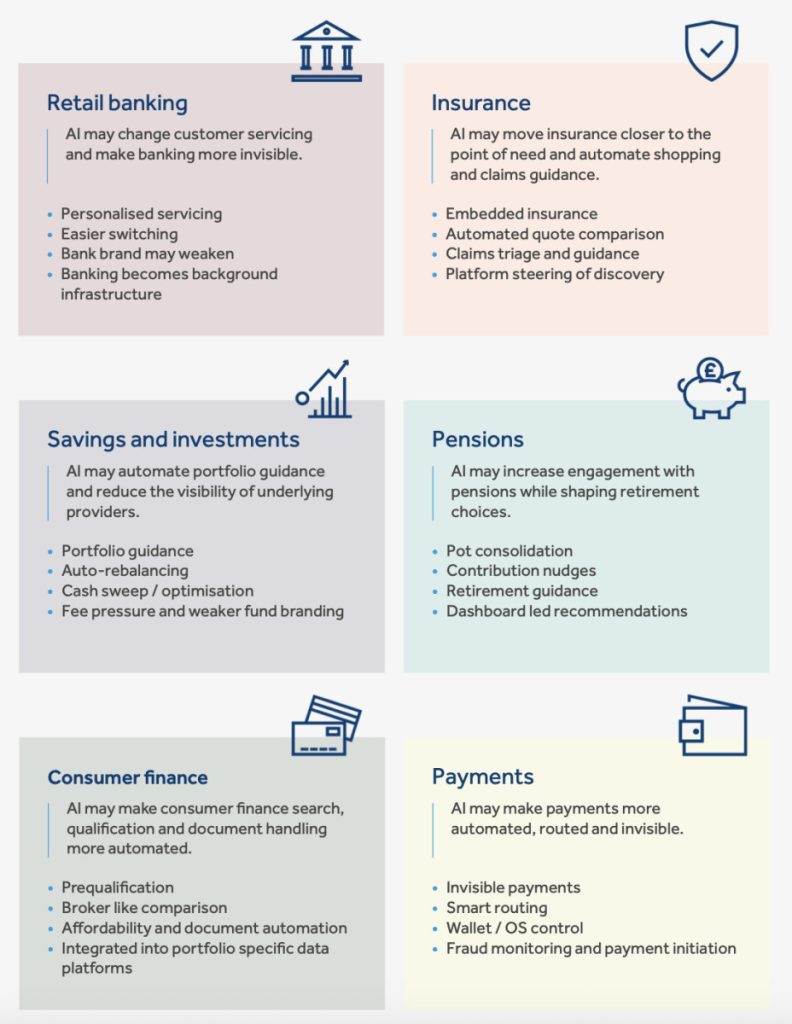
The four ‘systemic shifts’
The Mills Review outlined four structural market shifts that are expected to take place by 2030.
The first is the transformation of firms as AI will move beyond isolated task assistance solutions to becoming a core infrastructure, embedded tool to automate compliance, underwriting and product design as real-time monitoring of systems will become the norm.
The second shift outlined is agent-led consumer journeys. This refers to consumers leading their own retail experiences with the assistance of AI agents, but cautions the risks involved with hyper-personalisation and real-time behavioural manipulation.
The reshaping competition landscape is the third shift as AI is fast becoming one of the most valuable economic and capital opportunities. The report argues access to and control of AI-mediated consumer layers will become the dominant source of market power, as generative AI platforms such as OpenAI, Anthropic and more battle for market share.
The fourth and final shift was AI’s role in fraud mitigation and aggravation. AI is being dual-used by fraud prevention teams and criminals, with the technology posing new threats in the form of deepfakes and synthetic voice cloning to attack victims’ money.
The seven recommendations to the FCA
In order for the UK to capture the macro-and-micro economic benefits of AI adoption across the retail sector by 2030, The Mills Review has issued seven priority recommendations to the FCA Board and its Executives.
1. Secure and adapt the regulatory perimeter: Launch an immediate three-to-six-month review into general-purpose large language models (LLMs) operating outside the perimeter to eliminate regulatory arbitrage.
2. Strengthen system-wide coordination and oversight: Formalise domestic and international cross-regulator coordination on data, resilience, and competition using networks like the DRCF, IOSCO, and the FSB.
3. Monitor the transition to autonomous models and adapt regulatory frameworks: Issue clear adaptive guidance clarifying how outcomes-based standards, like the Consumer Duty and the SMR, apply to autonomous system environments.
4. Scale the FCA’s AI Lab: Build a structured independent capability within the AI Lab to evaluate technical explainability, model behaviour, and upstream design choices in regulated use cases.
5. Enable the foundations for agentic finance: Lead the development of a trusted agent protocol and standard financial architectures within open finance to manage digital identities, pre-authorised mandates, and clear liability rules.
6. Build and adopt an AI-enabled agentic supervisory model: Move from episodic human review to automated, real-time supervisory tools capable of observing market patterns and ecosystem dependencies across competitive firms.
7. Develop a trusted public-interest AI-enabled financial capability service: Explore a free, sovereign-style AI guidance platform in partnership with public bodies to ensure vulnerable or lower-income citizens maintain equal access to high-quality financial support.”

Should AI governance be the number one priority?
While the seven recommendations all have equal value to a future market built on the foundations of AI adoption, some within the UK payments industry argue that governance should be the number one priority.
Speaking to Payment Expert, Emma Banymandhub, CEO of The Payments Association, lauds the potential AI can have on financial services, such as investment and financial planning is enormous, but cautions the need for strong guidelines that put consumer protection at the forefront of the AI shift.
“Consumers may be increasingly comfortable using AI agents for routine tasks such as weekly shopping, but AI-driven savings and investment decisions present a very different set of challenges,” said Banymandhub.
“While AI can increasingly explain investment concepts and analyse financial information, personalised investment recommendations remain subject to important regulatory constraints.
“The FCA’s Mills Review reinforces that firms should treat agentic AI as an accountability and governance issue now, while providing greater confidence to innovate responsibly as AI adoption accelerates. AI has enormous potential for financial services, but realising that potential will depend on strong governance, clear accountability and maintaining consumer trust.”