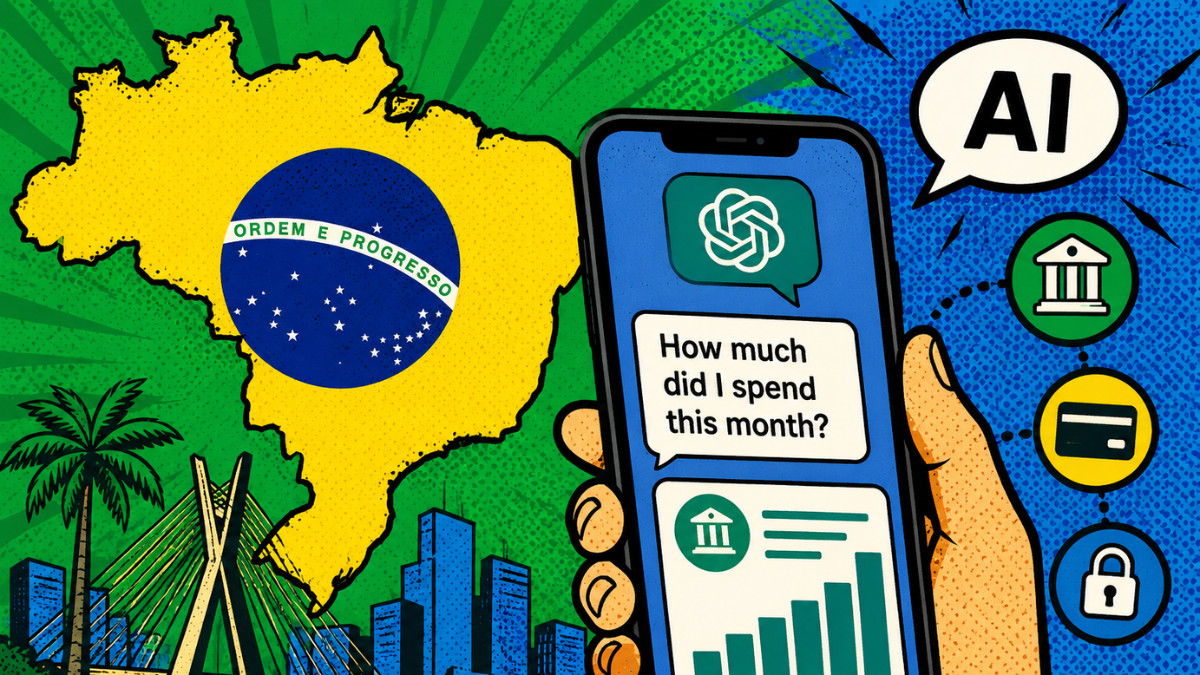
Cumbuca’s integration between Brazil’s Open Finance system and AI assistants like ChatGPT may represent more than another fintech launch. It could offer an early glimpse into how conversational AI becomes the next interface for financial services.
For years, digital banking has revolved around apps, dashboards and increasingly invisible payment rails. Consumers tap, scroll and swipe through financial interfaces designed to simplify access to money.
Now, Brazil may be testing what comes next.
In May 2026, Brazilian fintech infrastructure firm Cumbuca announced what it described as the country’s first integration between regulated open finance data and AI assistants such as ChatGPT and Claude. The launch enables consumers to query their own bank account and transaction data using natural language through AI tools, which many already use daily.
On the surface, the announcement resembles another AI-powered fintech product launch. Yet beneath arguably sits a more significant question for the payments and banking industries: what happens when conversational AI becomes the primary interface for financial services?
That possibility carries implications far beyond Brazil.
Why Brazil is the ideal testing ground
Brazil has become one of the world’s most advanced digital payments markets. The country’s Pix instant payments network, launched by the Central Bank of Brazil in 2020, now reaches around 91% of the adult population and processes more than six billion monthly transactions.
Alongside Pix, Brazil’s open finance framework has developed into one of the most ambitious regulated data-sharing ecosystems globally, giving consumers the ability to share banking information between institutions through standardised APIs.
Unlike many open banking initiatives in Europe and North America, Brazil’s system has achieved both scale and widespread consumer familiarity.
Speaking to Payment Expert, Pedro Castilho, CTO and co-founder of Cumbuca, argues one of Brazil’s key advantages lies in the mandatory nature of its Open Finance framework.
“The core difference is that we build on top of Open Finance Brazil, a regulated standard that every bank in the country is legally required to follow,” he says.
“That interoperability is guaranteed by mandate, not negotiated bank by bank. Plaid, Tink and MX integrate individually with each institution, which means unsupported banks and exclusivity deals with competitors are real constraints. In Brazil’s model, those problems don’t exist by design.”
Cumbuca connects regulated financial data directly to large language models through a Model Context Protocol (MCP) server. Users authenticate through Brazil’s open finance consent flows, connect their bank accounts and can then ask AI assistants questions about spending patterns, balances or transaction histories in plain language.
Spiros Margaris, venture capitalist and fintech adviser, says Brazil’s existing digital payments infrastructure gives it a significant advantage in testing these types of AI-driven financial services.
“AI needs data, speed and reach to be useful. Pix delivers all three. Open Finance adds the consumer consent layer,” he tells Payment Expert. “Together they create a sandbox at a national scale, not in pilots.”
He contrasts this with Europe and the US, which he describes as having more fragmented payment environments.
From open banking to conversational finance
The wider significance of the launch may lie less in open finance itself and more in the changing role of AI interfaces.
Financial technology firms have spent the past decade refining user experience through mobile applications and embedded finance. Increasingly, however, AI companies are attempting to reduce the need for traditional interfaces altogether.
Rather than opening a banking app and manually analysing statements, users may instead ask:
- Why did I spend more this month?
- Which subscriptions increased?
- Can I afford a large purchase?
- What are my biggest spending categories?
This shift could fundamentally alter how consumers interact with financial products.
Margaris argues conversational AI may reshape financial services faster than many expect. “Generative AI made finance conversational. Agentic AI makes it operational,” he says.
“The interface is shifting from screens to dialogue. You won’t open an app to move money or check your exposure. You’ll ask. And the agent will act on your behalf.”
Margaris adds the “bigger story” may ultimately sit beneath the interface itself. “The winners will be the companies building the rails, the orchestration layer and the trust layer. The chat is just the front door.”
The concept also aligns with the growing focus on “agentic” financial services, where AI systems do not simply retrieve information but eventually help automate financial decisions and transactions.
Several global fintech and banking firms are already moving in this direction. Klarna has expanded its AI customer service operations, while firms such as Plaid and Tink have explored AI-driven financial data experiences. Large banks are also increasingly integrating generative AI into personal finance tooling and customer support functions.
However, most implementations remain either internal-facing or limited to narrow use cases.
Regulation and risk remain unresolved
The model also introduces new regulatory and operational questions. While Cumbuca stressed users retain control of their data and can revoke access at any time, the combination of regulated financial infrastructure and third-party AI models introduces concerns around liability, explainability and data governance.
One unresolved issue is accountability. If an AI assistant misinterprets financial information or produces misleading recommendations based on transaction data, responsibility may become difficult to determine across infrastructure providers, AI platforms and licensed financial institutions.

Margaris says the industry still lacks clear answers around accountability when AI systems begin interacting with financial decisions.
“When an AI agent makes a financial decision and gets it wrong, who is responsible?” he asks. “The bank, the model provider, the customer who clicked yes? Nobody has a clean answer yet.”
He also warns that explainability and consent will become increasingly important as AI tools gain access to sensitive financial data. “Trust is the core currency of finance. AI doesn’t change that. It raises the bar,” he says.
The use of AI within regulated financial services is already attracting closer scrutiny from policymakers globally. Regulators in the UK, EU and US have all warned firms about governance, transparency and consumer protection risks linked to generative AI deployment.
At the same time, open finance frameworks themselves are still evolving. Europe continues to develop its Financial Data Access (FIDA) framework, while the UK is exploring the future structure of Open Banking infrastructure beyond PSD2-era regulation.
Against that backdrop, Brazil may become an early real-world case study for how AI and regulated financial data interact at scale.
Could this become a global model?
Whether consumers ultimately embrace conversational finance is something we will have to wait and see. Open banking adoption has historically struggled with consumer awareness, despite years of infrastructure investment. Industry estimates cited by Cumbuca suggest around 57% of consumers globally remain unfamiliar with relevant frameworks.
AI interfaces could help bridge some of that gap by simplifying access to financial data. Equally, they may introduce new trust concerns at a time when consumers remain cautious about how AI systems process personal information.
Still, payments infrastructure is increasingly real-time. Financial data is increasingly portable. AI assistants are increasingly embedded into daily digital behaviour. The next stage may be determining whether consumers continue interacting with banks through apps, or whether AI becomes the interface layer sitting on top of the financial system itself.
If that happens, Brazil’s latest Open Finance experiment may ultimately prove less significant for the product it launched and more for the future model it quietly tested.