Several banks have joined Qivalis ahead of its plans to launch a euro-pegged stablecoin later this year.
Qivalis, a consortium of financial institutions set to launch a euro-denominated stablecoin, has added 25 new banks to its network.
The expansion, announced on 19 May, brings total membership in the group to 37 financial institutions. ING, one of the founding members of the consortium, welcomed the increase, saying more participating banks would help to broaden reach and create a “stablecoin that’s increasingly relevant for clients doing business in euros.”
Launched in 2024, Qivalis aims to introduce a regulated euro stablecoin in the second half of 2026, targeting use cases in treasury operations, cross-border payments, and financial market settlement.
The initiative aims to strengthen Europe’s payments sovereignty and provide a regional alternative to US dollar-denominated stablecoins, which continue to dominate market share.
While interest in stablecoins launched and managed by banks is growing, much of today’s activity still relies on privately-run USD-backed assets, leaving a gap for euro-based settlement infrastructure in Europe.
“The real value of this initiative is not the technology itself, but what it enables,” said Geert Wijnhoven, CTO of ING’s Wholesale Banking unit.
“With over 25 additional banks joining, Qivalis is evolving into a genuinely shared European effort – creating common infrastructure that empowers clients to move value instantly, automate processes and operate seamlessly across borders in a more efficient way.”
Founding members of the consortium include ING, BNP Paribas, BBVA, UniCredit, SEB and Danske Bank, while the newly joined cohort features institutions such as ABN AMRO, Nordea, Rabobank and Intesa Sanpaolo.
More support = chance of succeeding?
The addition of the new banks is seen as an important development in adoption prospects for Qivalis, particularly as it looks to compete with the likes of Tether and Circle, whose stablecoins dominate market share.
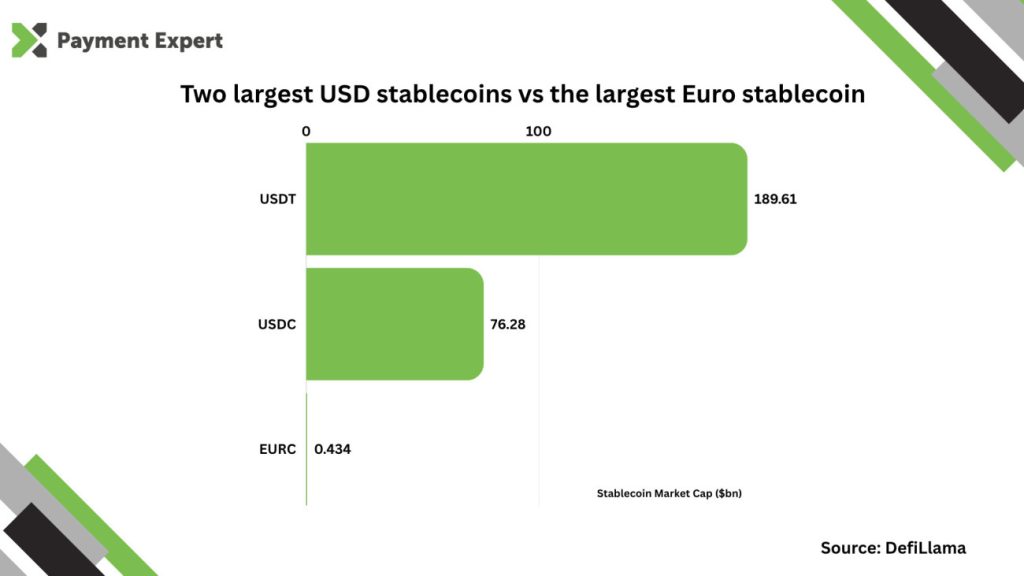
According to DeFiLlama, USDT leads the sector with a market capitalisation of $189.61bn, a significant gap ahead of USDC at $76.28bn. The leading euro-pegged stablecoin is Circle’s EURC, which sits at $434.16m in market value.
While European stablecoin continue to struggle to compete, Qivalis will benefit from integration with its banking members, giving it immediate access to corporate clients, treasury desks and financial infrastructure.
Digital euro comparisons fade
When Qivalis was first announced, people were quick to question if the project would impact the European Central Bank’s planned Digital Euro, a central bank digital currency (CBDC) still under development.
However, across the industry, the view now seems to be that the two can operate at the same time.
At MoneyLIVE 2025, a digital euro panel explored the relationship between CBDCs and stablecoins, with audience members asking whether privately issued stablecoins could undermine a future digital euro.
Ville Sointu, Chief Strategist for Transaction Banking and Digital Currencies at Nordea, described comparisons between CBDCs and stablecoins as “like apples to oranges”, arguing they should not be grouped. Notably, Nordea is one of the new banks to join the consortium.

Speaking to Payment Expert earlier this year, Qivalis CEO Jan-Oliver Sell said the initiative could become a “pillar of European strategic monetary autonomy” if widely adopted.
He added that while the digital euro and euro stablecoins share a common objective of modernising payments, they operate in different layers of the financial system, with stablecoins focused on programmable, blockchain-based settlement and the CBDC aimed at sovereign-issued retail payments.
Sell also noted the timing as a key differentiator, with Qivalis targeting a 2026 launch, while the Digital Euro is not expected to be issued until the end of the decade.