Worldpay’s 11th Global Payments Report maps a payments landscape in constant motion, with digital wallets consolidating their global lead and local payment systems reshaping e-commerce from Brazil to China.
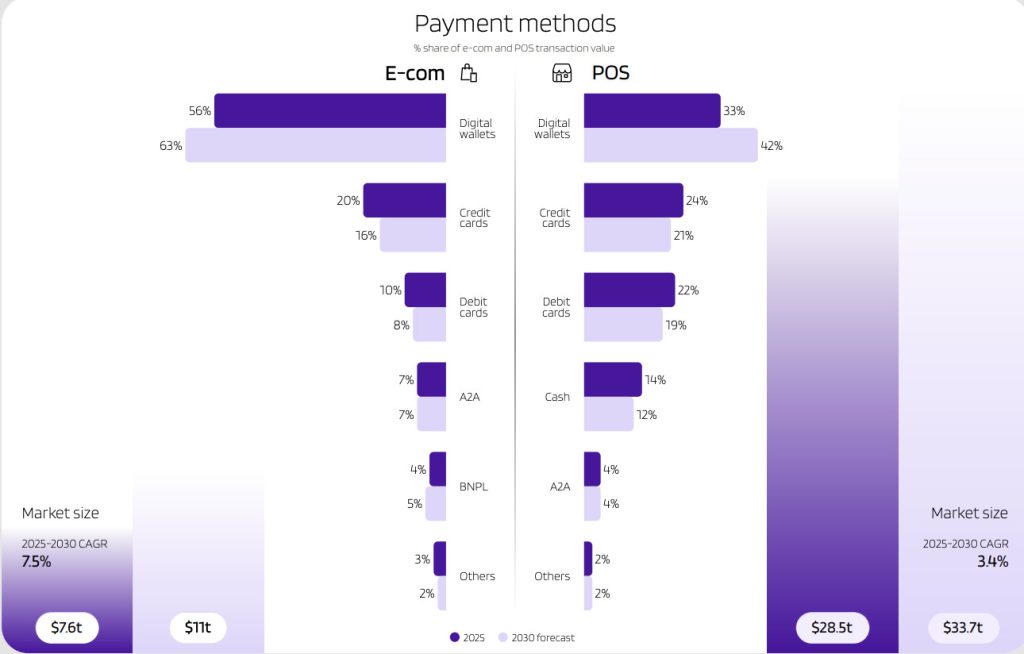
Digital wallets accounted for 56% of global e-commerce value and 33% of point-of-sale (POS) value in 2025, representing over $13.8tn in combined spending, according to Worldpay‘s 11th annual Global Payments Report (GPR).
Worldpay, which is now part of Global Payments following a merger, published its report on 31 March 2026, which analyses payment method share across 42 markets and offers forecasts through to 2030.
Its central finding is that digital wallets are now dominating across demographics, geographies and payment models simultaneously, with each market reflecting its own combination of card infrastructure, account-to-account (A2A) rails, BNPL integration and stored value.
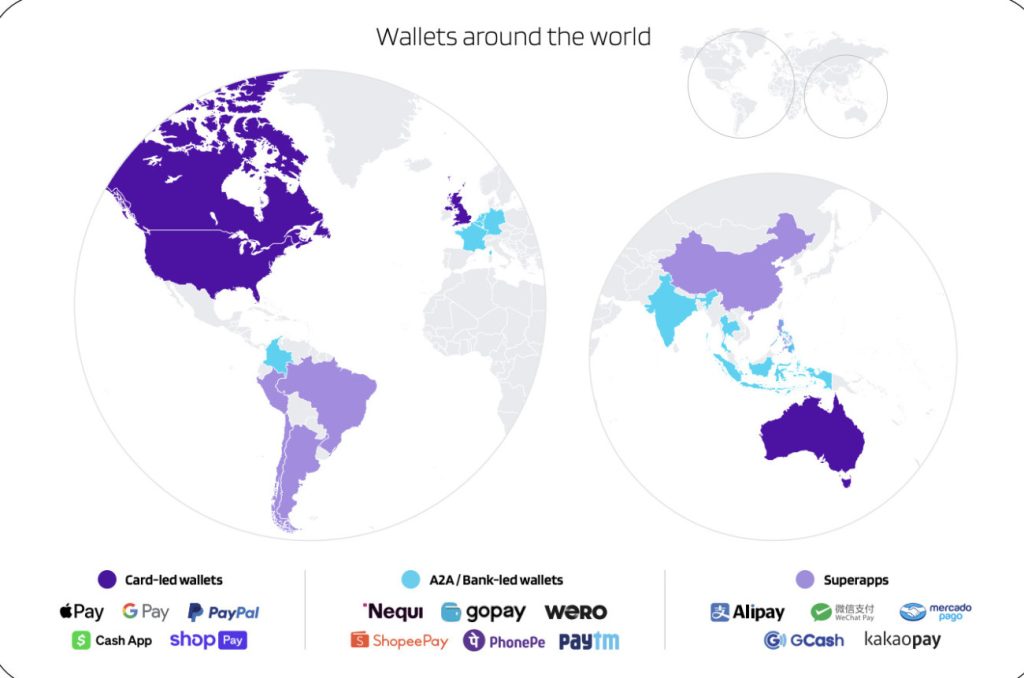
Though there is a stark divergence between markets. In China, Alipay and WeChat Pay account for 89% of e-commerce and 87% of POS value, effectively completing the country’s transition to digital payments. India’s United Payments Interface (UPI) driven wallet ecosystem accounts for 68% of online and 61% of in-store value, with leading wallet brands all leaning on UPI.
At the other end of the spectrum, the US sees digital wallets at 39% of e-commerce and just 17% of POS value – a market where cards remain deeply entrenched and wallet growth at the physical point of sale is only beginning to accelerate.
Local rails, global ambitions
One of the report’s more compelling findings is the globalisation of payment systems originally designed for domestic use. Brazil’s Pix instant payment system – which accounted for 42% of e-commerce and 34% of POS value in Brazil in 2025 – is now accepted in Argentina, Chile, Portugal, Spain and the US, driven by merchant demand for alternative payment acceptance.
India’s UPI has also expanded acceptance across Malaysia, Singapore, Thailand, the UAE and beyond. China’s Alipay+ platform connects 1.8 billion users to 100 million merchants across 14 markets.
This “glocalization”, as the GPR terms it, highlights a structural gap in how modern payment systems were built. Unlike card schemes, which were designed for international use from the outset, today’s fastest-growing payment rails – Pix, UPI, Alipay – were built for domestic markets first, and are only now extending their reach across borders.
In Western Europe, which has historically been a card-heavy market, new payment systems have evolved slightly differently. PayPal dominates Germany’s e-commerce, for example (as cited by 70% of online shoppers), and digital wallets reached 52% of online value in the country in 2025 – the highest in Western Europe.
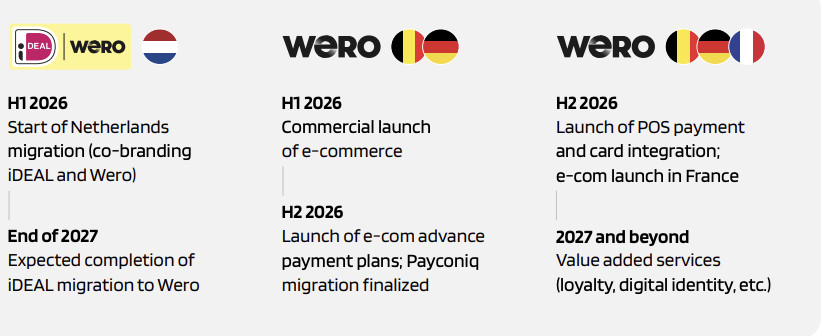
Elsewhere, BNPL accounts for 18% of German e-commerce, driven by a longstanding consumer preference for invoice-based payments that predates the modern instalment lending category. PayPal launched at German POS in 2025, and the pan-European wallet Wero is scheduled to roll out in-store in 2026, setting up a more competitive in-person market than the country has seen before.
The UK: cards evolve, digital wallets extend their lead
In the UK, the story is one of wallet growth built on card foundations rather than in opposition to them. Digital wallet spending is forecast to grow from £269bn ($357.8bn) in 2025 to £453bn by 2030 – a 68% increase – with adoption now spanning all age groups.
Two-thirds (66%) of 18–24-year-olds name digital wallets as their top online payment method, but nearly a third (29%) of 55–64-year-olds and almost a quarter (23%) of those aged 65 and over say the same.
Pete Wickes, General Manager of Enterprise EMEA at Global Payments, said: “We’re not seeing a sudden shift away from cards, but a steady evolution in how people choose to pay. Digital wallets are growing quickly because, in the UK, they build on familiar card infrastructure while offering greater convenience and security.”
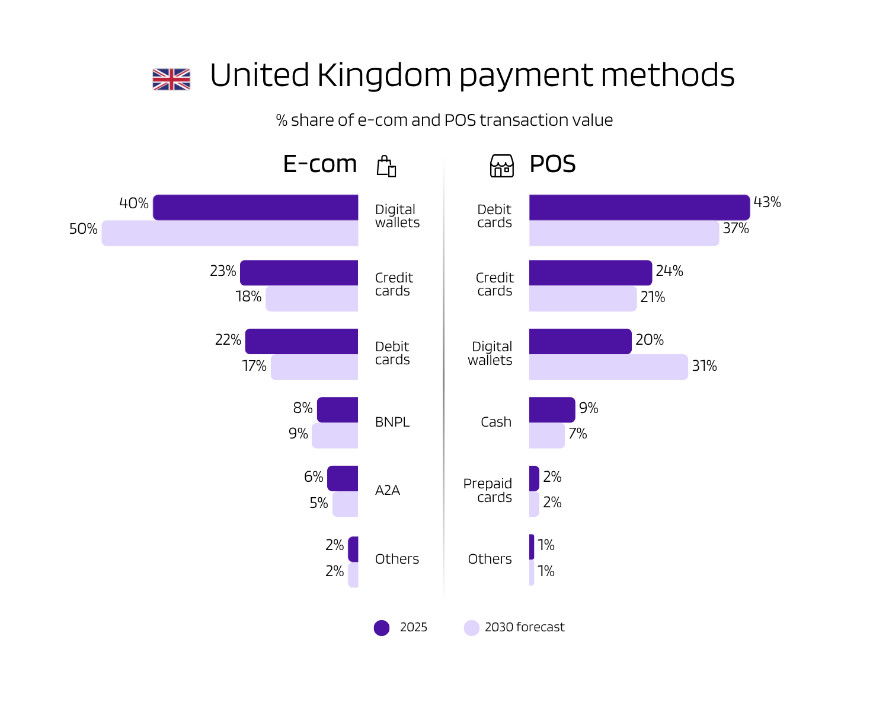
Cards accounted for 46% of UK online spending and 69% of point-of-sale (POS) value in 2025, with credit cards forecast to fall from 23% to 18% of online value by 2030 and debit cards at POS from 43% to 37%.
The GPR’s methodology classifies card-funded wallet transactions as wallet volume rather than card volume, so much of the headline wallet growth reflects card spending migrating into apps – though wallet functionality, from tokenisation to integrated BNPL, adds genuine value beyond a standard card transaction.
Wickes added: “As the payments landscape evolves, businesses need a clear view of how customers want to pay. Expectations are moving toward convenience and choice, and merchants who adapt their payment systems to serve every customer will be best positioned to capture the opportunities ahead.”