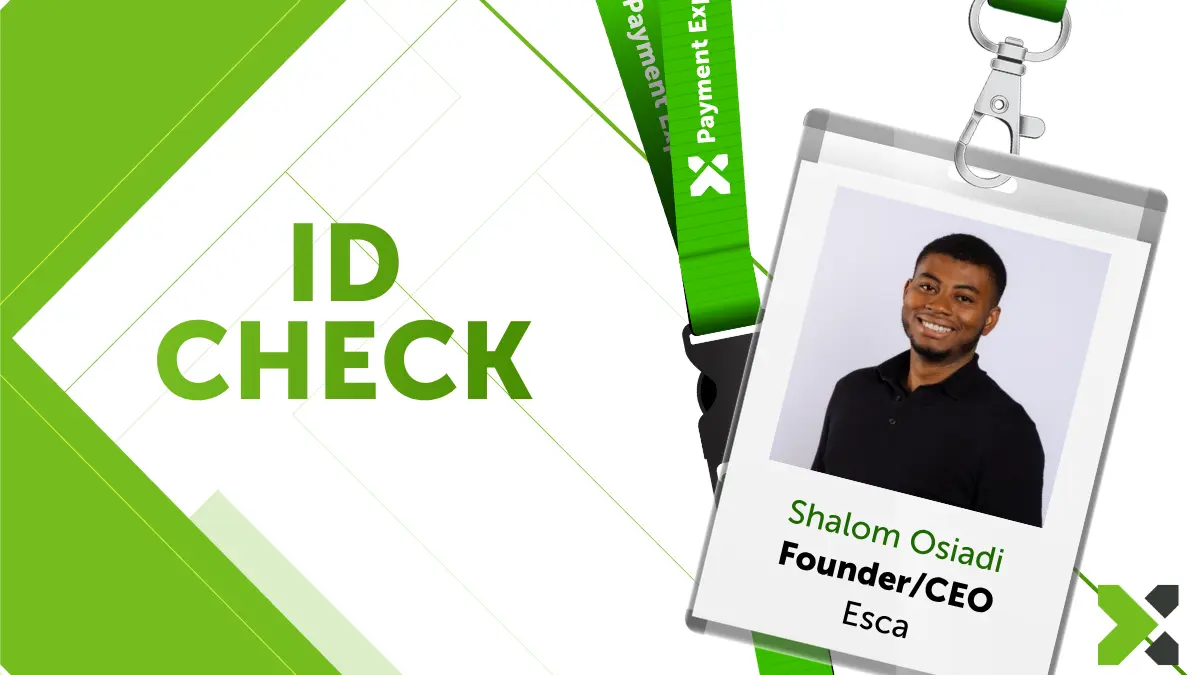
Payment Expert’s ID Check: Payments Professionals offers insight from industry leaders and experts on how they got their start in the financial industry, from their early years in education, to how they have been able to climb the corporate ladder.
This week, Shalom Osiadi, Founder and CEO of Esca, delivers insights into how building a stablecoin at the Yuro Foundation led to a career in payments, why Esca went pure software after its hardware partnership held the business back and why relationship management at Esca has become the most important skill in a slow-moving, regulated industry.
Where did you go to university and what did you study?
I completed my undergraduate degree at Dublin City University (DCU), studying computer science and business, and then went on to Dublin Business School (DBS) for my postgraduate studies.
What impact did this have on your current journey?
DCU gave me the foundation for everything I’ve done since. The mix of computer science and business taught me to think as a builder and a commercial operator at the same time, which is rare to get from one degree. Just as importantly, it shaped my mindset. I came out of it with the technical skills to build products and the psychological grounding to back myself as an entrepreneur.
What first drew you to the payments industry and why have you stayed?
Honestly, I was never drawn to payments, I was drawn to money: how it’s created, how it moves and why it works the way it does. That curiosity led me to build a stablecoin, and payments became the natural outcome of that financial engineering work. Once you understand how money works at a fundamental level, you realise payments is where that understanding meets real people and real businesses every day. That’s what keeps me here.
Are there any lessons from your first role in the industry which you still draw on?
Building Esca is my first role in payments, but I didn’t arrive cold. My experience building the Yuro Foundation gave me a real head start in understanding the mechanics of money. Designing a stablecoin forces you to think carefully about trust, settlement, liquidity and how value moves between parties. Those lessons are directly applicable to payments, and I draw on them constantly.

When was your first big break in the industry? Why was this such a significant moment for you?
My first big break was the work on the Yuro Foundation’s stablecoin, because it’s what opened the door to payments in the first place. It was significant because it showed me that the financial infrastructure we’d engineered had a practical use far beyond what we originally set out to build. That realisation is what became Esca.
Was there a moment you faced in the industry which really challenged you? How did you overcome this?
Expanding our offline offering was a defining moment. It forced us to answer a fundamental question: what kind of business are we? Hardware and software, or pure software? At the time, our hardware partner was becoming increasingly difficult to work and grow with, and it was clear that relationship was holding us back. We made the call to go pure software and build services around it. It wasn’t an easy decision, but it gave us focus, made us more scalable and put us in control of our own roadmap.
What are some of the skills you deem essential to starting in your industry and how have yours developed over the years?
Patience, resilience and relationship management. Payments is a slow-moving, heavily regulated industry built on trust, so nothing happens overnight. Patience is something I’ve had to learn, coming from a builder’s background where you want to ship fast. Resilience comes from the setbacks every founder faces. And relationship management has become the most important of the three: with partners, regulators, banks and customers, your relationships are often what determines how far and how fast you can go.
Who was your biggest role model – inside or outside of your industry – who continues to inspire you in your current career?
Nik Storonsky, the Founder of Revolut. What I admire most is his relentless focus on building the best possible solution to a problem, without being distracted by public opinion or the noise around him. That clarity of purpose is something I try to bring to Esca.
If you didn’t work in the industry, what other career option would you have pursued or would have loved to?
I would have stayed a data scientist. I really enjoyed machine learning, and I’ve always had a natural alignment towards analysis. AI was built by data scientists, and I always pictured myself being part of the early days of AI research and development – in many ways, that analytical mindset still shapes how I approach problems in payments today.
Lastly, what is some advice you would give to an aspiring person looking to get a start in your respective industry?
Build relationships and get ready to take the long road. Payments rewards people who invest in their network and stay committed for the long term. Be curious about how money actually works, not just the products built on top of it, and don’t be discouraged when progress feels slow – the people who succeed here are the ones who stick around long enough to see it pay off.
Interested in sharing your experiences from the industry and passing on advice to the next-generation for ID Check? Contact: [email protected]