Payment Expert’s ID Check: Payments Professionals offers insight from industry leaders and experts on how they got their start in the financial industry, from their early years in education, to how they have been able to climb the corporate ladder.
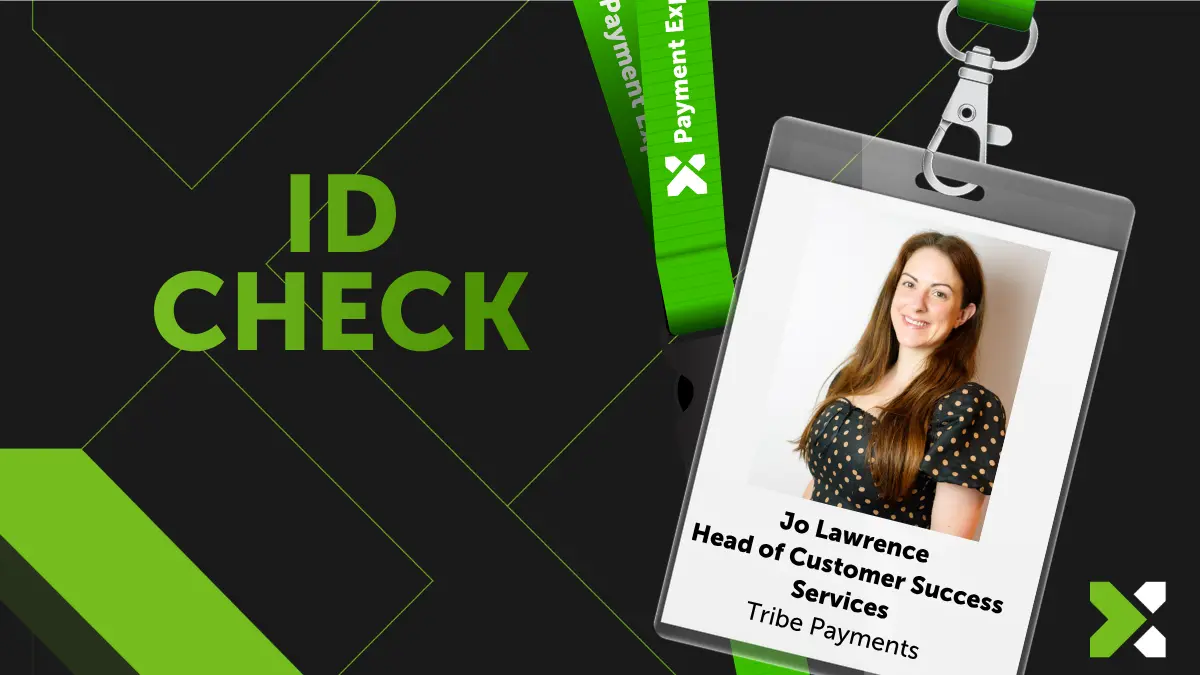
This week, Jo Lawrence, Head of Customer Success Services at Tribe Payments, delivers insights into how a contact centre role at Barclaycard Merchant Services started her career in payments, why sponsorship counts for more than advice and how she balances a senior commercial career at Tribe Payments with family life.
Where did you go to university and what did you study? What impact did this have on your current journey?
My route into payments wasn’t a traditional one. Before payments, I worked in account management roles, including route planning for a distribution company where I worked closely with the drivers and warehousing operatives.
I didn’t know it then, but that taught me how to communicate clearly under pressure and solve problems in real time on a human level beyond being distracted by titles. Those are skills I’ve relied on in every role since.
What first drew you to the payments industry and why have you stayed?
Honestly, payments found me. I had been made redundant and saw an advert for a contact centre role at Barclaycard Merchant Services, a local business. The interview included a role play: a delivery driver was stuck with a terminal, and I had to use my communication skills to get him to the merchant.
I left that interview so excited about the role that I did everything I could to make it work. I was a single mum who didn’t drive, so that meant a taxi and four buses a day, plus a huge amount of support from my family. I’ve stayed because of the customer relationship that fed my need for curiosity and problem solving.
Every role I’ve held, from the front line to leading the team behind it, has been about understanding and managing that relationship. I believe it tells you the truth about a business faster than almost anything else, and that’s what still keeps me hooked.
Are there any lessons from your first role in the industry which you still draw on?
The biggest lesson is that communication is everything. That first interview role play captured it perfectly – someone has a problem, and your job is to understand it, stay calm and guide them to a solution.
Over the next 11 years in fraud and risk, specialising in complex areas like gambling and payment facilitators, I learned something else I still draw on every day. Data only tells you part of the story. You have to understand what a customer actually does, not just what the label says they are.
When was your first big break in the industry? Why was this such a significant moment for you?
My first big break was moving from fraud and risk into account management. Women who held senior sales and account management roles, managing gambling portfolios in what was a very male-dominated space, took me under their wing. They gave me constructive feedback, pushed me out of my comfort zone and prepared me to succeed them.
It mattered because it was the first time someone invested in where I could go, not just in what I was doing. That opened the door to roles across Mastercard Gateway and Enterprise Security Solutions in Europe and then Cybersecurity globally, and eventually into Customer Success leading this function for several acquisitions.
Was there a moment you faced in the industry which really challenged you? How did you overcome this?
The challenge that has shaped me most is balancing a senior commercial career with family life. My husband and I are parents to twin boys who both have delayed speech and additional needs, and he’s now on his second career after retiring from the military. We also have an adult daughter who works in the financial world herself.
Home is its own full-time role, with appointments, advocacy and real emotional weight. I won’t pretend I’ve found a system that makes it all fit. Some days it holds together and some days it doesn’t, and I’ve learned to be comfortable with that. What got me through is what I call my tribe.
It’s a small group of people I can be completely unfiltered with, who won’t judge me but will keep me accountable, and the support goes both ways. My family, and the extended family I’ve built at work, have been incredible.
The experience has also made me more vocal. A career can quickly be treated as “on pause” when life gets complicated, and I want the industry to talk about that more openly.

What are some of the skills you deem essential to starting in your industry and how have yours developed over the years?
Communication comes first, especially the ability to listen for what isn’t being said. Next is curiosity, not assuming you know a customer because you know their segment or size, but going and finding out what they actually do. Resilience matters too, because payments, technology and the 24/7 world we live in move fast and things will go wrong.
Over the years, those skills have moved from reactive to proactive. Early on, I was solving the problem in front of me. Now it’s about reading the signals before a customer tells you anything. That might mean noticing a start-up has matured into a scale-up, or recognising that a polite, frictionless meeting may be hiding a risk.
I’ve also learned to have the harder conversations: owning what’s gone wrong, setting out a clear plan with dates, and sometimes saying “this isn’t working.”
Who was your biggest role model – inside or outside of your industry – who continues to inspire you in your current career?
Michelle Hafner. She was, is and always will be my inspiration for what a woman and working mum in payments can achieve. She didn’t just mentor me, she sponsored me. She spent her own credibility putting my name forward for opportunities I hadn’t even asked for yet, and that’s the single biggest reason I am where I am today.
It’s also why I feel strongly about paying it forward. Plenty of people will give you advice, but far fewer will use their influence on your behalf when you’re not in the room.
If you didn’t work in the industry, what other career option would you have pursued?
I’d have been a personal shopper. It might sound like a world away from payments, but the core of it is the same thing I love about my job now: really understanding the person in front of you. A good personal shopper doesn’t just hand someone what they asked for. T
hey listen to how that person lives, what they’re trying to achieve and how they want to feel, then find what genuinely works for them, even if it’s not what they first had in mind. That’s exactly how I approach customer relationships.
It’s about reading the signals, looking past the label and helping someone grow into where they’re heading, not just where they are today. And I’ll admit I’d quite enjoy spending other people’s money!
Lastly, what is some advice you would give to an aspiring person looking to get a start in your respective industry?
Don’t worry if your route doesn’t look traditional. Mine certainly didn’t. The skills you’ve picked up elsewhere, like communicating under pressure, solving problems and building relationships, are often exactly what this industry needs.
Interested in sharing your experiences from the industry and passing on advice to the next-generation for ID Check? Contact: [email protected]