
A Convera report looks at why advances in payment technology haven’t removed the pressure currency volatility puts on global businesses.
Cross-border payments have become faster, cheaper and more transparent, but the financial risk created by changing exchange rates hasn’t disappeared.
This is the main finding of a new Convera report, which says advances in real-time payments, stablecoins, ISO 20022 and APIs have improved how money moves without removing the underlying currency risk.
Convera describes this as a “volatility gap” between improvements in cross-border payment efficiency and how effectively businesses protect against changes in currency value.
Faster payments are only part of the puzzle
Speed has become a fixation in payments in recent years as consumers and businesses expect transactions to happen instantly. Payment systems such as Pix in Brazil have added to those expectations by showing what is possible within a country.
The G20 has set a target for 75% of cross-border retail payments to make funds available to recipients within one hour by the end of 2027.
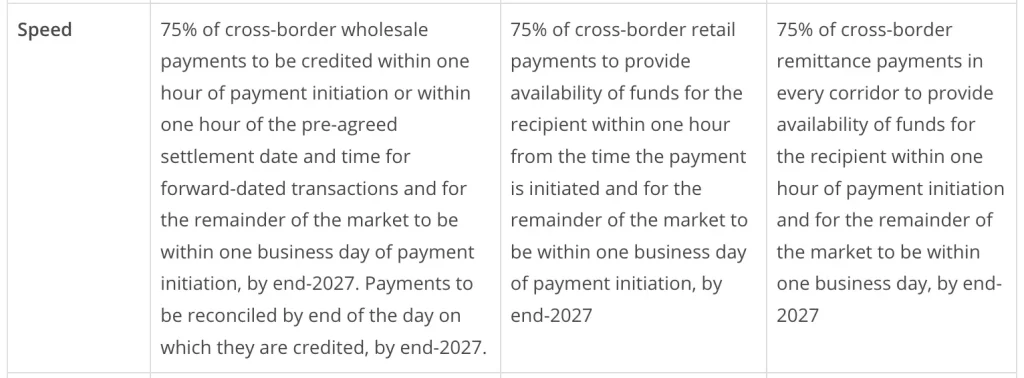
Cross-border payments are more complicated because transactions can pass through several institutions, currencies and regulatory systems, but settlement times have still improved significantly.
Swift says up to 75% of payments on its network reach the beneficiary bank within 10 minutes, although local banking processes and regulation can delay when funds are actually credited to the customer.
Part of the improvement has come from the expansion of real-time payment infrastructure, with Convera’s report saying real-time payment rails currently operate in around 80 countries and more domestic systems are connecting across borders.
Stablecoins have created another route by allowing value to be transferred around the clock through blockchain networks. In many B2B transactions, funds are converted into a stablecoin, transferred and then exchanged back into the recipient’s local currency.
However, the conversion means the underlying FX challenge hasn’t gone anywhere.
Shantnoo Saxsena, Founder and CEO of Encryptus, told Payment Expert earlier this year that the cost of acquiring stablecoins in emerging markets can also create friction.
“If you’re a business, think common sense. Why would you go and acquire a stablecoin in an emerging market when you can actually acquire dollars at a cheaper price?” he said. “If we are unable to pass on the benefit of technology to the end customer, how are we solving the problem?”
Currency volatility is hitting margins
The Convera report references Bank for International Settlements data showing global foreign-exchange turnover reached $9.5tn per day in April 2025, up 27% from 2022. It also says 44% of importers and exporters have reported currency movements eroding profit margins.

A company that agrees an overseas sale on 60- or 90-day payment terms can see its margin shrink before the invoice is settled if the exchange rate changes unfavourably, and the same risk applies to businesses buying goods from overseas suppliers.
Volatility can also make forecasting less reliable if finance teams build budgets around exchange rates that can change at the drop of a hat, while sudden swings make working-capital requirements and supplier payments harder to plan.
Michael Bourque, CFO at Convera, said many companies have modernised their payment infrastructure but still treat FX risk as something to address later.
“A faster, cheaper rail changes how quickly and affordably money reaches its destination,” he said. “At the same time, FX markets move, as they always have and always will.”
Payments and FX are becoming harder to separate
The report says finance teams need to consider currency exposure alongside the way payments are executed.
It mentions that this can include matching payment dates with hedging decisions, holding balances in currencies a business regularly uses and incorporating FX decisions into accounts payable and receivable workflows.
“The answer isn’t to build a massive currency risk apparatus,” said Bourque. “The objective isn’t to ‘beat the market’, it’s to support visibility into budgets and forecasts so they can keep investing when the headlines get noisy.”