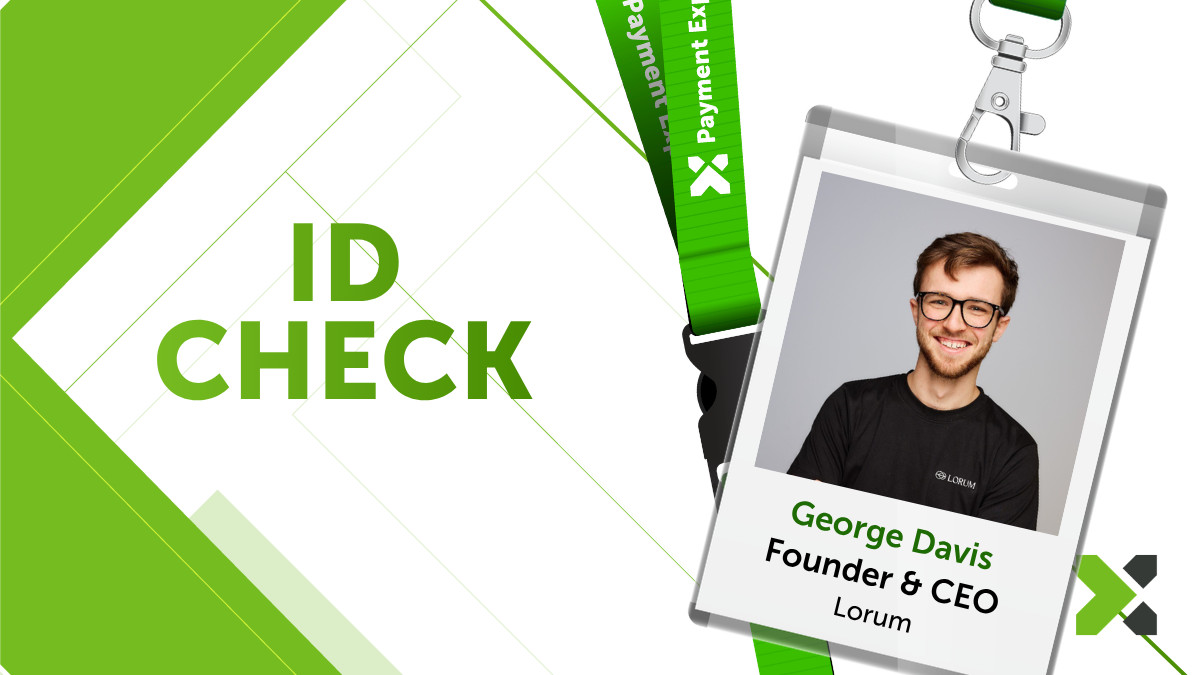
Payment Expert’s ID Check: Payments Professionals offers insight from industry leaders and experts on how they got their start in the financial industry, from their early years in education, to how they have been able to climb the corporate ladder.
This week, George Davis, Founder and CEO of Lorum, reveals what it takes to learn from two prominent payment companies to forge your own, explaining why an obsession with payments and why problem solving helps build an entrepreneur.
Where did you go to university and what did you study? What impact did this have on your current journey?
I started a machine learning business at 18-years-old at a university hackathon in London and dropped out to run it full time. At the time I was less interested in the curriculum than in the problem in front of me, which probably tells you something about how I approach things.
Machine learning teaches you to think about edge cases and failure modes rather than ideal conditions. Systems fail at the edges, not in the middle. That framing has stayed with me through everything I have built since. When I look at why clearing is slow, why funds get trapped, why settlement is uncertain, the answer is almost never the technology. It is the assumptions and incentives built into the institutions sitting inside the network.
What first drew you to the payments industry and why have you stayed?
Payments was not the plan. I came into it through TrueLayer, which was mostly a data business when I joined. We ended up pivoting the whole company toward payments and I became completely obsessive about it. Core banking, central bank settlements, ledgers, how money actually moves between institutions. I am either 100% into something or 0%, and payments became that.
What kept me was frustration as much as fascination. At BVNK, building on stablecoin rails, I could see what new infrastructure could do, but equally, where existing clearing frameworks held everything back. Every layer I worked on exposed the same underlying problem. Once you see that structural misalignment clearly, it is very hard to walk away from it.
What are the most important lessons you have taken from your time at TrueLayer and BVNK?
The most important lesson from TrueLayer was the difference between a great product and a durable business. TrueLayer had an exceptional product and a genuinely world-class team. But open banking payments was effectively a feature that banks provided for free, which made it very hard to monetise at scale. You were selling for a couple of pence per payment. That creates a ceiling regardless of how good the product is.
That taught me early that product quality and commercial durability are not the same thing. At Lorum we were very deliberate about building something structurally sticky from the start. Custodian accounts in the client’s name, tokenised money market funds, integrated wholesale FX. The stickiness has to be built into the model, not bolted on later.
Lorum was built to combine the product stickiness of TrueLayer with the monetisation model of BVNK. That combination has been central to how we have grown.
Launching dollar clearing was the inflection point. We always knew dollars were important but assumed it was a later-stage problem. When we launched, the product grew at 200% month on month and quickly became 60% of our entire business. It also completely changed how we thought about the addressable market. We had underestimated how much institutions wanted to consolidate all of their volume with one platform once it could solve the hard problems. Dollars into Africa. Dollars into Asia. Suddenly the pool had no visible bottom.
What was the hardest period during your career and how did you get through it?
The hardest period was early in the Middle East. Lorum got its DFSA licence in seven weeks, which was faster than almost anyone expected. But it then took nine months to operationalise because banks in the region simply did not have client money products.
We ended up building infrastructure for our banking partners that you would take entirely for granted in Europe.
At one point we had $2m in the bank, were burning around $90-100k a month, and were chasing banking relationships that kept going nowhere. The view in the market was that no one could get properly banked in that region, so the business probably could not scale. That was a real hit to morale, especially when you are small and every single day counts.
What kept the team together was transparency. Everyone knew exactly where we stood and everyone stayed bought in because of it. That experience shaped how we think about resilience and the kind of team you need around you when things are genuinely hard.
What are some of the skills you deem essential to starting in your industry and how have yours developed over the years?
Obsession matters more than almost anything else. Not obsession with payments specifically, but the capacity to go completely deep on something. To ask why repeatedly until you reach the structural answer rather than the surface one. I do not actually care what someone is obsessed with. I just care that they have the ability to be genuinely obsessive. That intensity is hard to fake and easy to spot.
Beyond that, communication is underrated in infrastructure businesses. You are constantly explaining something genuinely complex to regulators, clients, and investors who each have a completely different frame of reference.
My own development has shifted from product execution to judgement. I am good at strategy, product thinking, and solving problems at pace. I am not naturally good at the BAU. Knowing that clearly and hiring people who compliment it has probably been one of the most important things I have done.
Which founders or businesses do you admire most and why?
The founders I admire most are the ones who rebuilt the fundamental rails of an industry rather than adding a layer on top. The Collinson brothers did to card payments what we are trying to do with clearing and cash management. They went right to the bottom of the stack and built an entire platform around it. That kind of thinking, patient, structural, deeply long-term, is what I find most interesting and most difficult to execute well.
In general I am drawn to infrastructure businesses that go right down to the metal. The things I believe in least are the ones adding a better interface on top of the same underlying experience.
If you didn’t work in the industry, what other career option would you have pursued?
Probably software engineering or systems architecture. I have always been obsessive about how complex systems actually work underneath the surface. What draws me to payments is exactly that: it looks simple from the outside and is extraordinarily complex once you go one layer deeper.
I think I would have ended up somewhere with the same quality, systems that have to work reliably at scale and that most people take completely for granted until they stop working.
What do most people get wrong when starting out in fintech, and what advice would you give them?
Do not start a business just because you want to be a founder. When I started my first company at 18, I was building a solution without a real problem statement. We got lucky with an IP sale but the foundation was wrong. Chase a problem instead. Feel so frustrated by something that you cannot stop thinking about it.
In payments specifically, spend time with operations, compliance, and treasury teams before you build anything. Understand how central banks actually clear money between participants and what happens at the edges when settlements fail. That knowledge separates people who build features from people who build infrastructure.
And be prepared to stay. The industry rewards patience. Trust compounds slowly and the people still standing when an opportunity matures are almost always the ones who understood it deeply enough to wait.