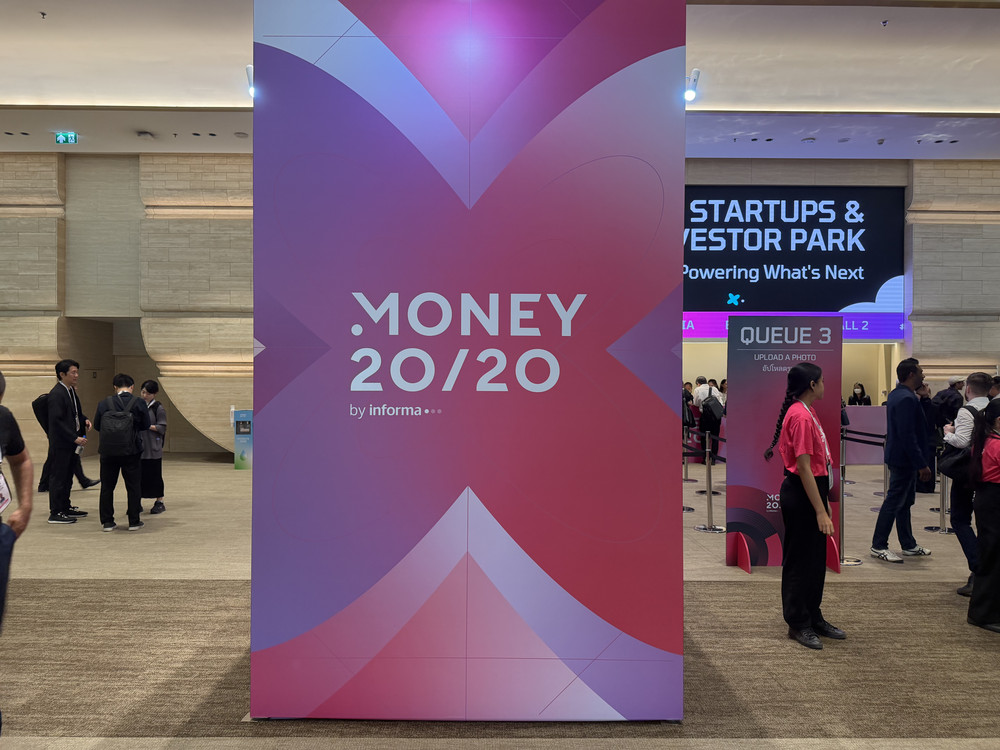
Payment Expert is back for the final day of Money 20/20 Asia 2026. Expect real-time insights from some of the leading industry leaders engaging in conversations around fintech, payments, banking, digital currencies and much more.
To read what happened on Day 1, click HERE | To read what happened on Day 2, click HERE
15:00 – That’s a wrap
Money20/20 Asia has been a whirlwind, showcasing the innovations, debates and ambitions influencing the future of payments across APAC and elsewhere in the World.
While the live reporting ends here, Payment Expert has lots more in store. Over the past three days, you’ll have seen vox‑pops, one‑on‑one interviews, and multimedia coverage, which is all part of our plan to keep the insights coming days after the booths and stages are packed up.
Stay tuned to Payment Expert’s LinkedIn, the daily newsletter, and of course The Payment Expert Podcast for deeper dives, exclusive interviews and post‑event analysis.
From the team here in Bangkok, it’s been a pleasure bringing you the action. Until next time.

14:30 – There’s a bigger picture
Bhau Kotecha, Co‑Founder at Paxos Labs, urges the audience to think past payments, comparing the new generation of money rails to the Internet. Just as the Internet provided an open platform for innovation, he says, these financial infrastructures allow new services to be built on top.
“It’s the first time we’ve had an open money development system,” Kotecha notes.
He emphasises the accessibility that lets small teams in Brazil and large institutions in the US build on the same platform is what makes this transformative.
14:10 – Why muck about with stablecoins?
Moderator David Birch challenges the panel on why anyone would bother with stablecoins or blockchain when Brazil’s Pix already sends payments instantly and for free.
The response is that Pix works brilliantly for domestic transfers, but it doesn’t solve the cross‑border problem. That’s where stablecoin rails come into play, with examples already emerging in markets like Bolivia, where workers in the US send funds home using stablecoins.
The ambition, the panel adds, goes beyond payments. Stablecoins are being built as developer platforms, and not just rails for moving money, but infrastructure to build new financial services on top of.

13:30 – MetaComp backs Solana
MetaComp has announced it will adopt Solana as the preferred chain within its StableX Network.

Bo Bai, Chairman and Co‑Founder of MetaComp, said: “We see Solana as one of the most compelling infrastructure layers for the next generation of institutional digital finance,” adding that it will enable faster, cheaper, and more accessible financial services for those who need them most.
Lu Yin, Head of APAC at the Solana Foundation, welcomed the decision, noting it will provide a strong foundation for cross‑border payments, treasury solutions, and tokenised capital markets across emerging economies.
12:45 – Building a digital bank for Gen Z
Is yield the future of unlocking Gen Z customer engagement with digital banking platforms?
Apurv Mishra, Co-Founder and Chief Product Officer at Yield.XYZ, believes yield “is where money is going to be” in the next several years to capture the Gen Z customer segment.
“What we’re seeing is access to yield, the access to experience your portfolio will become more automated than you can imagine,” said Mishra. “That is the future we are heading into.”
He outlined five key principles in building a modern neobank fit for Gen Z purpose.
The first is an income-first user interface, able to show earnings before balances, as Gen Z measures money by what it produces, not what it holds. The second is conversational onboarding, replacing forms with language model prompts such as, ‘What are you saving for?’.
The third is utilising risk as a feeling, using plain metaphors and colours to indicate action, not percentages and disclosures. The fourth is ambient feedback; real-time earnings tickers should be visible on the homescreen while watching money grow simultaneously in real-time.
The fifth and final principle is social proof being embedded. This is a personalisation tactic leveraging data to tailor prompts to customers, such as ‘people like you earn 5.4% on average’.
“The key for all these apps is thinking about the interface and making it accessible.”
12:15 – Transaction data to assess creditworthiness
Small and Medium-sized Businesses (SMB’s) can often face difficulties in receiving loans from financial institutions, especially for the first time. It can be even more difficult for customers.
Real-time data, therefore, becomes paramount for a payment or financial company to assess the creditworthiness of a customer, particularly transaction data.
Tony Isidro, President and CEO of Fuse Financing, the lending arm of GCash, revealed his company has been doing a lot of experimenting on assessing multiple variables into how to not only speed up the onboarding process of a first-time loanee, but also crediting SMEs with instant liquidity if it is needed instantly.
For Ida Tiongson, President of Opal Portfolio Investments SPV, she has called on the banks to leverage transaction data, like the billions of payment volumes GCash processes, as it can predict business and consumer behaviour better, giving the lending company an advantage in knowing the right amount to loan out.
She also believes that developments in Open Finance will also “provide a more granular and predictive credit assessment” in the future.
While too much data is hardly considered a negative, Mortitz Gastl, General Manager of Tala Financing Philippines, argues there is a “curve” with data that lenders need to utilise.
He said: “Every additional data point becomes less useful” if not adopted properly. Gastl also highlighted that first-time borrowers always face the most difficulty when applying for a loan, and therefore, companies, such as Tala, should begin to adopt embedded finance solutions to be able to shoulder the credit risk assessment by leveraging third-party services.
11:45 – Local payment methods still playing catch‑up
At Money20/20 Asia this week, local payment methods have been mentioned in nearly every conversation, and perhaps overshadowed cards as the preferred option across many APAC markets. Combining this with the push away from card networks in the UK and Europe, it might look like cards are on the way out. However, that’s not the case.

Jeff Parker, CEO of Paymentology, told Payment Expert that while the ecosystem is diversifying, cards still play an important role. They are often the first step in connecting the underbanked, play a key role in financial inclusion and still carry benefits such as consumer protections.
Cards have also been spoken of positively elsewhere at the event. On Day 1, Jacob Hu, Co‑Founder and UK CEO at TripLink, noted that card payments deliver higher success rates in cross‑border transactions. Parker says this comes down to the maturity of global card networks, with local payment providers still catching up to the likes of Visa and Mastercard.
11:10 – Customer loyalty comes down to emotion, not through a robot
Loyalty can often be something not many companies are now placing greater manual effort into, with the emergence of personalisation tools such as Generative AI.
But David Wang, Global Head of Loyalty Partnerships & GM of North Asia at Heymax, argued that for a company to build customer loyalty, it “comes down to one thing, and one thing only… building an emotional connection with your users”.
That is something AI can not process, although Wang revealed he came across a survey which revealed one-third of respondents perceive their AI chatbot service as their most trusted advisor.
AI can be leveraged to personalise a customer’s shopping or payment journey, but Wang stressed human interaction as the true driver of creating loyalty, reducing breakage of points, and building a potential long-lasting customer relationship.
10:50 – The economic-level threat of Quantum Computing attacks
Day three opened with a keynote address on a topic that is a new, emerging cybersecurity and blockchain threat that can cause an “economic crisis”.
Danny Lung, Founder and CEO of PQA Labs, detailed why quantum computing is a threat that needs to be addressed today as more and more companies begin to invest in blockchain technology to test its instantaneous settlement capabilities.
Quantum computing goes beyond classic computer processing by using quantum bits over regular bits to solve complex processing issues, such as calculations. However, bad actors and even state-level operations have been increasingly using quantum computing to perform attacks on the blockchain.
Bad actors use algorithms to process large numbers rapidly, as well as compromising blockchain networks to attack the cryptography and swiftly break its encryption. Quantum computing also has the ability to reverse engineer public keys to defraud users of their transactions.
“The day of the breaking of encryption is coming sooner than you think,” said Lung. “We are looking at a risk you simply can not look away.”
Companies are also treating this new and emerging threat seriously. The quantum market is expected to reach $97bn, according to McKinsey, and 75% of companies are prioritising efforts to prevent HDNL attacks, which Lung stated are “on top of everybody’s attention list”.
However, Lung shared there are post-quantum cryptography solutions, where it confuses the attacks to halt it in just enough time to block it from attacking public keys.
This also comes at a prevalent time as countries and economies are placing greater emphasis on stablecoin payments, which Lung revealed “trillions” are at risk if they do not begin to run post-quantum prevention solutions to their services today.
10:20 – AI in cross‑border, but what’s next to take the leap?
AI is already being used to forecast future cash flows, helping institutions set FX rates more accurately. But what’s missing to unlock the next leap in cross‑border payments?
Wenhui Yang, CEO of TenPay Global (Singapore, Tencent), points to the importance of localisation. He explains something as simple as changing the language on a checkout page so consumers can show merchants that their transaction is complete by just showing them their phone.
He adds that the next step is that once users get used to a payments app at home, they want to keep using it abroad and still access the local services they need. He says that allowing them to do this should be the next focus to improve cross‑border payments, and that this will be the norm in five years.

09:50 – Coinbase and Nium to provide stablecoin payments to banks and fintechs
Nium landed a partnership with Coinbase to enable USDC stablecoin payments across its platform for clients to send and receive stablecoins and convert them to fiat for payouts.
Coinbase will provide the stablecoin infrastructure that enables businesses to send, receive and convert USDC with Nium bringing those capability to its global network of banks, fintechs and enterprises.
“The future of money movement is multi-rail. Fiat and onchain infrastructure will increasingly work together, not in isolation,” said Prajit Nanu, CEO and Founder of Nium.
“This partnership with Coinbase makes that future operational today – giving our clients a single platform to send, receive and spend stablecoins at scale ahead of a fundamental shift in how money moves.”
09:35 – The final stretch
A Later start to Money 20/20 Asia today, but plenty of more conversations to be had on the future of finance.
There is expected to be lively discussions around quantum proofing and computing, more varied opinions on digital currencies, and developments in embedded finance.
Later on, Payment Expert’s Blockchain Bulletin will be live from Money 20/20 Asia, discussing a Coinbase and Gemini lawsuit, prediction market digital asset interest, and much more.