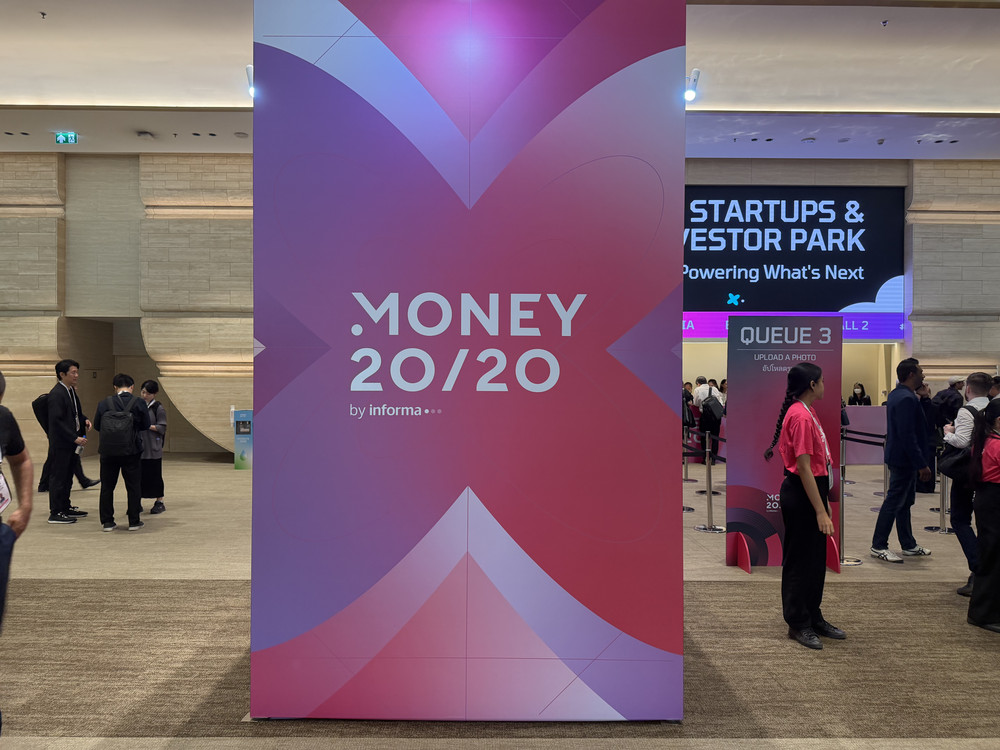
At Money 20/20 Asia 2026, agentic commerce is one of the key talking points, particularly as Asia-Pacific countries such as China are leading in consumer adoption.
Agentic commerce adoption is accelerating fastest in Asia-Pacific markets, with China and Singapore leading global uptake, according to new data presented by Money20/20 Asia 2026.
Lucy Anderson, Head of SMB Product in Asia for Global Payments, revealed during a keynote presentation today (22 April) that three out of the top five countries adopting agentic commerce are from APAC.
The data from Global Payments’ 2026 Commerce and Payment Trends report, show China leads the rankings, with 64% of respondents stating they trust and have trusted AI agents to perform commerce searches on behalf of them.
Following China in second is Singapore (45%), the US (44%), Brazil (37%), Australia (34%), the UK (31%), and France (25%).
“Highly sophisticated AI systems have raised new questions about relying on biometric data as a source of truth,” said Anderson. “We are at the beginning of a major shift. AI agents don’t just shop, they shop on our behalf, it’s not a payment trend, it’s a behavioural trend.”
However, Anderson also stated that trust remains the fundamental barrier for further adoption, both for consumers and merchants.
How trust is built with ‘know-your-agent‘
As agentic commerce develops, questions around security and participant verification are beginning to take shape alongside its rollout.
Abhijeet Ramesh, VP, Head of Innovation & Growth, APAC at Visa, highlighted the need for a “know-your-agent” (KYA) framework, positioning it as an extension of existing know-your-customer (KYC) processes.
He explained that while the technology remains in its early stages, networks are already working to define how AI agents are identified and integrated into payment systems without compromising existing safeguards.
“There needs to be a way to bring in every new kind of player that shows up,” he said. “In this case, we can’t yet let anyone in, as we need to know who the agent is, whether it is reliable, whether it is secure, and how it connects to us.”
Ramesh added that this visibility is required across the payment chain, not just at the network level.
“All the other network participants, such as the banks initiating transactions, need to know if agents are secure. Merchants also need to understand which agent is interacting with their platforms.
“To support this, we have structured programmes to bring agents into the ecosystem and ensure they operate under the same rules as existing participants.”
Is regulation keeping pace?
Regulatory frameworks are also evolving alongside agentic commerce, as authorities assess how responsibility should be defined when AI agents act on behalf of users.
The Monetary Authority of Singapore (MAS) has begun developing a risk-based approach focused on accountability and decision-making standards for both AI agents and the firms deploying them. The regulator is also exploring how similar technologies could be applied within financial services, including fraud detection, credit assessment and customer support.
Alvinder Singh, Head of the Innovation Acceleration Office at MAS, said regulatory clarity is still developing as use cases emerge. “Regulations don’t get strengthened in the very early days,” he said. “We are finding our way and learning from all of you.”
Singh added that while frameworks are progressing, the deployment of agentic systems also introduces an element of user responsibility.
“Are we there with regulations for agentic commerce? Maybe, maybe not,” he said. “You can solve that quite effectively, or you could do quite a lot of things online without an agent.”
“I’m not suggesting that that is foolproof in any case, where you could do it yourself, but you deploy this requires a degree of sophistication on your part, which means that personal responsibility has to come in as well.”