A decade after becoming the UK’s first new clearing bank in more than 250 years, ClearBank now sits at the centre of debates over interoperability, real-time risk and the future governance of Faster Payments.
Clearing is rarely the loudest part of the payments debate. It sits beneath the customer interface, beneath the brand, beneath the app.
In the UK, access to core payment schemes was once concentrated among a handful of incumbent banks operating on decades-old infrastructure. The post-financial crisis period exposed both the fragility and the lack of competition within that model. ClearBank was founded in said context — the first new clearing bank in more than 250 years — with a proposition built around cloud-native architecture and direct access to the UK’s payment rails.
A decade on, the competitive landscape looks different. Challenger banks have matured. Embedded finance has moved from theory to deployment. Real-time volumes continue to rise, while regulators scrutinise resilience, interoperability and the future governance of Faster Payments.
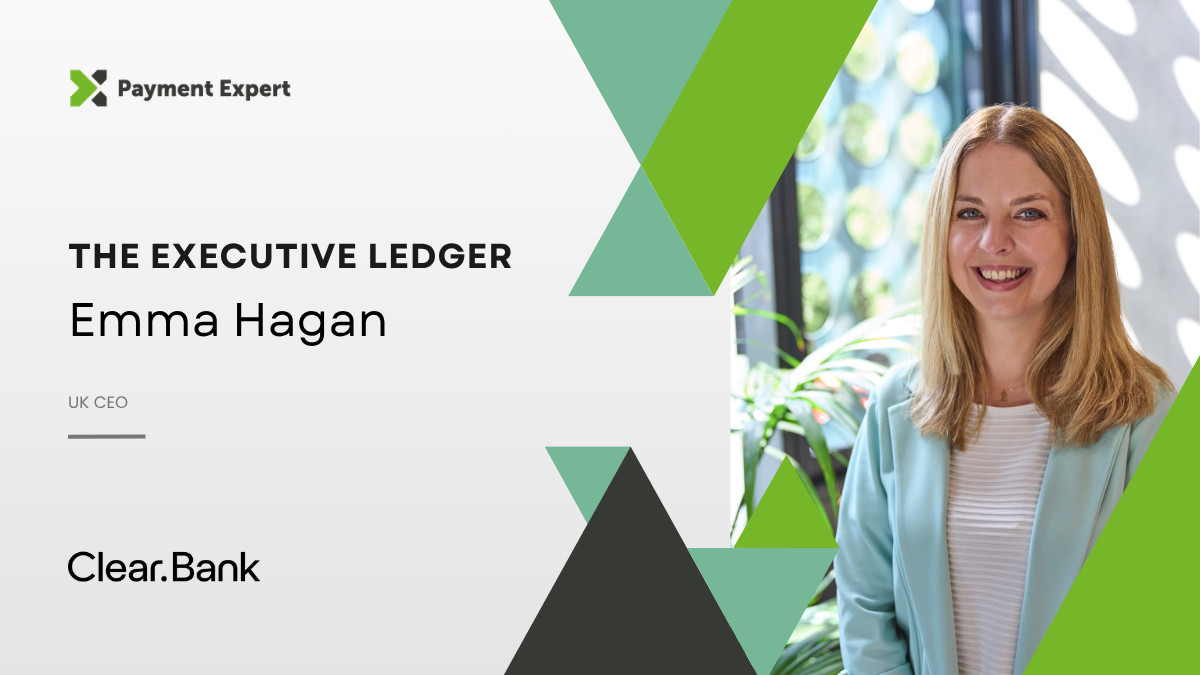
Emma Hagan, CEO at ClearBank UK, operates at this intersection. Her remit spans scheme access, embedded banking partnerships and cross-jurisdictional resilience as the UK considers the next phase of structural reform.
As part of Payment Expert’s Executive Ledger series, Hagan discusses competition in clearing, the operational realities of scaling real-time infrastructure, the growing role of corporate embedded banking, and why interoperability — including with stablecoins — will define the next chapter of UK payments reform.
Read the full interview below. Additional reporting from Louis Thompsett.
ClearBank was founded to modernise access to the UK’s payment systems. How do you assess the state of competition in clearing today?
I think if we look back, we started as the first new clearing bank in 250 years, with a new technology stack. That was really the big thing — moving away from legacy banking and being set up to serve what was, at that point, a wave of new digital challenger banks coming to market who were looking for access.
Post-financial crisis, there had been a lot of consolidation in the market. There were only a few providers and a lot of legacy, patchwork technology. ClearBank was set up with brand-new, effectively cloud-native, API-led technology, and we really serviced that digital challenger community and the new wave of fintechs coming to market who wanted real-time access and to integrate into a technology stack that looked like their own.
Ten years on, the premise we started with — that there was a gap in the market for that type of clearer — still holds. We are still seeing demand for that model. We have seen competition enter the space, and we welcome that. Choice in the market was one of the reasons we started. But it is incredibly challenging to gain access to all the payment clearing systems, to build in resiliency, regulatory compliance, and to develop the right products and services.
Our focus on being an infrastructure bank — rather than directly serving SMEs or consumers — has helped us concentrate on what we do best and do it well.
We expanded into embedded banking around 2019, starting with Tide. That was a natural extension of the same premise: cloud-native, API-led technology, resilient infrastructure, built-in compliance and controls. By partnering with other financial institutions that focus on the front end, we help them compete in the market while we focus on the banking infrastructure underneath.
We now have nine embedded banking partnerships live in the market, including names such as Revolut and Chip. Again, competition exists in this space too, and we welcome that, because a thriving, competitive fintech ecosystem is good for the UK as a whole. That said, it takes time and investment to scale properly and to understand how to make these partnerships work in practice. We never take that for granted.
Has indirect access become meaningfully easier, and what structural limitations still constrain innovation in UK clearing?
We try to make it as simple as possible for our customers to connect to the payment schemes. We provide simple APIs that allow them to integrate with Faster Payments, BACS and CHAPS, and we take care of the complexity behind the scenes. As far as possible, that complexity should be invisible to them. We manage scheme compliance, ensure real-time settlement works as expected, and handle regulatory change as it arises.
There is significant ongoing regulatory change across the payments landscape. We spend a lot of time working with customers to implement necessary API updates, but we take responsibility for the core compliance requirements and upgrades to connectivity to keep things seamless.
More broadly, one of the reasons we have the National Payments Vision is that the last major structural innovation in UK payments was Faster Payments — and that is no longer new. We still operate older schemes such as BACS and CHAPS. While there have been upgrades, particularly in RTGS, there has not been a fundamental structural change for some time.
Meanwhile, innovation has accelerated elsewhere, including in digital assets and interoperability between fiat and digital systems. Other markets are moving forward with developments such as SEPA Instant. Customer expectations are shaped by their digital experiences; they expect payments to be instant, visible in-app and fully transparent. The back-end systems must evolve to support that.
The next phase of reform, particularly around interoperability and real-time evolution, will be key to maintaining competitiveness globally and supporting the next wave of fintech growth in the UK.
How does a cloud-native bank think differently about resilience compared with more traditional institutions?
Even before the PRA and FCA operational resilience rules came into force, resilience was already embedded in how we operate.
Because we were aiming for real-time payments and a strong client experience from day one, resilience had to be central to our strategy. We work with a large number of financial institutions who process on behalf of others, so our resilience is critical to them as part of their own decision-making when choosing ClearBank.
When it comes to operating across the UK and EU, we aim to comply with the highest applicable standard. We operate a single technology platform, so we build resilience and compliance to the highest threshold and apply that consistently.
In the licensing process, that meant ensuring we were measuring the right things, adhering to regulatory standards and maintaining those controls on an ongoing basis. But resilience has always been a core part of our technology strategy.
As real-time payments volumes grow, what new operational risks are emerging at the infrastructure level?
Particularly on the real-time side, you see increased potential for fraud risk and financial crime. It’s a hard balancing act between delivering instant, real-time settlement and making sure you’re not facilitating bad actors.
We all have a duty to ensure the UK financial system is resilient and safe, so that consumers can trust that when they move money, protections are in place. One of the challenges is differing standards around areas like sanctions, particularly cross-border. How do you transmit information effectively? How do you create common standards so compliance is maintained while removing friction?
We’ve also seen the introduction of APP reimbursement introduce additional friction into the payment process. Again, it’s about balance, ensuring consumers are protected while still delivering a near real-time experience and keeping the market open to competition.
There’s also a question of dealing with fraud at source rather than managing consequences downstream. How do we tackle the origins of APP fraud more effectively? Ultimately, it’s about managing fraud and financial crime risk while continuing to deliver payments as close to real time as possible.
ClearBank works with fintechs and corporates as well as regulated institutions. How is demand from these groups changing?
We launched corporate embedded banking last year. Previously, we had focused on embedded banking with financial institutions, but we expanded into the corporate space. The premise is similar: companies are looking at how they can add more value within their ecosystem and differentiate in the market.
One example is PayCaptain, a payroll provider we went live with last year. They saw embedded banking as a way to differentiate. Through “Save by Payroll”, employees can divert part of their salary directly into a savings account in their own name. It’s FSCS-protected, just like a traditional bank account, but delivered through the ClearBank–PayCaptain partnership.
Open banking and Pay by Bank models depend on reliable settlement infrastructure. Do you believe the current UK framework is fit for that growth?
I think there are a couple of factors. Part of it is consumer familiarity. When people see the benefit of something, and it works well, it becomes part of their normal behaviour. It’s similar to buy-now, pay-later; consumers may not know the regulatory terminology, but they see the option, they like it, they use it and they become comfortable with it.
We support several providers in this space and have done so since the early days, including companies such as TrueLayer, which have been flying the pay-by-bank flag for a long time. Speed of settlement is important. For consumers, the experience needs to compare favourably to tapping a card. If there is a delay or friction, that becomes noticeable. There has been progress, but we’re not necessarily there yet in terms of parity.
There are also regulatory considerations. PSD2 is now several years old, and some of the requirements introduce friction, for example, around authentication. There are plans to amend aspects of that, which may help support pay-by-bank further. It can be cheaper for merchants and, ultimately, for consumers. But without regulatory tweaks that enable the experience to feel equivalent to using a card or digital wallet, adoption may remain slower than it could be.
The UK is reviewing the future governance of Faster Payments. What principles should guide the next phase of reform?
Interoperability is really important.
It’s difficult to talk about payments reform without mentioning stablecoins. Integrating stablecoins into the system, and looking at interoperability between different forms of money, is going to be key.
From our perspective, stablecoin regulation should treat stablecoins as a means of payment, not just an asset. Reform should create a level playing field, while maintaining the high regulatory standards the UK is known for. The UK has a strong regulatory framework. Initiatives like the crypto asset regime have helped establish clear guardrails. That allows good businesses to flourish because there’s clarity around what ‘good’ looks like.
If interoperability and stablecoins are integrated properly within a clear regulatory structure, it provides comfort and safety to the market. It gives participants confidence that payments can operate securely and consistently.
Looking ahead, does the UK need deeper structural change in clearing, or is incremental evolution sufficient?
We’ve always found that the FCA and PRA engage very actively with the industry. They work to understand what innovations are coming through, where the risks are and where the opportunities lie.
As long as that partnership continues (between government, regulators and industry) we usually get to the right outcome. We might disagree at times about how we get there, but the objective is shared: making the UK a thriving fintech and innovation community that maintains high regulatory standards while remaining resilient.
We all want the UK to be a gold standard for regulation that supports innovation but is robust through the cycle. As long as that collaboration continues, we’ll get there together over time, regardless of the specific topic.
The Executive Ledger is Payment Expert’s new leadership series spotlighting senior payment executives across the global banking sector. The series explores how systemic institutions are responding to regulatory reform, real-time infrastructure demands, fraud risk, and intensifying competition in the payments market.
If you are a senior payments leader within the banking industry and would like to take part, please contact Editor Rachael Kennedy at [email protected]