As instant payment schemes reshape domestic markets from Brazil to Mexico, transaction banking in the Americas is being redefined by real-time liquidity, cross-border complexity and the convergence of open finance and API infrastructure.
In the Americas, the payments story is unfolding at two different speeds.
Domestically, instant rails such as Pix in Brazil and SPEI in Mexico have reset expectations around immediacy and accessibility. Real-time settlement is infrastructure first and foremost, innovation second. Corporates can collect funds outside business hours, reconcile instantly and manage liquidity continuously. What once operated in batches now moves in motion.
Yet cross-border payments across the region remain fragmented. Multiple correspondent banks, varied regulatory regimes and diverse currencies still introduce delay, cost and opacity. The result is a region where domestic innovation has accelerated, but international flows continue to lag behind.
For transaction banks operating across this landscape, the challenge is structural: how to standardise client experience while adapting to highly localised rails; how to deliver interoperability in markets that share geography but not infrastructure; and how to turn payments from operational plumbing into a strategic source of liquidity insight and working capital optimisation.
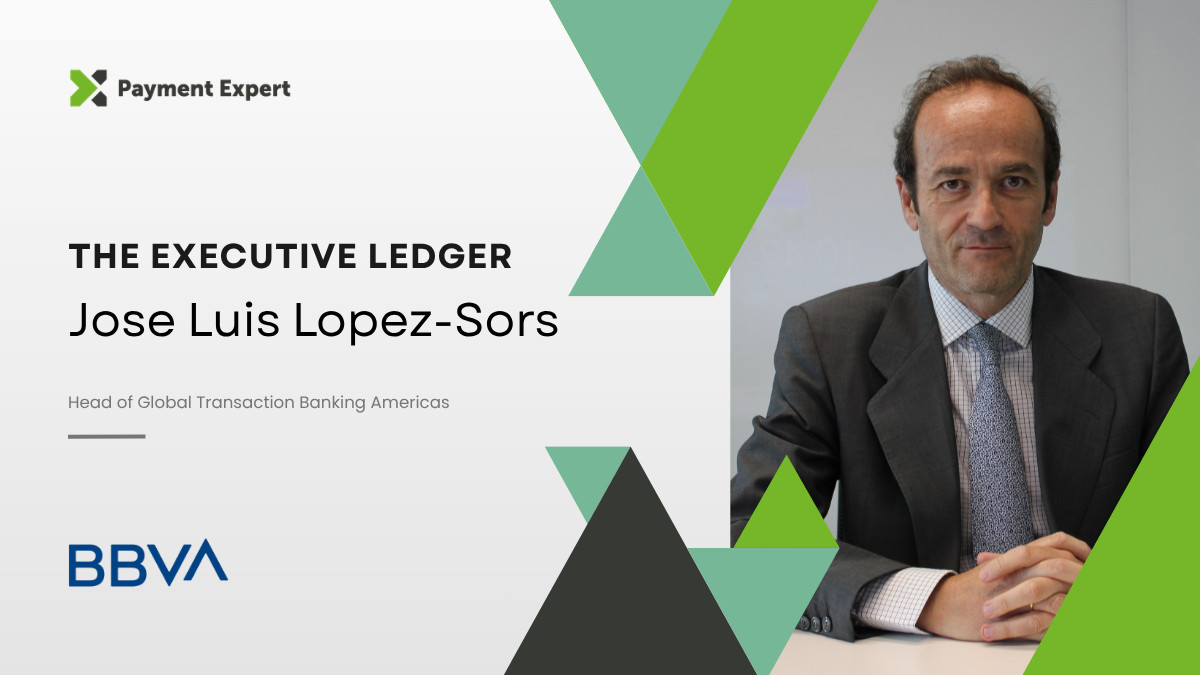
José Luis López-Sors, Head of Global Transaction Banking Americas at BBVA, works at this intersection. His remit spans real-time domestic schemes, cross-border treasury management and the integration of APIs and ISO 20022 standards across diverse markets.
As part of Payment Expert’s Executive Ledger series, Lopez Sors discusses discusses the rise of instant payments across the Americas, the persistent friction in cross-border flows, the strategic value of payments data, and why the convergence of open finance and real-time infrastructure will redefine transaction banking over the next five years.
Read the full interview below.
Real-time payments are expanding rapidly across the Americas. How is that reshaping client expectations in transaction banking?
If you look at the evolution of payments across the Americas, the shift is not just technological but behavioral. Clients today compare their banking experience with platforms like Amazon or Uber, not with other banks. So immediacy and simplicity are no longer differentiators, they’re ‘must have’ items.
In Latin America, this change has been accelerated by schemes like Pix in Brazil, which processes billions of transactions within a few years of launch, or SPEI in Mexico, which has been evolving toward more real-time use cases. In Brazil, for instance, Pix is already used not only for P2P but also for payroll, tax payments, and e-commerce purposes.
As a result, corporates now expect instant onboarding, real-time collections, and immediate reconciliation. A retailer, for example, doesn’t want to wait days to confirm a payment, they want instant confirmation to release goods. Similarly, marketplaces expect to onboard sellers and activate payments almost immediately.
All this changing environment is becoming even more dynamic with the inclusion of the fintech ecosystem into the banking business, reducing the time to market of innovations, and trying to spot the relevant pain points in the treasury arena.
So the bar has clearly moved up: payments must be real-time, data-rich, and seamlessly integrated into business processes.
How does BBVA approach interoperability between markets with very different payment infrastructures?
BBVA’s approach is based on standardizing the client experience while adapting to local payment infrastructures which varies a lot in each of the countries where we work in the Americas.
Through our E-banking platforms such as Pivot and our API strategy, we enable clients to access to a common connectivity model, portal, APIs, host-to-host, and SWIFT, regardless of the geography.
At the same time, we have tailor made the underlying payment rails to each market’s specific characteristics. This combination of global consistency and local adaptability is key to achieving interoperability and improving cross-border efficiency when dealing with payments.
This is particularly valuable for regional treasury centers, that need to manage multiple markets efficiently without the burden of handling fragmented infrastructures. During recent years there’s been a tendency to concentrate payments into regional centers creating important efficiencies in our clients’ financial departments.
What are the biggest friction points corporates still face in cross-border payments across the region?
Despite all the progress in domestic payments, cross-border transactions are still far from seamless. For example, a payment from Mexico to Colombia may still go through multiple correspondent banks, each adding time, cost, and complexity.
Treasurers often face challenges such as limited visibility on payment status, FX spreads that are not fully transparent, and reconciliation issues due to missing or inconsistent data. Even something as simple as matching an invoice to a payment can become complex when done across borders. Although a region as Europe shares a common currency, the Americas has a a diverse currency and regulatory landscape, with very differing regulations among countries that affect currency exchanges.
Initiatives like ISO 20022 are helping to alleviate this issue, by enabling richer and more structured data in every payment communication, but adoption is still uneven. Similarly, regional efforts to improve interoperability are progressing, but we’re not yet at the level of domestic instant payments.
This creates a clear gap, and therefore a strong opportunity, for banks to innovate and simplify the cross-border experience.
Has the growth of instant payment rails changed how corporates manage liquidity and cash positioning?
Absolutely. Instant payment rails are shifting treasury management from periodic and batch-based processes to a continuous, real-time liquidity management.Take a company operating in Brazil using Pix for collections: they receive funds instantly, even outside business hours, which means their cash position changes continuously.
This eliminates the traditional delay between the moment Sales are done and the cash availability, improving working capital efficiency. But it also requires treasurers to adapt, as they can no longer rely on end-of-day balance reports.
For example, a corporate may now use real-time data to trigger automated sweeps between accounts, or to decide instantly whether to invest excess liquidity or to cover a short position in any specific currency.
In markets like Mexico, where SPEI is widely used, we’re also seeing corporates moving toward an intraday liquidity management, supported by real-time reporting and alerts.
This evolution is driving a more agile and data-driven approach to liquidity and cash positioning.
How is BBVA evolving its transaction banking platform to support 24/7, real-time treasury operations?
Our strategy is to embed banking into our clients’ daily operations. Through our APIs, a client can, for example, integrate Pix collections directly into their checkout process in Brazil, or initiate SPEI payments automatically from their ERP in Mexico.
This means eliminating manual interventions and file uploads from our clients’ treasury departments as everything happens in real time. For instance, a company can receive a payment via Pix, automatically reconcile it against an invoice, and update its accounting system instantly.
Our Pivot platform complements this environment by providing a global view. A multinational client can see balances across countries, manage liquidity centrally, and access standardized reporting, even though the underlying payment rails differ among countries under our scope..
This combination of APIs and global platforms is key to enabling real-time treasury operations.
We are continuously expanding our API ecosystem and co-creating solutions with our clients to meet their evolving needs.
In a region with varied regulatory frameworks, how do you deliver consistency while remaining locally responsive?
The key to this question lies in combining global standards with local execution.
From the client’s perspective, however, we aim to deliver a consistent experience—same API structure, similar reporting formats, unified security standards.
Internally, we adapt to each market’s requirements, including compliance checks, data formats, and operational processes. This allows a corporate treasury team in, say, Madrid or New York to manage payments across Latin America in a standardized way, without needing deep local expertise.
It’s about combining global simplicity with local precision. This approach ensures a seamless client experience across markets while remaining fully compliant with the various regulatory frameworks that may affect any payment.
Many corporates still treat payments as operational plumbing. Where do you see the greatest untapped strategic value?
The greatest untapped value lies in transforming payments into a strategic data provider and a working capital management tool.
Let me give you a practical example. A large retailer using real-time payments can analyze transaction data to understand peak sales times, customer preferences, and payment behavior. That insight can be used to optimize inventory, pricing, and even marketing strategies.
Similarly, a company can use payment data to better manage supplier relationships—identifying which suppliers are paid early under any supply chain finance programme, which ones face delays, and how that impacts negotiations or financing needs of the client’s cash conversion cycle.
In supply chain finance, for instance, integrating payment data allows companies to offer early payment programs to suppliers based on actual transaction flows.
So payments are not just about moving money—they’re about generating actionable intelligence that may help any client to foster revenues and improve its working capital.
How are data and real-time visibility changing the way treasurers think about working capital?
Real-time data is fundamentally changing working capital management. For example, in a Pix-enabled environment, a company can immediately identify incoming payments and reduce its days sales outstanding (DSO).
At the same time, automated reconciliation—enabled by richer data and APIs—reduces manual effort and errors. This is particularly valuable for high-volume businesses like e-commerce, utilities and retailers.
On the payables side, companies can use real-time information to optimize payment timing—delaying payments when appropriate or accelerating them to capture available discounts.
All of this leads to a more efficient use of cash and converts the treasury function within any company into a more proactive function, enhancing the connection between Treasury and Sales areas.
This results into a more efficient cash utilization and better-informed financial decisions, ultimately strengthening the overall treasury performance of the company..
What role does embedded finance play in BBVA’s transaction banking strategy in the Americas?
Embedded finance plays a central role in our strategy. It will fuel sales in our clients…. which is at the end of the day, the main target of any customer.
By integrating banking services directly into our client ecosystems, we enable corporates to digitize payments, automate reconciliation, and enhance cash flow visibility without leaving their operational platforms.
Embedded finance is emerging as a powerful enabler for corporates to streamline their financial operations and reduce reliance on cash, which in our region still an important issue that entails a relevant chunk in our clients operational costs . By integrating payment and financial services directly into their own platforms, companies can digitize collections, improve reconciliation through real-time data and automation, and gain greater visibility over their cash flows. Additionally, embedded finance allows corporates to offer financing solutions to their suppliers and clients within their own ecosystem, strengthening supply chain relationships and optimizing working capital.
This reduces friction, improves user experience, and opens up new revenue streams for our clients. Resulting is a financial services transformation into integrated, value-generating capabilities rather than standalone functions.
Looking ahead, what structural shift in the Americas’ payments landscape will most redefine transaction banking over the next five years?
Looking ahead, I believe the biggest shift will be the convergence of instant payments, open finance, and API/ISO 20022 standardization, leading to a fully real-time, account-to-account payment ecosystem.
In that environment, transaction banks will play a different role. Instead of just processing payments, we’ll orchestrate liquidity across markets, provide real-time insights, and embed financial services into our clients ecosystems.
In other words, we’ll move from being infrastructure providers to strategic partners in our clients’ financial operations. Our job will not only consist in reducing our client’s operational costs, but providing them with tools that will enhance their sales figures and provide them with relevant information to better manage their cash conversion cycle.
The Executive Ledger is Payment Expert’s new leadership series spotlighting senior payment executives across the global banking sector. The series explores how systemic institutions are responding to regulatory reform, real-time infrastructure demands, fraud risk, and intensifying competition in the payments market.
If you are a senior payments leader within the banking industry and would like to take part, please contact Editor Rachael Kennedy at [email protected]